
ow Do Gorillas Sleep? Nests, Trees & Night Secrets Revealed Guide 2026
How Do Gorillas Sleep? Learn how gorillas sleep, build fresh leaf nests every night—never reusing them. Discover where, how & why they sleep, plus how trekking guides track nests at dawn. Book now.
Gorillas sleep in nests they build from leaves, branches, vines, and other vegetation, not in beds like humans. They usually start nesting before sunset, settle down for the night, and sleep for about 12 hours on average.
Whether you are a wildlife enthusiast planning your first African safari or simply curious about primate behavior, understanding how gorillas sleep offers a fascinating glimpse into their daily survival.
In the dense forests of East and Central Africa, a gorilla’s bedtime routine is a masterclass in adaptation, engineering, and family bonding.
This article explains where gorillas sleep, how they build their nests, why they make a new one almost every night, and how sleep differs between mountain gorillas and lowland gorillas.
You’ll also learn what gorilla night routines look like, why this behavior matters for conservation, and where travelers can see gorillas in the wild. If you’re planning a gorilla trekking trip, GoSilverback Gorilla Safaris can help with permits and tailor-made itineraries.
Ready to uncover the secrets of the forest at night? Let’s dive into the fascinating world of gorilla nesting and night routines.

Quick Answer
-
Gorillas sleep in nests, not beds, built fresh from forest vegetation.
-
They make a new nest almost every night and rarely reuse old ones
-
Most nest on the ground, but females and juveniles frequently sleep in trees.
-
Baby gorillas usually sleep with their mothers at first, in the same nest until they are old enough to build their own.
-
Gorillas sleep about 12 hours a day, typically from dusk until dawn.
Where Do Gorillas Sleep?
Gorillas sleep in night nests made from vegetation, and these nests can be built either on the ground or in trees. Nest choice depends on safety, vegetation, age, species, and habitat conditions.
Females and young gorillas are more likely to sleep in trees, especially when the forest structure makes that safer or more comfortable.
Adult males, including silverbacks, usually sleep on the ground more often to act as a physical shield for their family. Elevated nests provide a secure refuge from ground-dwelling predators and keep the smaller, more vulnerable members of the group safe and dry.
This flexible sleeping behavior helps gorillas adapt to different forest environments, from dense lowland rainforest to cooler highland habitats. For wildlife lovers, this is one reason gorillas are so fascinating to observe in the wild.

Where Do Gorillas Sleep? Habitat-Specific Nesting Sites
1. Mountain Gorillas (Volcanoes NP & Bwindi)
Mountain gorillas construct ground nests in bamboo clearings, open meadows, sheltered forest edges, and the lee of volcanic ridges.
At altitudes of 2,200 to 4,300 meters, nighttime temperatures can drop to 0–5°C. Gorillas compensate by folding significantly more vegetation into their nests, creating thicker insulation layers than their lowland counterparts.
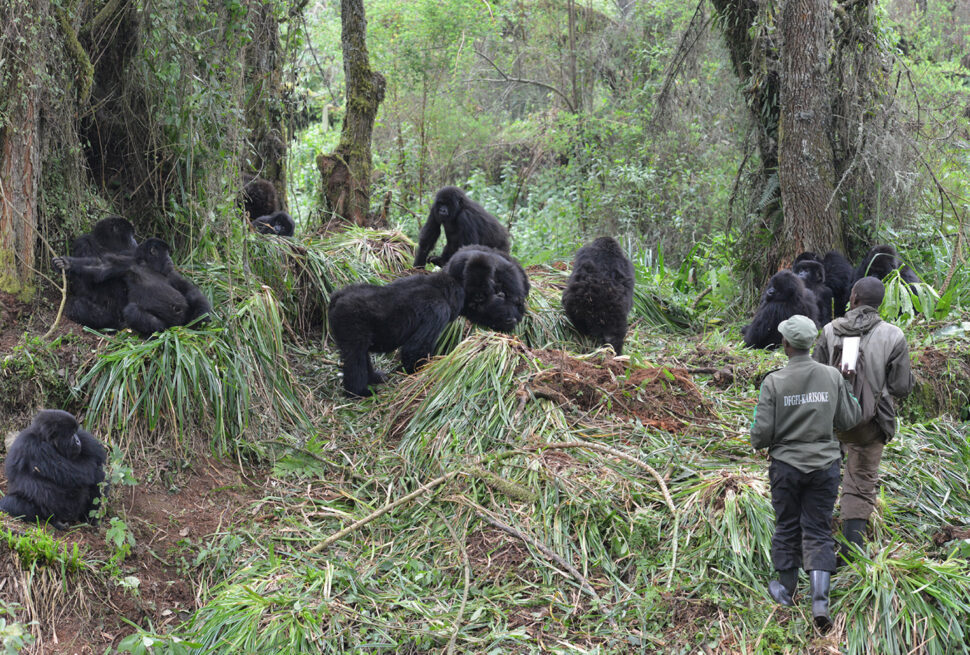
In Volcanoes National Park, Rwanda, trekkers frequently encounter overnight nests in the open bamboo zone—clear, visible depressions surrounded by snapped stems.
In Bwindi Impenetrable Forest, Uganda, nests are often hidden beneath dense canopy, requiring trained guides to identify them.
2. Eastern Lowland Gorillas (Kahuzi-Biega, DRC)
Eastern Lowland Gorillas (Grauer’s gorillas) show a mix of ground and tree nests depending on forest density, terrain, and individual preference.
At altitudes ranging from 600 to 2,900 meters, the habitat transitions from dense tropical lowland rainforest to sub-alpine bamboo. In the lower, denser forest zones, females and juveniles nest in trees while the silverback remains on the ground below.
3. Western Lowland & Cross River Gorillas (Central/West Africa)
Western Lowland Gorillas and Cross River Gorillas are the most arboreal sleepers.
They construct nests at heights of 3 to 15 meters in large fruit trees that provide both food and sleeping platforms. The silverback, too heavy for most branches, sleeps on the ground beneath the canopy where his family rests.

How Gorillas Build Nests
Gorilla nest building is an impressive display of natural engineering. To construct their beds, gorillas build nests by collecting leaves, vines, twigs, and branches, then bending the vegetation inward to form a circular sleeping platform.
The nest is usually built quickly and efficiently, often as part of the evening routine before rest.
Each gorilla generally builds its own nest, which is why you often see multiple sleeping sites close together in a group. The main exception is infants, who usually sleep with their mothers until they are old enough to nest on their own.
Using their immense strength, they bend vegetation inward and weave it together to form a circular, bowl-shaped bed.
The base is made of thick branches for support, while the top is lined with soft leaves and ferns for comfort. Remarkably, this entire architectural process takes only a short time—usually between 2 to 5 minutes.
This behavior is simple but highly effective. A fresh nest gives gorillas a soft, insulated place to rest and helps keep them comfortable through the night.
Why Gorillas Build a New Nest Every Night
Gorillas usually make a new nest every night because it improves comfort, hygiene, and safety. Fresh nesting sites also let them adjust to where food is available and where they feel most secure.
Why gorillas rarely reuse the same sleeping spot:
- Hygiene and Comfort: Fresh nests prevent the buildup of parasites, insects, and bacteria. A new bed ensures a clean, comfortable sleep.
- Foraging and Movement: Gorillas are nomadic foragers. They consume up to 40 pounds of food a day, meaning the group must shift its location daily to find fresh vegetation. Building a new nest near the next morning’s food source is highly efficient.
- Safety: Leaving a predictable trail of reused nests would make them vulnerable to predators. Shifting sleep sites keeps their movements unpredictable.
Their sleeping location changes with daily movement patterns, so nest sites often reflect the route the group followed while foraging.
Gorillas rarely return to the same sleeping spot night after night, which is one reason field researchers use nest counts to track populations and movement.
In simple terms, gorillas do not settle into one bedroom. They build a fresh one as they move through the forest.
Do Gorillas Reuse Their Nests?
This is one of the most consistent and well-documented behaviors in gorilla sleep biology.
The reasons are practical:
- Hygiene: Reusing a nest allows parasites, fungi, and pathogens to accumulate. A fresh structure each night minimizes disease risk.
- Structural safety: A nest compressed and exposed to weather for 24+ hours loses integrity. Branches weaken, leaves decompose, and the platform may collapse under the gorilla’s weight.
- Nomadic movement: Gorilla groups shift their location by 0.5 to 2 kilometers daily, tracking food availability. Returning to a previous nesting site would require backtracking through terrain already exploited.
1. The Rare Exception
2. Research Significance

Do Gorillas Sleep in Trees or on the Ground?
Yes, gorillas can sleep in trees, but they do not always do so. Tree nests are more common for females and juveniles, while adult males usually sleep on the ground.
Most gorillas sleep on the ground in nests built from vegetation. Mountain gorillas nest almost exclusively on the ground. Lowland gorilla females and juveniles frequently sleep in trees at heights of 3–15 meters. Silverbacks of all subspecies sleep on the ground.
1. Mountain Gorillas: Ground Dwellers at Night
Mountain gorillas (Gorilla beringei beringei) are predominantly ground nesters.
Their heavier body mass—adult males reach up to 195 kg (430 lbs)—combined with the open bamboo and alpine meadow habitat of Volcanoes National Park and Bwindi Impenetrable Forest, makes tree-sleeping impractical and unnecessary.
There are fewer canopy predators at altitudes of 2,200–4,300 meters, and the dense ground vegetation provides natural windbreaks and insulation.
2. Lowland Gorillas: Arboreal Sleepers
Western Lowland Gorillas and Eastern Lowland Gorillas (Grauer’s gorillas) show significantly more arboreal nesting behavior, particularly among adult females and juveniles.
The dense tropical forests of Central Africa offer sturdy canopy branches at heights of 3–15 meters, and the presence of leopards makes elevated sleeping a survival advantage.
In Kahuzi-Biega National Park (DRC), guides regularly spot Eastern Lowland Gorillas in low tree nests.
3. The Silverback Exception
Regardless of subspecies, silverbacks almost always sleep on the ground. At weights reaching 250 kg (550 lbs) for Eastern Lowland males, most branches simply cannot support them.
More importantly, the silverback must remain in a ground-level defensive position, ready to intercept any threat before it reaches his family.

Gorilla Nest Building: Architecture Without Tools
Gorillas build their nests by bending, breaking, and layering branches, leaves, ferns, and vines into a circular platform measuring 1–1.5 meters in diameter. Construction takes approximately 2–5 minutes. A new nest is built every single night.
How Do Gorillas Build Their Nests? (Step by Step)
- Select a site. The gorilla identifies flat ground, a sturdy tree fork, or dense vegetation offering shelter from wind and rain. Proximity to the next morning’s feeding patch is preferred.
- Gather materials. Using bare hands, the gorilla bends, breaks, and folds branches, leaves, ferns, and vines within arm’s reach. No tools are used. No materials are carried from distant locations.
- Construct the base. Thicker branches are layered into a circular platform, typically 1 to 1.5 meters in diameter. The structure is compressed by the gorilla’s body weight into a stable, bowl-shaped depression.
- Add lining. Softer leaves, moss, and ferns are pulled inward for cushioning. In colder alpine zones, additional vegetation is folded for insulation.
- Test and adjust. The gorilla shifts weight, adds support branches if the structure feels unstable, and repositions until comfortable.
- Final positioning. The gorilla sits, lies, or reclines. Some individuals bundle leaves into a rudimentary “pillow” beneath the head.
1. The Critical Fact
Gorillas build a new nest every single night. They do not reuse, return to, or maintain previous nests. A nest begins to degrade within 48–72 hours, collapsing under rain, fungal growth, and the weight of decomposing vegetation.
2. The Science Behind It
This behavior is the foundation of Dian Fossey’s 1974 nest-count methodology, still used today by ICCN (Institut Congolais pour la Conservation de la Nature) and RDB (Rwanda Development Board) rangers to conduct gorilla population censuses.
By counting fresh nests along forest transects and applying decay-rate corrections, researchers estimate total population size without ever seeing every individual.
3. Trekking Bridge
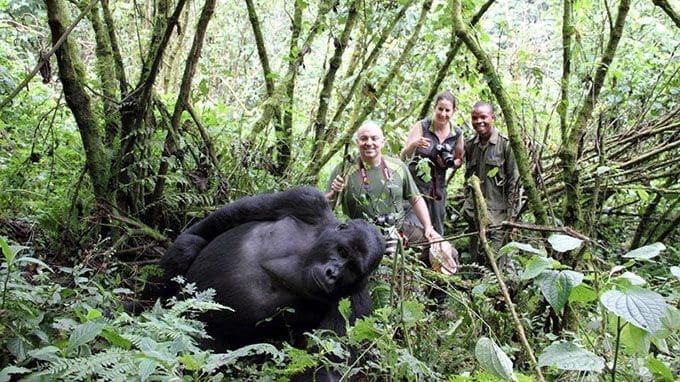
Your guide identifies the family’s sleeping site by the freshness of bent stems and the warmth of dung.
A nest built within 12 hours means the gorillas are close—often within 30 to 60 minutes’ hiking distance. You are, in the most literal sense, following last night’s bedtime trail.
Silverback Sleeping Behavior: The Night Guardian
The Guardian’s Position
- He sleeps on the periphery of the group, positioned between the most likely approach vector for predators or rival males and the core of his family.
- His nest is never at the center. It is the outer wall.
- In tree-nesting groups, the silverback remains on the ground directly beneath the females’ canopy nests, forming a living barrier.
1. Semi-Alert Doze
The silverback does not enter deep REM sleep the way other group members do. His rest is a semi-alert doze: ears rotating, nostrils sampling the air, muscles primed.
A snapped twig, a leopard’s scent, or the vocalization of a rival silverback triggers an instantaneous response—a bark, a chest-beat, or a full charge.
2. No Separate Guard Post
He does not build a separate “guard nest” or station himself away from the group. His strategy is proximity and positioning. He is close enough to react in seconds, positioned so that any threat must pass through him first.
3. The Emotional Weight
The silverback sacrifices deep sleep so his family can rest. Every night, for years, he maintains this vigil.
On a dawn trek, your guide reads the silverback’s overnight position—whether he faced the trail, whether the group was tightly clustered or spread—to assess the family’s stress level and determine how calmly they will receive visitors.
Do Baby Gorillas Sleep With Their Mothers?
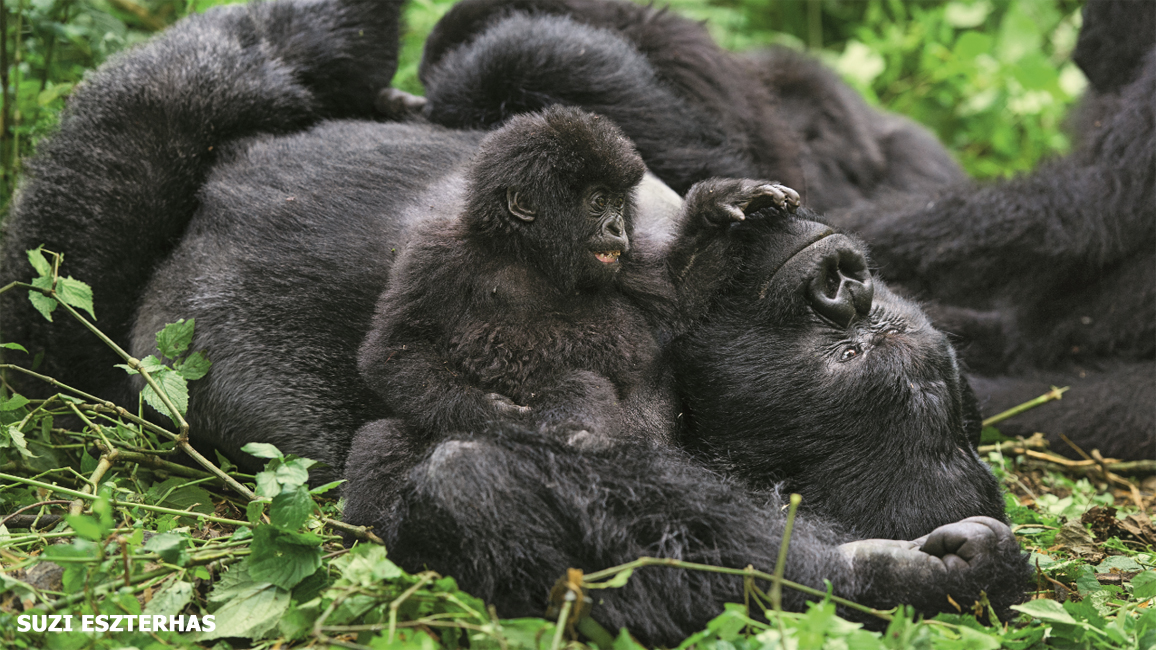
Yes, infant gorillas sleep in the exact same nest as their mothers. For the first few years of life, a baby gorilla relies entirely on its mother for warmth, protection, and nursing throughout the night.
As young gorillas grow, they begin building their own nests and gradually sleep more independently. This transition is an important part of their development and one of the clearest examples of how gorilla family life changes with age.
For readers looking for family-friendly wildlife facts, this is one of the most searched and shareable gorilla sleep questions.
Infant & Juvenile Sleeping Habits
1. Infants (0–3 Years): The Mother’s Bed
Infant gorillas never sleep in their own nests. From birth until weaning at approximately 3 years of age, an infant sleeps on the mother’s chest, back, or nestled in her arm.
The infant’s body heat is regulated by the mother’s fur. The mother adjusts her sleeping position throughout the night to keep the infant warm, sheltered, and close to her nursing breast.
2. Juveniles (3–8 Years): First Nests, Close Proximity
At roughly 3 years, juveniles begin constructing their own nests. However, they sleep within arm’s reach of the mother for several more years.
The transition is gradual: first a nest beside her, then a few meters away, then eventually independent positioning within the group.
3. Play-Nesting: Practice Makes Perfect
During the midday rest period (10:30–14:00), juveniles engage in play-nesting: folding small branches, compressing leaves, and mimicking adult nest-building.
This is not rest—it is critical motor and cognitive development. Researchers at the Dian Fossey Gorilla Fund have documented juveniles building and destroying dozens of miniature nests in a single afternoon.
4. Allomothering at Night
In larger families, a sibling, aunt, or older juvenile may hold an infant while the mother shifts position or briefly feeds. This cooperative care—called allomothering—strengthens social bonds and distributes the energetic cost of infant rearing.
5. Trekking Bridge
If your trek coincides with the midday rest period, you may watch juveniles play-build miniature nests—a behavior rarely captured on camera and almost never seen in zoos. It is one of the most tender, photogenic moments in gorilla trekking.

How Long Do Gorillas Sleep?
Gorillas sleep about 12 hours per night on average. Some sources also describe 12–14 hours of total rest, including daytime resting periods.
Their day usually follows a steady rhythm: feeding, resting, grooming, nesting, and then sleeping. Because gorillas spend a lot of energy foraging, long rest periods help them recover and stay healthy.
If you are comparing gorilla sleep to other primates, this long rest cycle is one of the reasons gorillas are often described as calm, deliberate, and highly structured in their daily behavior.
Night-Time Vulnerabilities: What Threatens Sleeping Gorillas?
1. Natural Predators
- Leopards are the primary natural threat, targeting infants and juveniles sleeping in low tree nests in lowland forests.
- At high altitudes (Volcanoes NP, Bwindi), predator pressure is minimal, which is one reason mountain gorillas nest on the ground.
2. Human Threats
- Poaching snares set for bushmeat can maim or kill a sleeping gorilla.
- Habitat encroachment from agriculture and mining fragments sleeping territories.
- Disease transmission from humans (respiratory infections) is a critical risk, which is why the 7-meter distance rule and mask protocols exist.
3. Weather
- Heavy rain, cold at altitude, and wind exposure can cause hypothermia, particularly in infants.
- Gorillas mitigate this by selecting sheltered sites and folding extra vegetation for insulation.
4. The Silverback’s Defense
5. Conservation in Action

How Guides Use Nest Evidence to Find Gorillas at Dawn
1. The Science of Dawn Tracking
Every morning, advance tracking teams leave park headquarters at 04:00–05:00, well before trekkers arrive for the 07:00 briefing.
Their mission: locate the previous night’s nesting site and determine the family’s current direction of travel.
2. Five Signs Trackers Read
- Freshness of bent and broken stems. A nest built within 12 hours has green, flexible stems. Older nests show wilting, browning, and fungal growth.
- Warmth and moisture of dung. Fresh gorilla dung retains body heat for several hours. Trackers touch dung to gauge time elapsed since the group passed.
- Residual body heat in the nest depression. In cool mornings, the compressed vegetation in a fresh nest retains warmth detectable by hand.
- Feeding trails leading away from the nest. Broken celery stalks, stripped bark, and half-eaten shoots indicate the direction the group moved after waking.
- Vocalizations. Low grunts, hoots, and juvenile squeals echo through the canopy at dawn. Trackers triangulate sound to pinpoint the family’s location.
3. Communication Protocol
4. The Trekking Bridge

Mountain Gorillas vs Lowland Gorillas
Mountain gorillas and western lowland gorillas both build nests, but their sleeping behavior can differ depending on habitat and climate.
- Mountain Gorillas: Living in the colder, high-altitude forests of Bwindi Impenetrable National Park and Volcanoes National Park, mountain gorillas build thicker, heavily insulated ground nests to retain body heat. Because of the steep, rugged terrain and lack of large canopy predators at high altitudes, they nest on the ground almost exclusively.
- Western Lowland Gorillas may nest differently depending on forest density and seasonal conditions: Inhabiting the dense, warm, and flat tropical rainforests of Central Africa, lowland gorillas exhibit much higher rates of arboreal (tree) nesting. The abundance of sturdy fruiting trees and the presence of ground predators make the canopy a safer, more practical choice.
The key point is that both species are nest builders, but the environment strongly influences tree vs ground nesting. That adaptability is one reason gorillas are such successful forest apes.
Mountain vs. Lowland Gorilla Sleep: A Comparison Table
|
Factor
|
Mountain Gorilla
|
Eastern Lowland Gorilla
|
Western Lowland Gorilla
|
|---|---|---|---|
|
Primary nest location
|
Ground
|
Ground & trees
|
Trees (3–15 m)
|
|
Nest height
|
0 m (ground)
|
0–10 m
|
3–15 m
|
|
Nest diameter
|
1–1.5 m
|
1–1.5 m
|
0.8–1.2 m
|
|
Silverback position
|
Ground, group periphery
|
Ground, group periphery
|
Ground, beneath tree nests
|
|
Sleep duration
|
8–10 hrs
|
8–10 hrs
|
9–10 hrs
|
|
Nest reuse
|
Never
|
Never
|
Rarely (rain exception)
|
|
Insulation behavior
|
Heavy vegetation folding (cold)
|
Moderate
|
Minimal (warm climate)
|
|
Best park to observe
|
Volcanoes NP / Bwindi
|
Kahuzi-Biega (DRC)
|
Dzanga-Sangha (CAR)
|
What Gorilla Night Routines Look Like
- Afternoon Feeding: The group spends the final hours of daylight filling up on bamboo shoots, leaves, and fruit.
- Socializing and Slowing Down: As light fades, the gorillas slow their pace. They engage in gentle grooming, quiet vocalizations, and social bonding.
- Nest Building: About 30 minutes before sunset, the snapping of branches echoes through the forest as each member constructs their bed.
- Deep Sleep: The family settles in. The silverback takes his post on the periphery, and the forest goes quiet.
- Dawn Awakening: At first light, the silverback stirs, signals the group, and they dismantle their nests to resume morning feeding.
This sequence makes gorilla behavior easy to describe but fascinating to witness. Their routines are calm, organized, and deeply tied to forest life. For safari travelers, understanding this nightly rhythm adds real depth to a gorilla trekking experience.
Why This Behavior Matters For Conservation
Gorilla nesting is not just interesting biology; it is also an important conservation tool. Researchers use nest counts to estimate gorilla populations, and nest locations help reveal movement patterns and habitat use.
Protecting forest habitat also means protecting the places gorillas use for sleeping. If nesting areas are disturbed or forests are fragmented, gorillas lose the space they need for safe rest and daily survival.
That is why conservation in Uganda, Rwanda, and the DRC remains so important. Gorillas are not just a wildlife attraction; they are an indicator of healthy forest ecosystems.
Gorilla Sleep Facts People Search for
-
Gorillas build a new bed almost every night.
-
They sleep in circular, bowl-shaped nests.
-
Babies sleep with their mothers at first.
-
Gorillas also rest during the day.
-
They rarely use the same nest twice.
Where Travelers Can See Gorillas In The Wild
If you want to see gorillas in their natural habitat, you must travel to the protected national parks of East Africa. The premier destinations for gorilla trekking include:
- Bwindi Impenetrable National Park (Uganda): Home to nearly half the world’s mountain gorillas, offering dense, thrilling jungle treks.
- Mgahinga Gorilla National Park (Uganda): A stunning, less-crowded park set against the backdrop of the Virunga volcanoes.
- Volcanoes National Park (Rwanda): Famous for its accessible, bamboo-rich slopes and world-class luxury safari lodges.
These parks are the best-known places for mountain gorilla trekking, and they attract travelers from the USA, UK, Europe, Canada, Asia, China, Oceania, Latin America, and the Middle East.
If you are planning a trek, GoSilverback Gorilla Safaris helps organize gorilla permits, transport, and a complete safari itinerary.
Frequently Asked Questions
How do gorillas build their nests?
Do gorillas sleep on the ground?
Yes, the majority of gorillas, especially adult silverbacks, sleep on the ground in nests made of vegetation. However, females and juveniles often sleep in trees.
Do gorillas reuse their nests?
Do gorillas sleep standing up?
No. Gorillas sleep lying down or sitting in a reclined position inside their custom-built nests. Only humans and a few other species (like horses or elephants) can sleep standing up.
Can I see gorilla nests on a trek?
How many hours do gorillas sleep?
Gorillas sleep for about 12 hours a night, usually from dusk to dawn. Including midday rests, they may rest for up to 14 hours a day.
Do gorillas snore?
How long do gorillas sleep each night?
Do gorillas sleep in trees?
What time do gorillas wake up?
Where do baby gorillas sleep?
Do gorillas sleep in groups?
They sleep in close proximity as a family group, but each individual (except infants) builds and sleeps in their own separate nest.
Do gorillas build nests every night?
Yes, with extremely rare exceptions during severe storms, gorillas build a completely new nest every single evening.
Why do gorillas sleep in trees?
Females and juveniles sleep in trees to avoid ground-dwelling predators, stay dry during heavy rains, and access fruiting branches safely.
Experience the Magic of the Forest: Book Your Gorilla Trek Today
Reading about gorilla nesting and night routines is fascinating, but nothing compares to the thrill of standing in the misty mountains of East Africa, watching a massive silverback wake up and lead his family into the morning light.
Whether you are traveling from the USA, Canada, the UK, Europe, Latin America, Asia, China, Oceania, or the Middle East, navigating the logistics of a gorilla trekking safari requires expert guidance.
Permits are strictly limited to protect the gorillas, and they sell out months in advance.
Don’t leave your once-in-a-lifetime wildlife encounter to chance. GoSilverback Gorilla Safaris specializes in seamless, luxury, and adventure-focused gorilla tours in Uganda and Rwanda.
Our expert guides don’t just lead you through the forest; they teach you how to read the nests, track the silverbacks, and understand the deep, complex lives of these gentle giants.
🦍 VIEW OUR UGANDA & RWANDA SAFARI ITINERARIES →
🦍 SPEAK TO A GORILLA TREKKING EXPERT TODAY →