
What Are Eastern Lowland Gorillas? Facts, Habitat, Threats, Where to See Them, Safety & Tips Guide 2026
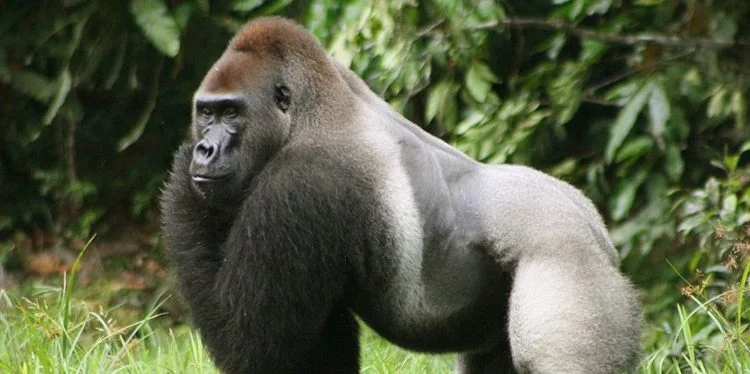
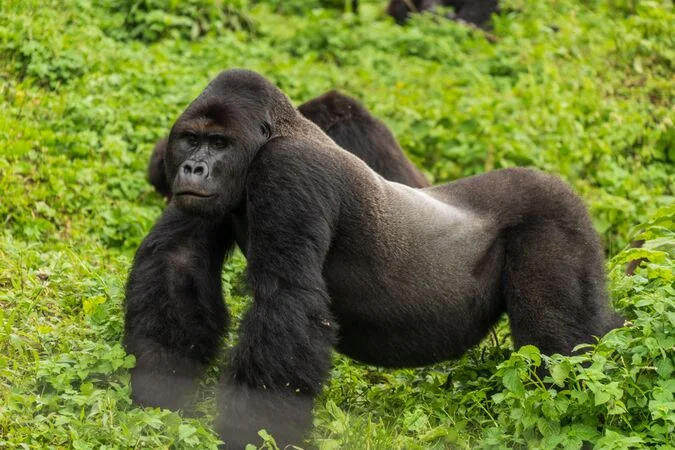
Eastern Lowland Gorillas, also known as Grauer’s gorillas, are the largest of the world’s gorilla subspecies and are native to the forests of eastern Democratic Republic of the Congo (DRC).
They are distinguished by their powerful bodies, broad hands, dark coats and highly social family groups led by dominant silverbacks. Eastern lowland gorillas mainly eat leaves, stems, fruits and other vegetation.
Their populations face serious threats from habitat loss, hunting and armed conflict, making conservation essential.
Unlike mountain gorillas, they are not commonly visited through standard gorilla trekking tourism. Protecting their forest habitat is vital for their long-term survival.
Imagine a 500-pound silverback rising from a tangle of vines, his broad chest catching the filtered equatorial light as he moves through the Congo basin with the silent, deliberate grace of a creature that owns every shadow around him.
This is not a mountain gorilla. This is something rarer, larger, and far harder to find. This is the Eastern Lowland Gorilla.
Fewer than 3,800 Grauer’s gorillas survive in the wild today. They exist in one country on Earth: the Democratic Republic of Congo. No zoo holds them. No sanctuary breeds them.
They live in the dense, humid, impenetrable forests of eastern DRC, and seeing one requires commitment, courage, and a willingness to go where 99% of primate tourists will never set foot.
This guide covers everything you need to know: physical traits, habitat, DRC safety protocols, permit costs, trekking logistics, conservation realities, and how to book a once-in-a-lifetime expedition to Kahuzi-Biega National Park.
Ready to track the rarest primates on Earth? Here is your blueprint.
👉 Check Eastern Lowland Gorilla Permit Availability → GoSilverback Gorilla Safaris
What Is an Eastern Lowland Gorilla (Grauer’s Gorilla)?
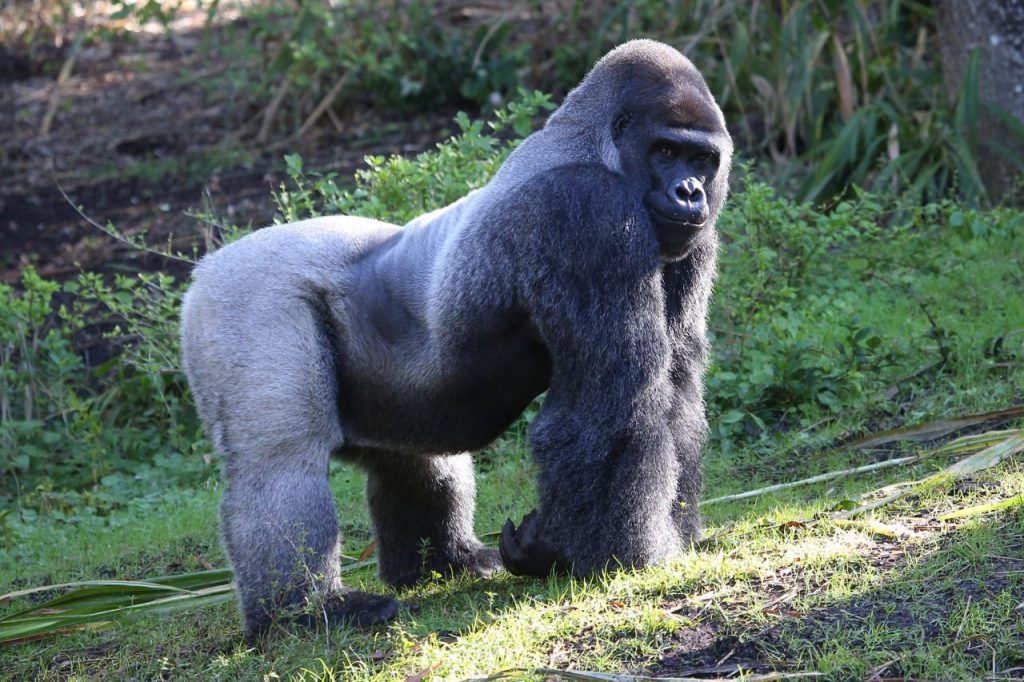
The Eastern Lowland Gorilla (Gorilla beringei graueri), also known as Grauer’s gorilla, is the largest of all four gorilla subspecies.
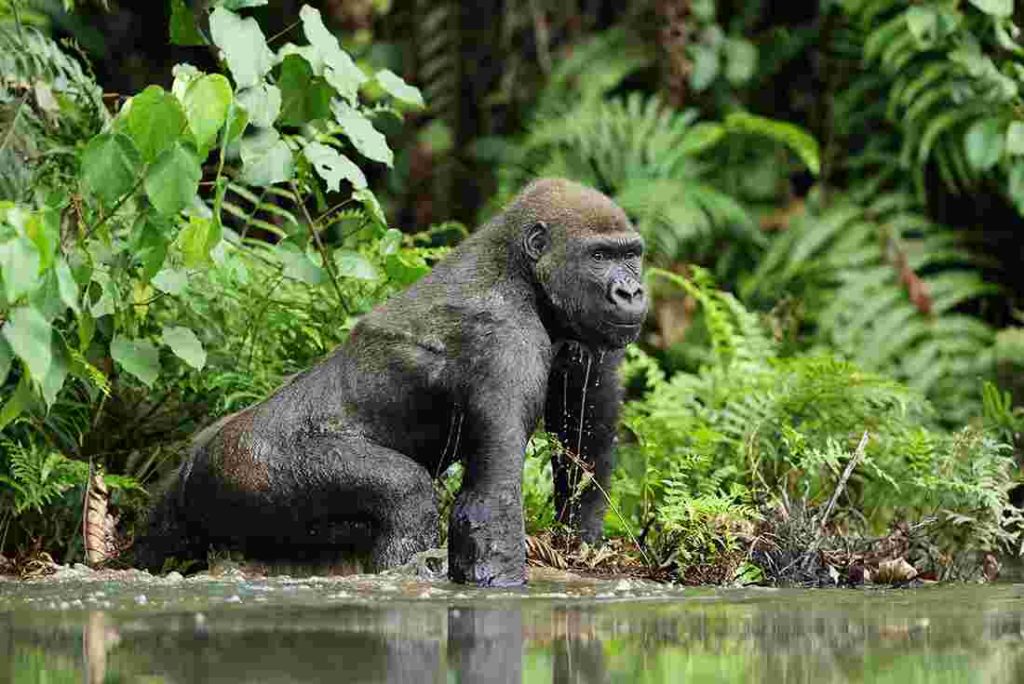
Endemic to the eastern Democratic Republic of Congo, it inhabits lowland and sub-alpine tropical forests, feeding primarily on fruits, leaves, stems, and pith.
Adults display shorter, sleeker hair than mountain gorillas and live in family groups of 5 to 30+ individuals led by a dominant silverback.
Now let’s break that down for the traveler standing at the trailhead.
Eastern Lowland Gorilla Physical Traits: The Largest Primate on Earth
Eastern Lowland Gorillas dwarf every other gorilla subspecies. A mature silverback can weigh up to 250 kilograms (550 pounds) and stand 1.8 meters (6 feet) tall when upright.
Compared to their mountain cousins, Grauer’s gorillas carry:
- Shorter, less dense hair (an adaptation to humid, warm lowland forests rather than cold alpine slopes)
- Broader chests and longer arms
- Massive hands and feet adapted for knuckle-walking through dense undergrowth
- Darker, more uniform coat coloration ranging from jet black to deep brown
Habitat: From Jungle Floor to Bamboo Summit
Unlike mountain gorillas confined to volcanic slopes above 2,200 meters, Eastern Lowland Gorillas occupy a staggering altitudinal range: from 600 meters in dense tropical lowland rainforest up to 2,900 meters in sub-alpine bamboo zones.
This vertical migration means a single family can traverse radically different ecosystems within its home range.
Diet: A Broader Menu Than Mountain Gorillas
Where mountain gorillas are almost exclusively folivorous (leaf-eaters), Grauer’s gorillas consume a wider diet:
- Fruits (seasonal, highly sought after)
- Leaves, stems, pith, and bark (staple foods)
- Insects (ants, termites, larvae)
- Herbs and wild celery
This dietary flexibility means trekkers often observe Eastern Lowland Gorillas foraging actively in fruiting trees—a dynamic, noisy, visually spectacular experience compared to the quieter, ground-based feeding of mountain gorillas.
👉 Plan Your Grauer’s Gorilla Expedition – Speak to a DRC Specialist →
Eastern Lowland vs. Mountain Gorillas: The Ultimate Comparison
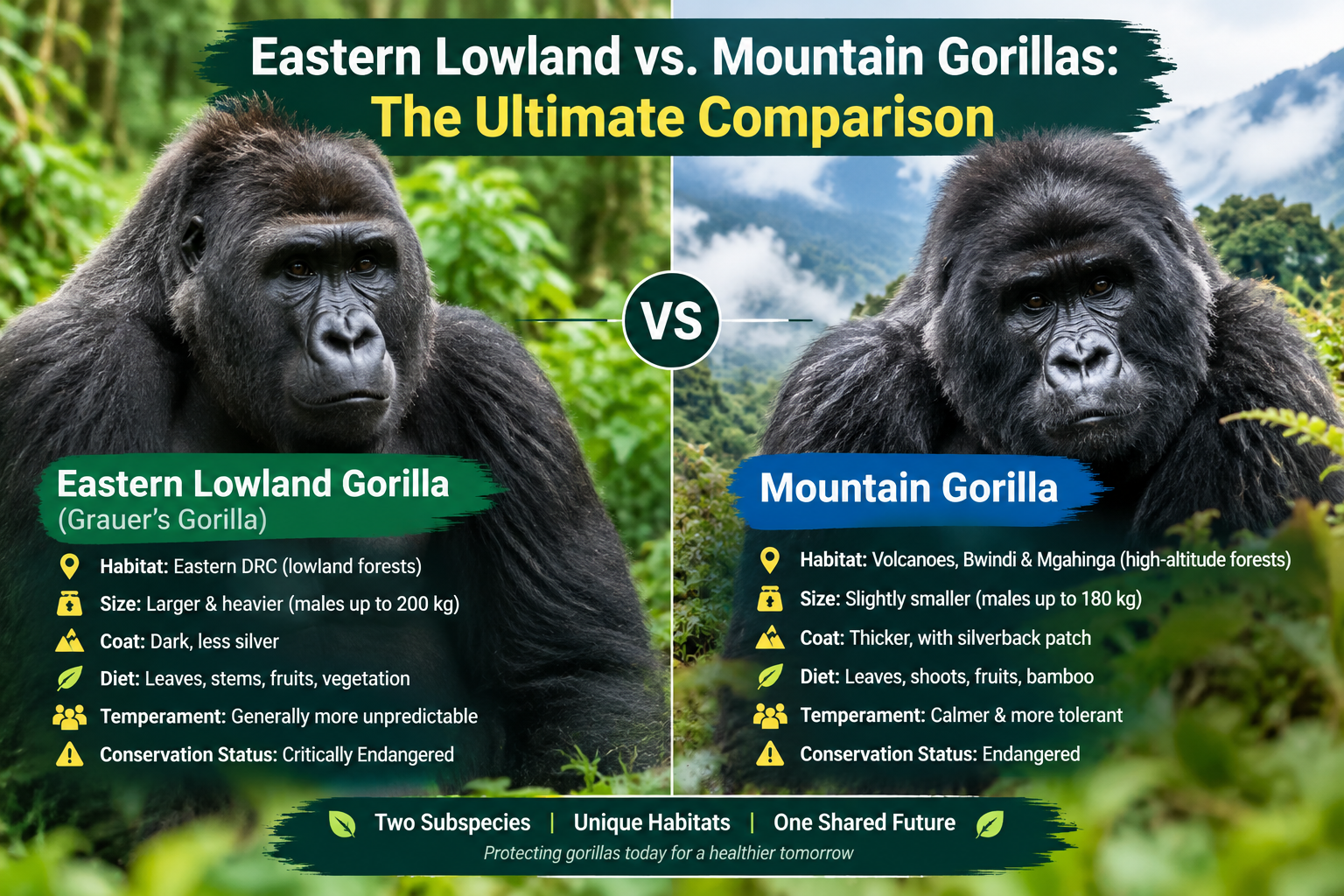
This is the question every serious primate traveler asks. Here is the definitive, side-by-side breakdown.
|
Feature |
Eastern Lowland Gorilla (Grauer’s) |
Mountain Gorilla |
|
Scientific Name |
Gorilla beringei graueri |
Gorilla beringei beringei |
|
Max Weight (Silverback) |
250 kg / 550 lbs |
195 kg / 430 lbs |
|
Hair |
Shorter, sleeker, less dense |
Thicker, shaggier, longer |
|
Habitat |
Lowland jungle to sub-alpine bamboo (600–2,900 m) |
Volcanic slopes (2,200–4,300 m) |
|
Location |
DRC only (Kahuzi-Biega, Maiko, Tayna) |
Uganda, Rwanda, DRC (Virungas) |
|
Population |
~3,800 (Critically Endangered) |
~1,063 (Endangered) |
|
Permit Cost |
$400 USD |
$800 (Uganda) / $1,500 (Rwanda) |
|
Trek Terrain |
Dense, humid, tangled lowland jungle |
Steep volcanic inclines, alpine meadows |
|
Trek Difficulty |
Moderate–Strenuous (dense vegetation) |
Strenuous (altitude + incline) |
|
Group Behavior on Trek |
Active, arboreal foraging, boisterous |
Ground-based, calmer, sedentary |
|
Visitor Volume |
Very low (exclusive) |
High (competitive booking) |
The takeaway: If you want exclusivity, raw jungle adventure, and the bragging rights of seeing the world’s largest primate, the Eastern Lowland Gorilla trek in the DRC is unmatched.
If you prefer shorter logistics and alpine scenery, mountain gorillas in Rwanda or Uganda suit you.
Why not do both? GoSilverback Gorilla Safaris builds seamless multi-country primate circuits.
👉 Compare DRC & Rwanda Gorilla Packages – Get Your Free Custom Itinerary →
Where to See Them: Kahuzi-Biega National Park
The Park
Kahuzi-Biega National Park is a UNESCO World Heritage Site spanning 6,000 km² in South Kivu province, eastern DRC.
Named after two dormant volcanoes—Mount Kahuzi (3,308 m) and Mount Biéga (2,790 m)—the park protects one of the last intact tracts of primary tropical rainforest in Africa and serves as the primary stronghold of the Eastern Lowland Gorilla.
The Trekking Sectors
Tourist access centers on the Tshivanga Ranger Station, located approximately 25 km from Bukavu. From here, trained ICCN (Institut Congolais pour la Conservation de la Nature) rangers guide visitors into the forest to locate habituated gorilla families.
Habituated Families You May Visit
- Chimanuka Family: The most famous group, comprising over 30 individuals under a dominant silverback. Known for their tolerance of visitors and dramatic social interactions.
- Mpungwe Family: A mid-sized group often found in transitional bamboo forest.
- Mugahuka Family: Smaller, more intimate encounters in dense lowland vegetation.
- Chimanuka Sub-groups: Periodically, splinter groups become available for trekking, offering even more exclusive encounters.
Critical note: Only habituated families receive visitors. The habituation process takes 2–3 years, ensuring gorillas tolerate human presence without stress.
👉 See Which Families Are Available for Your Dates – Ask GoSilverback →
Is DRC Gorilla Trekking Safe? (The Honest Truth)
Let’s address this directly, because it is the single biggest question every traveler from the USA, UK, Canada, Europe, Australia, China, and the Middle East asks before booking.
Geography Matters: South Kivu ≠ North Kivu
The DRC is vast. The conflict zones that dominate international headlines—Goma, Virunga National Park’s northern sector, and the Ituri region—are located in North Kivu and beyond, hundreds of kilometers from the gorilla trekking hub.
Kahuzi-Biega National Park sits in South Kivu, accessed via the city of Bukavu. This corridor benefits from a dedicated tourism security infrastructure established specifically to protect visitors and wildlife.
Security Protocols on Every Trek
- Armed ICCN rangers accompany every gorilla trek from trailhead to trailhead.
- Military and park police escorts are stationed along access roads.
- Real-time radio communication links your guide to Tshivanga HQ and security command.
- No independent trekking is permitted. You move only with licensed guides.
The Safest Entry Route
The recommended route for international travelers is:
- Fly into Kigali, Rwanda (KGL) – one of Africa’s safest, most efficient airports.
- Drive south to Cyangugu/Kamembe (approximately 5–6 hours).
- Cross the Ruzizi 1 or Ruzizi 2 border post into DRC (30–60 minutes).
- Drive 30–45 minutes to Bukavu/Lwiro and your lodge.
This route completely bypasses volatile northern zones and places you directly in the South Kivu tourism corridor.
Trust Signal
Licensed operators running Eastern Lowland Gorilla treks in the Bukavu region report zero incidents involving tourists in the past five years of regulated trekking. Your safety is managed by professionals who know this terrain daily.
👉 Ask Our DRC Safety Team Your Questions – Free Pre-Trek Consultation →
The Trekking Experience: What to Expect in the Jungle
1. The Morning Briefing
Your day begins at 06:30–07:00 at the Tshivanga Ranger Station. Here, ICCN rangers brief your group (capped at 4–8 visitors per family per day) on:
- Current gorilla family location (tracked overnight by advance teams)
- Trek difficulty and expected duration
- Safety protocols, distance rules, and emergency procedures
2. The Hike: Dense Jungle, Not Alpine Climbs
Forget the steep volcanic ascents of Rwanda. Eastern Lowland Gorilla trekking is a battle against vegetation, humidity, and mud.
Your path cuts through:
- Tangled lianas and thorny vines
- Dense undergrowth requiring machete-wielding trackers to forge the trail
- Stream crossings on slippery roots
- Occasional steep ravines in bamboo zones
Treks range from 1 to 6 hours depending on the family’s overnight location. The terrain is physically demanding not because of altitude, but because of the sheer density of the forest.
3. The Encounter: Active, Loud, and Unforgettable
When you locate the Grauer’s gorilla family, expect spectacle. Unlike the calm, ground-based mountain gorillas,
Eastern Lowland silverbacks are frequently arboreal, climbing into fruiting trees, shaking branches, and vocalising loudly.
Juveniles swing through the canopy. Infants tumble over roots. The silverback may chest-beat, hoot, or bark as he monitors your group.
Your guide will position you safely, remind you to crouch, speak softly, and avoid direct eye contact during any display, and ensure you maintain the 7-meter (23-foot) minimum distance.
4. The One-Hour Rule
You get exactly 60 minutes with the habituated family. This strict rule, enforced by ICCN, protects gorillas from disease transmission and behavioral disruption.
Use every second.
👉 Reserve Your Kahuzi-Biega Trek – Only 4–8 Permits Released Per Family Per Day →
Best Time to Visit & Essential Packing List
Seasons
- Dry seasons (June–September, December–February): Firmer trails, passable jungle roads, easier hiking. Peak demand—book permits 2–4 months ahead.
- Wet seasons (March–May, October–November): Lush, photogenic forest; fewer visitors; trails become muddy and leeches are active. Gorillas remain fully active year-round.
Packing for the Lowlands (Not the Alps)
Your gear list differs significantly from a mountain gorilla trek:
- Leech socks (mandatory in wet months)
- Lightweight, breathable long-sleeved shirts and trousers (neutral colors; avoid blue/black)
- Heavy-duty gardening gloves (for gripping thorny vines)
- Waterproof, machete-resistant gaiters
- Broken-in hiking boots with aggressive tread
- Rain jacket (humidity and downpours are constant)
- High-DEET insect repellent (malaria zone)
- 2 liters of water, energy snacks, packed lunch
- Dry bags for electronics and permits
- Sunscreen SPF 50, basic first-aid kit, personal medications
Photography Gear
The lowland canopy is dark and humid.
Bring:
- Fast lenses (f/2.8 or wider) for low-light performance
- Weather-sealed camera bodies (humidity kills unprotected electronics)
- Silica gel packs in your bag
- Extra batteries (cold drains them slower, but humidity corrodes contacts)
Costs, Permits, and Logistics (2026 Guide)
Permit Costs
The Eastern Lowland Gorilla trekking permit costs $400 USD per person for foreign non-residents. This is a fraction of Rwanda’s $1,500 mountain gorilla permit, making the DRC the most cost-effective great ape encounter on Earth.
Getting There: Step-by-Step
- Fly into Kigali International Airport (KGL), Rwanda.
- Drive south to Cyangugu/Kamembe (5–6 hours via paved road).
- Cross the Ruzizi border into DRC (bring passport, visa, yellow fever certificate, permit printout).
- Drive 30–45 minutes to Bukavu or Lwiro for your lodge.
- Report to Tshivanga HQ at 06:30 the following morning for your trek briefing.
Visas
- DRC Tourist Visa: Apply through the DRC embassy in your home country or via the e-visa portal (available for most nationalities including USA, UK, Canada, EU, Australia, China, and Middle Eastern countries). Processing takes 7–14 business days.
- East African Tourist Visa: If combining Uganda and Rwanda, this multi-entry visa ($100) simplifies border crossings before entering DRC separately.
Sample Budget: 3-Day / 4-Night Eastern Lowland Gorilla Safari
|
Item |
Solo Traveler (USD) |
Couple (USD, per person) |
|
Gorilla permit |
$400 |
$400 |
|
Kigali–Bukavu transfers (return) |
$350 |
$250 |
|
3 nights mid-range lodge |
$360 |
$280 |
|
Meals & incidentals |
$150 |
$130 |
|
DRC visa |
$100 |
$100 |
|
Travel insurance |
$80 |
$80 |
|
Total per person |
≈ $1,440 |
≈ $1,240 |
Compare this to a Rwanda mountain gorilla package averaging $3,500–$5,000. The DRC offers extraordinary value for a far rarer encounter.
👉 Get Your Personalized DRC Gorilla Safari Quote – Free Within 24 Hours →

Conservation Crisis: Saving the Grauer’s Gorilla
The Numbers Are Alarming
In the early 1990s, surveys estimated 17,000 Eastern Lowland Gorillas in the wild.
Today, that number has collapsed to approximately 3,800 individuals—a 78% decline in three decades. The IUCN Red List classifies them as Critically Endangered, one step from Extinct in the Wild.
The Threats
- Artisanal mining: Coltan, gold, and tin extraction destroys habitat and funds armed groups.
- Poaching: Gorillas are killed for bushmeat or caught in snares set for other animals.
- Habitat destruction: Agricultural expansion and charcoal production fragment forest corridors.
- Civil unrest: Decades of conflict in eastern DRC have undermined enforcement capacity.
How Your Trek Directly Helps
Every $400 permit you purchase funds:
- ICCN ranger salaries and armed anti-poaching patrols
- Community development projects (schools, clinics, clean water) in villages bordering Kahuzi-Biega
- Veterinary monitoring and disease prevention programs
- Habitat restoration and corridor protection
You are not just a tourist. You are a financial lifeline for a species on the brink. Choosing a responsible operator with verified conservation credentials ensures your money reaches the forest, not middlemen.
👉 Trek Responsibly – Book with a Conservation-Certified Operator →
Combining Your Trip: The Ultimate Primate Safari
The Eastern Lowland Gorilla trek is best experienced as part of a broader East African primate circuit. GoSilverback Gorilla Safaris designs seamless 10-to-14-day itineraries that combine:
- Eastern Lowland Gorillas – Kahuzi-Biega National Park, DRC (1–2 nights)
- Mountain Gorillas – Volcanoes National Park, Rwanda (1–2 nights)
- Chimpanzee Tracking – Nyungwe Forest National Park, Rwanda (1 night)
- Golden Monkey Trekking – Volcanoes NP, Rwanda (add-on morning)
- Kigali City Tour – Genocide Memorial, local culture, departure (1 night)
Logistical Ease
Our team handles all multi-country border crossings, visa coordination, internal transfers, and permit sequencing so you focus on the primates, not the paperwork.
Travelers from the USA, UK, Canada, Latin America, Europe, Australia, China, and the Middle East benefit from our established relationships with Rwandan and Congolese immigration authorities.
👉 Build Your Multi-Country Primate Safari – Get a Free 10-Day Itinerary →
Frequently Asked Questions About Eastern Lowland Gorillas
Are Eastern Lowland Gorillas dangerous?
No. Silverback displays (chest-beating, bluff charges, barking) are deterrents, not attacks. Armed ICCN rangers manage positioning and distance. In regulated trekking history at Kahuzi-Biega, no tourist has been seriously injured by a habituated gorilla.
How many Eastern Lowland Gorillas are left in the wild?
Approximately 3,800 individuals remain, down from 17,000 in the 1990s. They are listed as Critically Endangered on the IUCN Red List.
Can I see Eastern Lowland Gorillas in Uganda or Rwanda?
No. Grauer’s gorillas are endemic to the Democratic Republic of Congo. They exist only in Kahuzi-Biega, Maiko, and Tayna reserves in eastern DRC.
How hard is the trek in Kahuzi-Biega?
Moderate to strenuous. The challenge is dense vegetation, mud, and humidity rather than altitude. Treks last 1 to 6 hours. Machete-wielding trackers clear the path. Moderate hiking fitness is sufficient.
What is the difference between Grauer’s and Mountain gorillas?
Size, hair, and habitat. Eastern Lowland Gorillas are larger (up to 250 kg), have shorter hair, and live in lowland-to-sub-alpine forests. Mountain gorillas are smaller (up to 195 kg), shaggier, and restricted to volcanic slopes above 2,200 meters.
Secure Your Eastern Lowland Gorilla Expedition
Here is the reality: habituated Eastern Lowland Gorilla families are few.
Permits are capped at 4 to 8 visitors per family per day. DRC logistics—visas, border clearances, ICCN coordination, armed escort scheduling—require weeks to months of advance preparation.
This is not a last-minute booking destination. This is an expedition.
GoSilverback Gorilla Safaris operates with on-the-ground teams in both Bukavu (DRC) and Kigali (Rwanda), managing every permit, transfer, border crossing, and security protocol so you arrive at the trailhead with nothing to worry about except the silverback waiting in the trees.
We have guided travelers from New York, London, Toronto, Sydney, Beijing, São Paulo, Dubai, Frankfurt, and beyond into the Congo basin safely. Our conservation partnerships ensure your trek funds ranger patrols, community schools, and habitat protection.
The rarest gorilla on Earth is waiting. The question is whether you will be one of the few who goes to see it.
🦍 CHECK DRC GORILLA PERMIT AVAILABILITY FOR 2026 →
🦍 SPEAK TO A DRC SAFARI SPECIALIST NOW →
Book your Eastern Lowland Gorilla trek through GoSilverback Gorilla Safaris today. Secure your permit. Cross the border. Enter the jungle. Come face-to-face with the largest, rarest, most unforgettable primate alive.
👉 BOOK YOUR GRAUER’S GORILLA EXPEDITION NOW →
Last updated: September 2026 | Permit prices verified with ICCN and Kahuzi-Biega National Park authority. DRC safety conditions monitored continuously. Always confirm current travel advisories before departure.