How Big Are Silverback Gorillas? Size, Weight, Height & Trekking Facts 2026
How Big Are Silverback Gorillas?
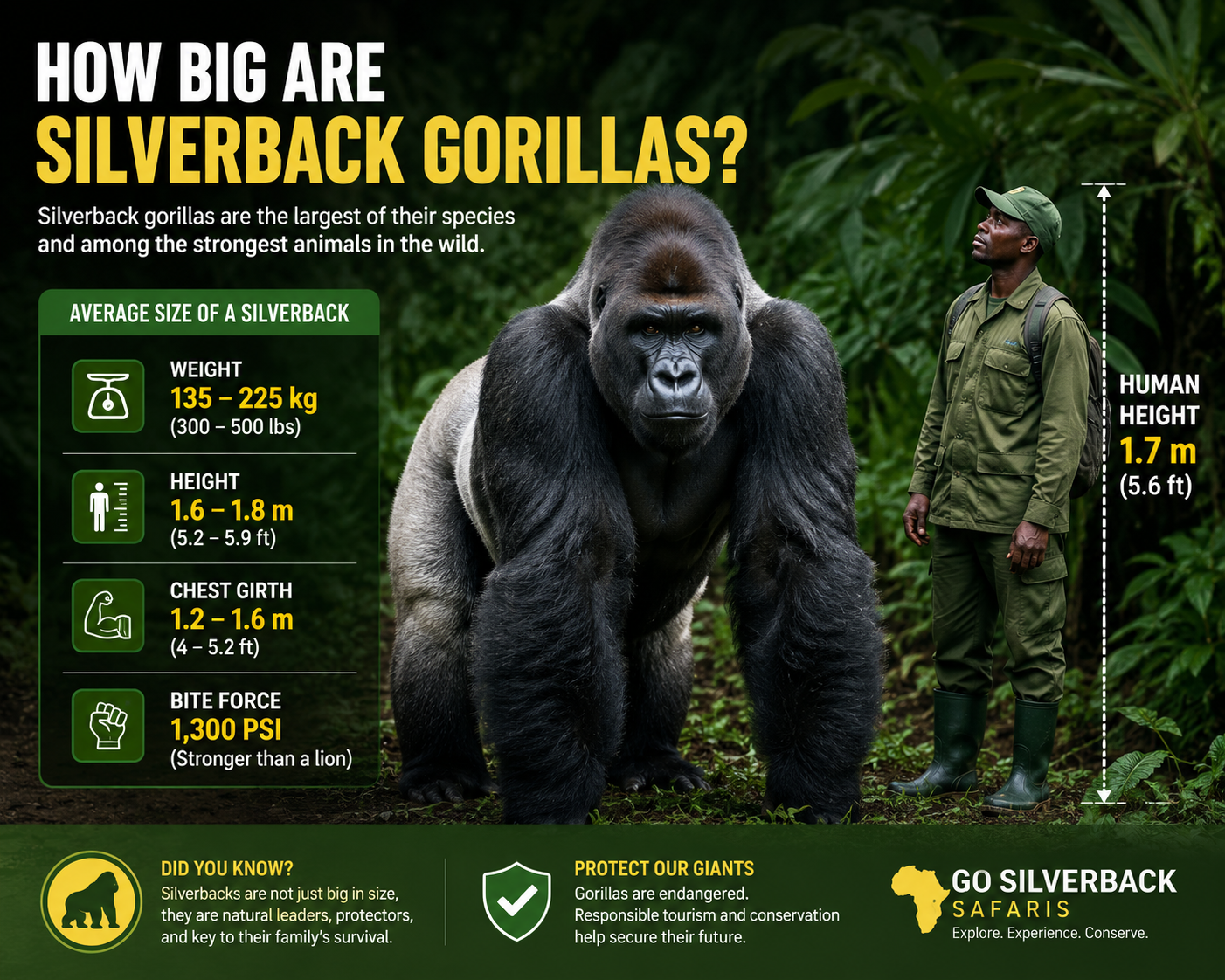
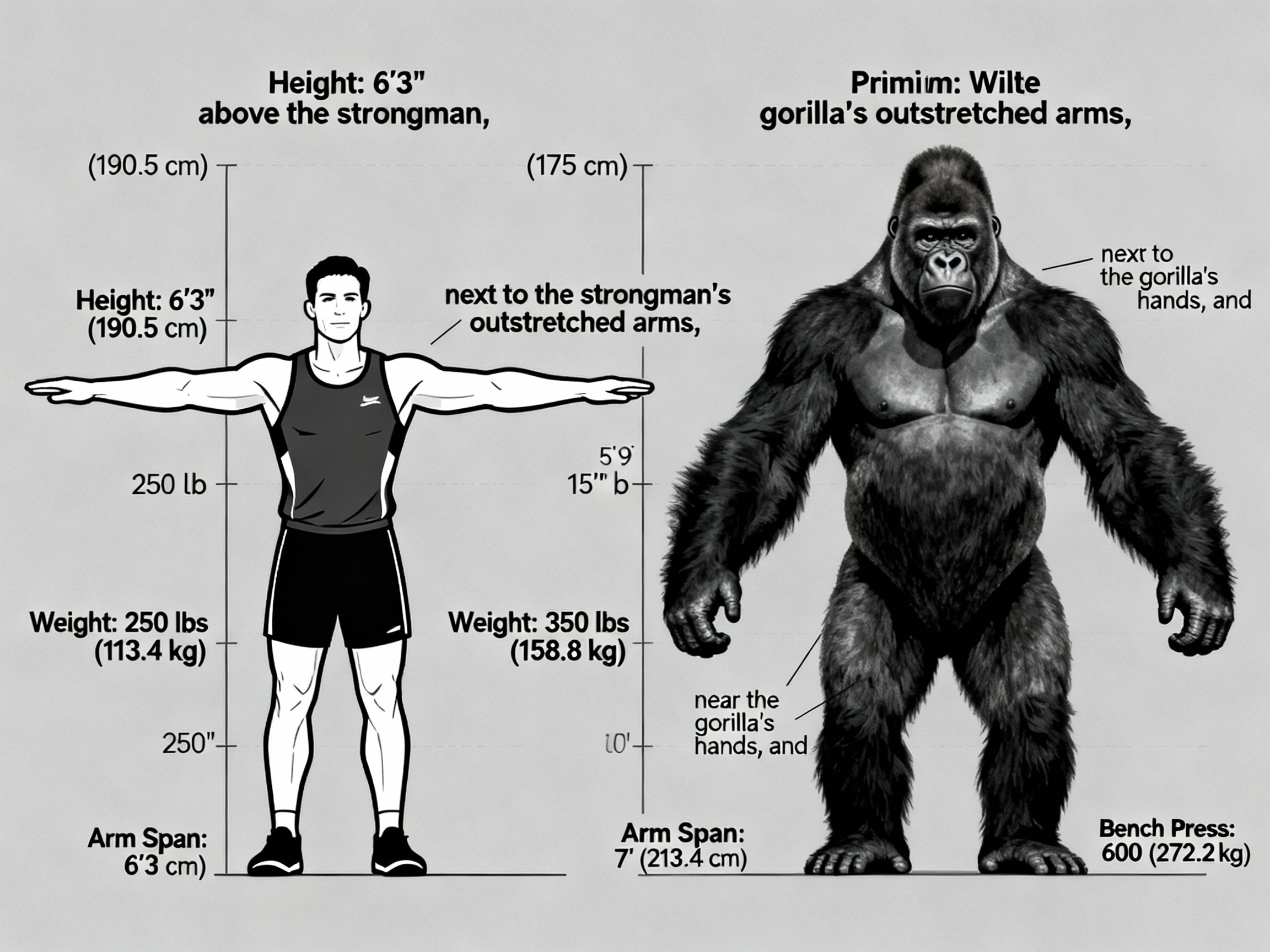
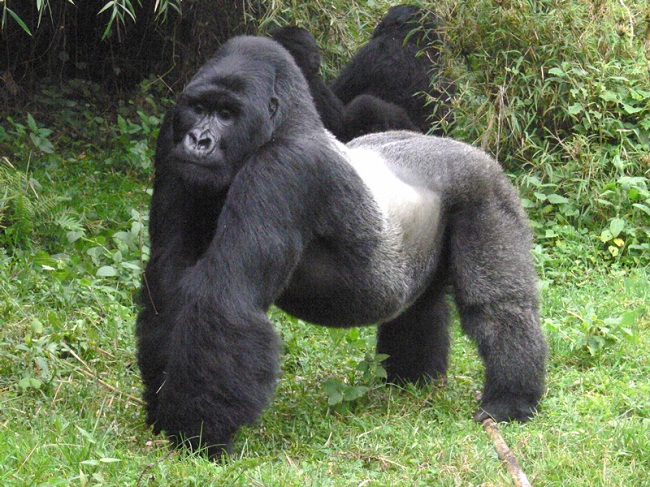
An Adult silverback gorillas are the largest living primates, standing 1.4–1.8 meters (4 ft 7 in–5 ft 11 in) tall when upright and weighing 140–220 kg (310–485 lbs) in the wild.
Their powerful bodies, broad chests, and arm spans of up to 2.6 meters (8.5 feet) make them exceptionally strong while remaining gentle and social animals.
Found in the rainforests of Uganda, Rwanda, and the Democratic Republic of the Congo, silverback gorillas lead and protect their families.
Learning how big are silverback gorillas highlights their remarkable adaptations and makes encountering them during gorilla trekking even more unforgettable.
A silverback gorilla is not just the largest primate on Earth — it is one of the most awe-inspiring creatures any traveler will ever encounter in the wild.
Standing upright, a mature male can look a 6-foot human directly in the eye. Weighing more than a heavyweight boxer, with arms that span 8.5 feet, and a chest built like a barrel, the silverback commands absolute authority over its forest kingdom.
Yet here is what surprises first-time trekkers from New York, London, Tokyo, Sydney, Dubai, and São Paulo: despite their staggering size, silverback gorillas are gentle, intelligent, and deeply family-oriented.
They do not attack humans. They do not hunt. They spend their days foraging for leaves, bamboo shoots, and fruit — up to 40 pounds of vegetation daily — while nurturing infants, mediating family disputes, and leading their troop through mist-shrouded mountains.
What makes a male gorilla a “silverback”? It is not a separate species.
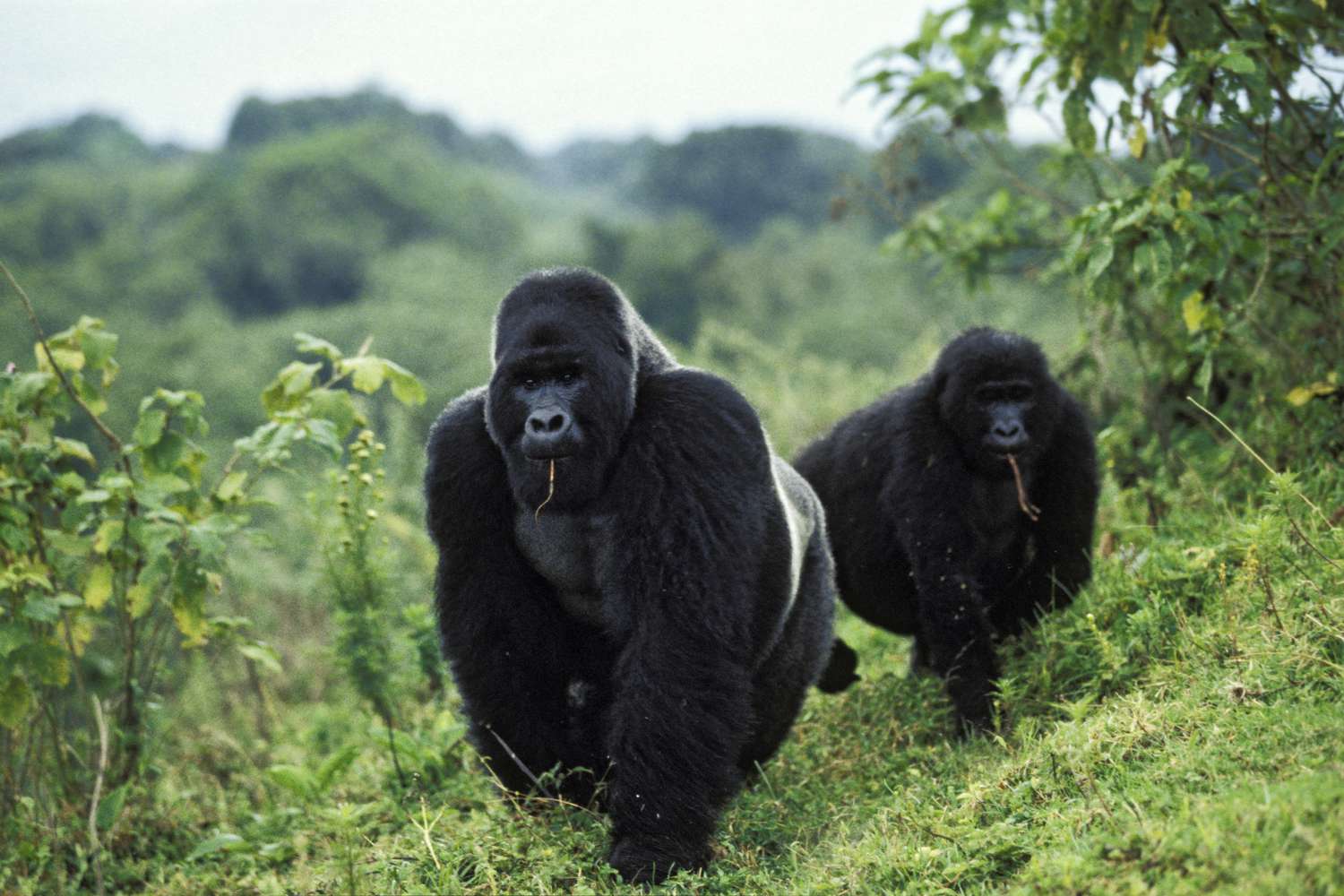
The term describes a mature adult male mountain gorilla (typically 12–15 years or older) who has developed the distinctive silver-gray saddle of hair across his back and hips — a biological billboard signaling testosterone, dominance, and breeding rights.
He is the alpha leader, the protector, and the decision-maker for a family of 5 to 35 individuals.
Quick Answer: Adult silverback gorillas typically stand 1.4–1.8 meters (4 ft 7 in–5 ft 11 in) tall when upright and weigh 140–220 kg (310–485 lbs) in the wild.
They have an arm span of up to 2.6 meters (8.5 feet) and are the largest living primates on Earth. The heaviest wild silverback ever recorded weighed 267 kg (589 lbs) in Cameroon, while the tallest reached 1.95 meters (6 ft 5 in) in DR Congo.
In this guide, you will learn exactly how big silverback gorillas are, how they compare to humans and other great apes, what fuels their massive growth and — most importantly — where you can stand meters away from one in the wild on a gorilla trekking safari in Uganda or Rwanda.
Ready to witness a 200-kilogram silverback in its natural habitat? Book your gorilla permit with GoSilverback Gorilla Safaris — we secure permits year-round for travelers from the USA, UK, Europe, Canada, Latin America, Asia, China, Oceania, and the Middle East.
What Is a Silverback Gorilla?
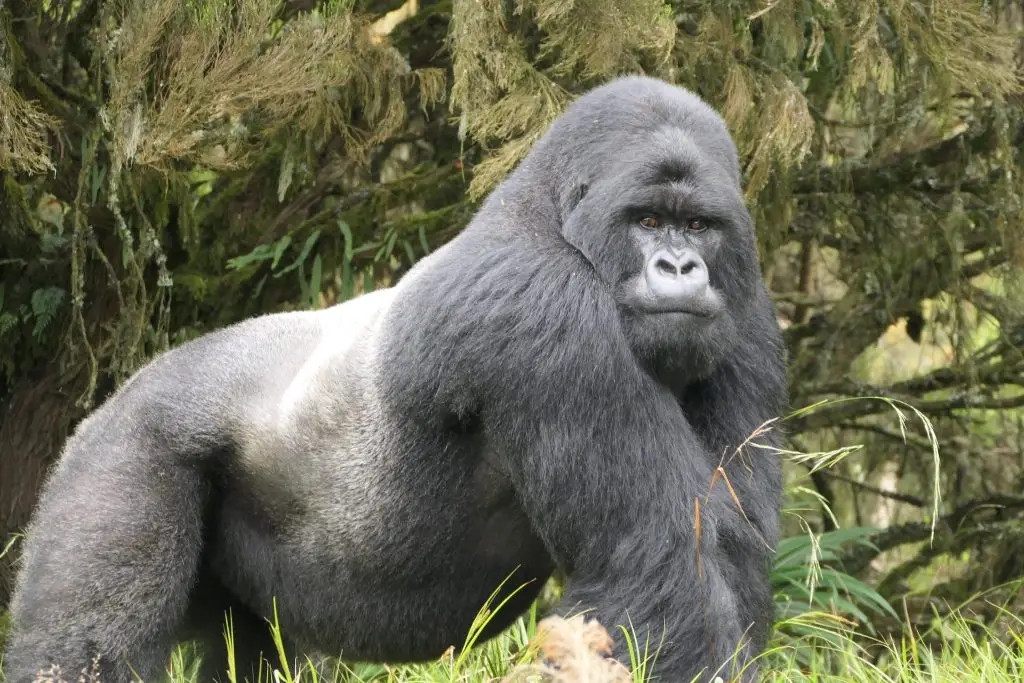
A silverback gorilla is a mature adult male gorilla distinguished by the silver-gray hair that develops across his back and hips as he reaches full sexual maturity.
This is not a separate species or subspecies — it is a life stage within both mountain gorillas (Gorilla beringei beringei) and eastern lowland gorillas (Gorilla beringei graueri).
The Silverback Development Timeline
- Infant (0–3 years): Weighs 1.8–2.5 kg at birth, clings to mother’s belly, entirely dependent
- Juvenile (3–6 years): Begins climbing, playing, learning social behavior; weighs 10–30 kg
- Blackback (8–12 years): Young adult male with all-black fur; subordinate to the dominant silverback; weighs 120–160 kg
- Silverback (12–15+ years): Full maturity, silver saddle appears, testosterone surges, may challenge for dominance or leave to form own troop; weighs 140–220 kg
Not every male gorilla becomes a silverback leader. Some remain subordinate silverbacks in multi-male groups, assisting the dominant male with protection while waiting for a chance to lead — or to steal females and start their own family.
The dominant silverback holds absolute authority. He decides when the troop wakes, where they forage, when they rest, and which females mate.
He is also the first line of defense against predators, rival silverbacks, and human threats.
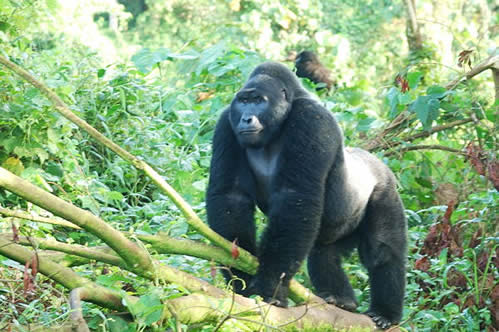
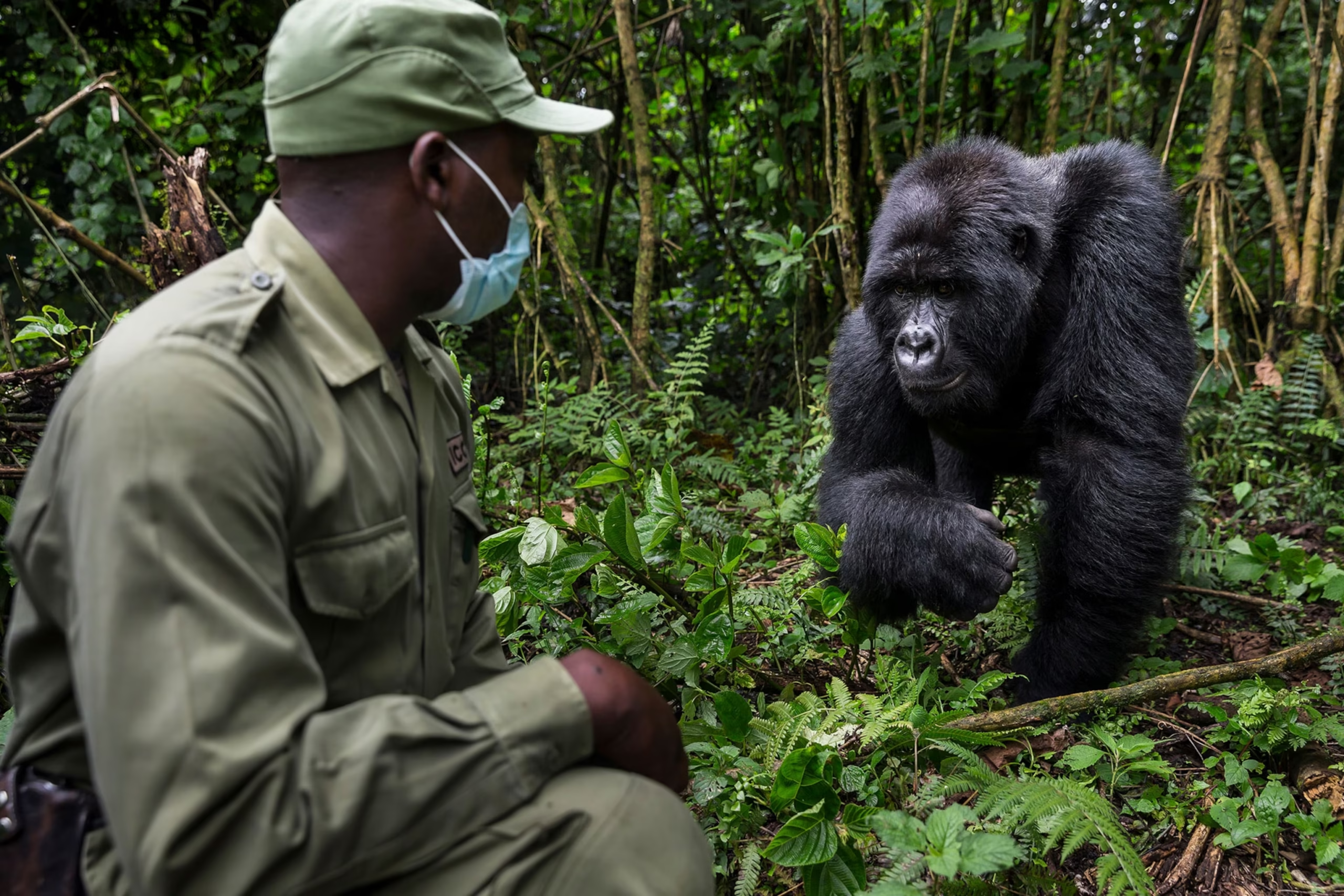
During your gorilla trek in Uganda or Rwanda, the silverback may sit calmly 3–7 meters away, observing you with the patience of a being who has nothing to prove — because at 220 kg, he does not.
Want to observe silverback behavior with expert guides who interpret every gesture?GoSilverback Gorilla Safaris assigns you rangers with 10+ years of silverback tracking experience.
How Big Are Silverback Gorillas? Height, Weight & Arm Span
1. Height
Table
|
Measurement |
Range |
Average |
|
Standing upright |
1.4–1.8 m (4 ft 7 in–5 ft 11 in) |
1.65 m (5 ft 5 in) |
|
Shoulder height (quadrupedal) |
1.0–1.2 m (3 ft 3 in–3 ft 11 in) |
1.1 m (3 ft 7 in) |
When a silverback stands fully upright — which they do rarely, usually to display dominance or survey surroundings — they can look an average human male in the eye.
Most of the time, they move knuckle-walking, with their enormous arms bearing much of their weight.
2. Weight
Table
|
Population |
Range |
Average |
|
Wild mountain gorillas (Uganda/Rwanda) |
140–220 kg (310–485 lbs) |
170–195 kg (375–430 lbs) |
|
Wild eastern lowland gorillas (DR Congo) |
160–250 kg (350–550 lbs) |
200+ kg (440+ lbs) |
|
Captive western lowland gorillas |
Up to 310 kg (683 lbs) |
— |
Wild gorillas are leaner and more muscular than captive gorillas. Captive males can become overweight due to sedentary lifestyles and calorie-rich diets, with the heaviest captive silverback reaching 310 kg (683 lbs).
In the wild, constant foraging across steep volcanic terrain keeps silverbacks powerfully built but not obese.
3. Arm Span
A silverback’s arm span reaches 2.3–2.6 meters (7 ft 7 in–8 ft 6 in) — nearly double his height.
These arms are not just for show:
- Knuckle-walking across rough forest floor
- Reaching fruit on distant branches
- Climbing despite their bulk (silverbacks can climb 15+ meters when motivated)
- Displaying dominance — spreading arms wide during chest-beating rituals
4. Chest Width
A mature silverback’s chest circumference measures 1.3–1.5 meters (4 ft 3 in–4 ft 11 in).
Combined with a sagittal crest (a bony ridge on the skull anchoring massive jaw muscles), this creates the iconic barrel-chested silhouette that defines the species.
The bottom line: A silverback gorilla is roughly twice the weight of an average human male, with arms longer than most humans are tall, and a bite force of 1,300 PSI — strong enough to crush a coconut.
Imagine standing 7 meters from a 200-kilogram silverback. Now make it real. Book your Uganda or Rwanda gorilla trek with GoSilverback Gorilla Safaris.
Silverback Gorilla Size Comparison
Table
|
Animal |
Height (Standing) |
Weight |
Key Difference |
|
Silverback Gorilla |
1.4–1.8 m (4 ft 7 in–5 ft 11 in) |
140–220 kg (310–485 lbs) |
Largest primate; herbivorous; knuckle-walker |
|
Average Human Male |
1.7 m (5 ft 7 in) |
70–90 kg (154–198 lbs) |
Bipedal; far less muscle mass |
|
Chimpanzee (male) |
1.1–1.2 m (3 ft 7 in–3 ft 11 in) |
40–70 kg (88–154 lbs) |
Smaller; more arboreal; omnivorous |
|
Orangutan (male) |
1.2–1.4 m (3 ft 11 in–4 ft 7 in) |
50–100 kg (110–220 lbs) |
Arboreal; solitary; reddish hair |
|
Black Bear |
1.5–1.8 m (4 ft 11 in–5 ft 11 in) |
100–270 kg (220–595 lbs) |
Carnivorous; quadrupedal; hibernates |
Key insight: Silverbacks outweigh chimpanzees by 3x and orangutans by 2x. They rival black bears in mass but are entirely herbivorous — their size comes from plant-powered muscle, not meat.
See the world’s largest primate in person — not behind glass. GoSilverback Gorilla Safaris offers guaranteed silverback encounters in Bwindi and Volcanoes National Park.
Male vs Female Gorilla Size — Sexual Dimorphism Explained
Table
|
Feature |
Male (Silverback) |
Female |
Difference |
|
Weight |
140–220 kg (310–485 lbs) |
68–113 kg (150–250 lbs) |
Males are 2x heavier |
|
Height (standing) |
1.4–1.8 m (4 ft 7 in–5 ft 11 in) |
1.25–1.5 m (4 ft 1 in–4 ft 11 in) |
Males 15–20% taller |
|
Arm span |
2.3–2.6 m (7 ft 7 in–8 ft 6 in) |
1.8–2.2 m (5 ft 11 in–7 ft 3 in) |
Males have 30% longer reach |
|
Bite force |
~1,300 PSI |
~800 PSI |
Males 60% stronger |
|
Chest circumference |
1.3–1.5 m (4 ft 3 in–4 ft 11 in) |
0.9–1.1 m (2 ft 11 in–3 ft 7 in) |
Males 40% broader |
This extreme sexual dimorphism evolved because male gorillas compete violently for harems.
A larger, stronger silverback can:
- Defeat rival males in physical combat — protecting his breeding rights
- Intimidate predators — leopards are the only real threat, and a 200-kg silverback is more than they can handle
- Display dominance — chest-beating, branch-throwing, and charging are more impressive at 220 kg
Females do not need this bulk. Their smaller size allows efficient foraging and infant care.
During your gorilla trek, you will likely see females half the silverback’s size — yet they are the social glue of the troop, grooming, nursing, and maintaining alliances.
Photographers: capture the dramatic size difference between silverback and female.GoSilverback Gorilla Safaris books you into families with multiple silverbacks for dynamic shots.
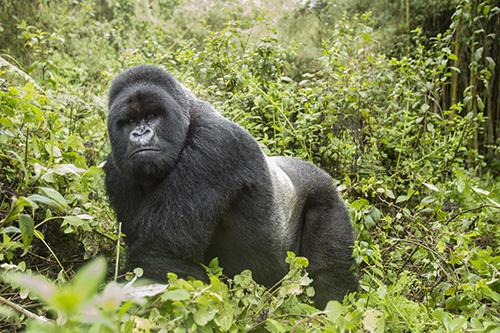
Why Are Silverback Gorillas So Big?
1. Evolutionary Arms Race
For millions of years, male gorillas fought to control harems. Natural selection favored larger, stronger males who could defeat rivals and protect females.
Over generations, this produced the extreme sexual dimorphism we see today.
2. Plant-Powered Muscle
Silverbacks consume 25–40 kg (55–88 lbs) of vegetation daily — leaves, stems, bamboo shoots, fruit, bark, and roots.
Their caecum (a specialized digestive organ) ferments this plant matter, extracting protein and calories that fuel massive muscle growth.
They are living proof that plants build muscle.
3. Testosterone-Driven Growth
Once a male reaches 12–15 years, testosterone levels surge, triggering:
- Silver hair growth on the back and hips
- Muscle hypertrophy — particularly in shoulders, chest, and arms
- Sagittal crest development — the bony ridge supporting jaw muscles
- Aggressive territorial behavior — necessary to maintain dominance
4. Habitat Demands
Mountain gorillas live at 2,400–4,000 meters in the Virunga Massif and Bwindi Impenetrable National Park.
The steep, rugged terrain requires powerful limbs for climbing, balancing, and navigating bamboo thickets.
Lowland gorillas are slightly smaller because their flatter forest habitat demands less climbing strength.
5. Genetic Isolation
Mountain gorillas have limited gene flow due to their restricted range. This genetic isolation has amplified certain traits — including size — over thousands of years.
Witness evolution’s masterpiece in the misty mountains of Uganda and Rwanda. GoSilverback Gorilla Safaris designs treks to families with the largest, most photogenic silverbacks.
How Strong Is a Silverback Gorilla?
Silverback strength is legendary — but let’s separate verified facts from internet exaggeration.
Verified Strength Metrics
Table
|
Metric |
Measurement |
Human Comparison |
|
Dead-lift capacity |
800–1,000 kg (1,760–2,200 lbs) |
2x a world-class weightlifter |
|
Bite force |
~1,300 PSI |
Stronger than a lion (650 PSI) |
|
Arm pull strength |
Estimated 9–10x human male |
Can uproot small trees |
|
Charging speed |
Up to 40 km/h (25 mph) |
Faster than most humans can sprint |
|
Grip strength |
Sufficient to crush a coconut |
Human grip: ~50–80 kg |
What Silverbacks Actually Use Strength For
- Felling trees — to reach fruit or create pathways
- Uprooting bamboo — staple food in Volcanoes National Park
- Throwing vegetation — during dominance displays (not at tourists)
- Defending the troop — against rival silverbacks or rare leopard attacks
- Carrying infants — yes, silverbacks babysit; their strength allows gentle handling
Important: Silverbacks do not use their strength against humans during regulated gorilla trekking. Habituated silverbacks have known human observers since infancy.
In 30+ years of gorilla tourism, no habituated silverback has ever seriously harmed a tourist. Their displays — chest-beating, charging, vocalizing — are bluff behavior designed to intimidate, not attack.
**Nervous about encountering a 200-kg silverback? Don’t be — our guides at GoSilverback Gorilla Safaris have 100% safety records across thousands of treks](#).
Largest Silverback Gorilla Ever Recorded
While internet rumors claim absurd sizes, here are the verified records:
Table
|
Record |
Details |
Location & Year |
|
Heaviest wild silverback |
267 kg (589 lbs) |
Ambam, Cameroon (Western lowland gorilla) |
|
Tallest wild silverback |
1.95 m (6 ft 5 in) standing; arm span 2.7 m (8 ft 10 in) |
Alimbongo, northern Kivu, DR Congo (Mountain gorilla), 1938 |
|
Largest chest circumference |
1.98 m (6 ft 6 in) |
Same Alimbongo individual |
|
Heaviest captive silverback |
310 kg (683 lbs) |
Antwerp Zoo, Belgium (Western lowland gorilla named “Gust”) |
|
Tallest captive gorilla |
2.20 m (7 ft 3 in) |
Antwerp Zoo, Belgium (“Gust”) |
Context matters: The 1938 DR Congo mountain gorilla was shot during a census — a practice now unthinkable. Modern conservation relies on non-invasive monitoring.
Today’s habituated silverbacks in Uganda and Rwanda are protected, not hunted, and their sizes are estimated via photogrammetry (measuring from photographs) rather than physical capture.
Average silverbacks you will encounter on trek: 170–195 kg and 1.6–1.7 m tall — still imposing enough to make your heart stop when he makes eye contact.
Want to see a silverback that weighs more than a motorcycle? GoSilverback Gorilla Safaris tracks the largest families in Bwindi’s Rushaga and Nkuringo sectors.
Silverback Gorilla Growth Stages — From Tiny Infant to Forest King
Table
|
Stage |
Age |
Weight |
Key Characteristics |
|
Newborn |
0–3 months |
1.8–2.5 kg (4–5.5 lbs) |
Clings to mother’s belly; entirely dependent |
|
Infant |
3 months–3 years |
2.5–10 kg (5.5–22 lbs) |
Rides on mother’s back; begins playing |
|
Juvenile |
3–6 years |
10–30 kg (22–66 lbs) |
Explores independently; learns foraging |
|
Blackback |
8–12 years |
120–160 kg (265–350 lbs) |
All-black fur; subordinate; may leave natal troop |
|
Silverback |
12–15+ years |
140–220 kg (310–485 lbs) |
Silver saddle; dominant or subordinate; breeding rights |
|
Elder Silverback |
25+ years |
May decline to 150 kg |
Graying; may be overthrown by younger rival |
Critical transition: The shift from blackback to silverback is not automatic. It requires:
- Physical maturity — silver hair, full size, testosterone peak
- Social opportunity — either challenging the dominant male or leaving to form a new troop
- Female acquisition — stealing females from other groups or attracting solitary females
Some blackbacks never become dominant silverbacks. They remain subordinate in multi-male groups, helping protect infants and patrol territory — a strategy that may eventually pay off if the dominant male weakens.
Watch blackbacks test their strength against silverbacks during your trek.GoSilverback Gorilla Safaris selects families with dynamic multi-male structures for maximum behavioral observation.

What Do Silverback Gorillas Eat to Grow So Large?
The answer shocks most first-time trekkers: silverbacks are almost entirely vegetarian.
Daily Diet Breakdown
Table
|
Food Type |
Percentage |
Examples |
|
Leaves & stems |
40% |
Wild celery, thistles, nettles |
|
Bamboo shoots |
25% |
Staple in Volcanoes National Park |
|
Fruit |
20% |
Seasonal; figs, berries when available |
|
Bark & roots |
10% |
Fallback foods during scarcity |
|
Insects |
<5% |
Ants, termites (occasional protein) |
Daily Intake
- 25–40 kg (55–88 lbs) of vegetation per day
- 8–10 hours of active foraging
- Water consumed primarily from vegetation; rarely drink from streams
Digestive Adaptation
Silverbacks have long intestines and a large caecum — a fermentation chamber where bacteria break down cellulose into usable proteins and fatty acids.
This hindgut fermentation is less efficient than cow stomachs, which is why gorillas must eat massive volumes to extract sufficient nutrients.
The result: A plant-based diet fuels 200 kg of pure muscle — no meat, no dairy, no supplements.
Follow a silverback’s foraging trail through Bwindi’s ancient rainforest.GoSilverback Gorilla Safaris offers full-day gorilla habituation experiences where you observe feeding behavior for 4 hours.

Where Can You See Giant Silverback Gorillas in the Wild?
For international travelers, three countries offer regulated, safe silverback encounters:
1. Uganda — Best Value & Family Diversity
- Bwindi Impenetrable National Park — 18 habituated gorilla families, the highest concentration of silverbacks globally
- Mgahinga Gorilla National Park — Nyakagezi family, known for 3 silverbacks coexisting peacefully
- Permit cost: $800 (best value for silverback photography)
- Trek duration: 30 minutes–8 hours depending on family location
- Best for: Budget travelers, photographers, wildlife enthusiasts from USA, UK, Europe, Canada, Latin America, Asia, China, Oceania, and the Middle East
2. Rwanda — Luxury & Accessibility
- Volcanoes National Park — 12 habituated families, including Susa (famous for twin silverbacks)
- Permit cost: $1,500 (premium positioning)
- Travel time: 2.5 hours from Kigali Airport — easiest access from Dubai, Doha, Europe, and North America
- Best for: Luxury travelers, short vacations, honeymooners
3. DR Congo — Adventure & Grauer’s Gorillas
- Virunga National Park — Mountain gorillas; security-dependent
- Kahuzi-Biega National Park — Eastern lowland gorillas (even larger than mountain gorillas)
- Permit cost: $400 (lowest cost, highest risk)
- Best for: Experienced adventure travelers only
Recommendation for first-time visitors: Uganda or Rwanda. Both offer professional guiding, luxury accommodation, direct flight connections, and proven safety records. GoSilverback Gorilla Safaris specializes in both destinations.
Unsure whether Uganda’s $800 permit or Rwanda’s $1,500 luxury model fits your travel style? Get a free, personalized consultation from GoSilverback Gorilla Safaris.
Can Humans Be Bigger Than a Silverback Gorilla?
Table
|
Measurement |
Silverback Gorilla |
Average Human Male |
Tallest Human Ever |
|
Height (standing) |
1.4–1.8 m (4 ft 7 in–5 ft 11 in) |
1.7 m (5 ft 7 in) |
2.72 m (8 ft 11 in) — Robert Wadlow |
|
Weight |
140–220 kg (310–485 lbs) |
70–90 kg (154–198 lbs) |
199 kg (439 lbs) — Jon Brower Minnoch |
|
Arm span |
2.3–2.6 m (7 ft 7 in–8 ft 6 in) |
1.7 m (5 ft 7 in) |
— |
|
Muscle mass |
~40% of body weight |
~35% of body weight |
— |
|
Bite force |
1,300 PSI |
120–160 PSI |
— |
Yes, the tallest humans exceed silverback height. Robert Wadlow at 2.72 meters towered over any gorilla.
But no human has ever matched a silverback’s muscle mass, bone density, and functional strength.
A silverback’s arm span exceeds most humans’ height, and their grip strength can crush objects no human could dent.
The real comparison: A silverback is essentially a human-shaped being built like a bear, with 10x the strength and none of the aggression.
Stand face-to-face with a silverback and understand what “wild” truly means. Book your life-changing encounter with GoSilverback Gorilla Safaris.
Silverback Gorilla Myths vs Facts
Table
|
Myth |
Fact |
|
Silverbacks are aggressive and attack humans |
False. Habituated silverbacks are calm and tolerant. In 30+ years of tourism, no tourist has been seriously harmed by a habituated silverback. |
|
Silverbacks eat meat |
False. They are primarily herbivorous, eating leaves, bamboo, and fruit. Insects comprise <5% of diet. |
|
Bigger silverbacks are faster |
Partially true. Size does not guarantee speed, but silverbacks can charge at 40 km/h — faster than most humans. |
|
All male gorillas become dominant silverbacks |
False. Many remain subordinate or solitary their entire lives. |
|
Silverbacks are “king of the jungle” |
Misleading. Gorillas live in rainforest and montane forest, not savanna. Lions do not coexist with mountain gorillas. |
|
You can outrun a charging silverback |
False. At 40 km/h, a silverback covers 7 meters (the minimum viewing distance) in 0.6 seconds. Do not run. Crouch and stay still. |
Learn the real behavior of silverbacks from guides who’ve studied them for decades. GoSilverback Gorilla Safaris employs only UWA and RDB-certified rangers.
Why Size Matters for Gorilla Conservation
A silverback’s massive size is not just a tourist attraction — it is ecologically critical:
1. Habitat Engineering
At 200 kg, a silverback consumes 25–40 kg of vegetation daily. This heavy foraging creates clearings in the forest, allowing sunlight to reach the forest floor and new plants to grow.
They are unwitting gardeners of their ecosystem.
2. Seed Dispersal
Silverbacks travel 1–3 km daily across their home range. Their dung spreads seeds of 100+ plant species, maintaining forest diversity.
Without silverbacks, Bwindi’s ancient rainforest would gradually lose plant diversity.
3. Family Protection
A large silverback deters predators (leopards, occasionally hyenas) and rival males. Infants in troops with mature, healthy silverbacks have higher survival rates.
When a silverback dies, his family may fragment or be absorbed by a rival — disrupting social bonds and breeding success.
4. Tourism Revenue
A single dominant silverback can generate $1 million+ in tourism revenue over his lifetime through gorilla permit fees.
This revenue funds anti-poaching patrols, veterinary care, and community development — creating a direct economic incentive to protect him.
Protecting silverbacks means protecting entire ecosystems. Every gorilla permit purchased in Uganda or Rwanda is an investment in keeping these forest giants alive.
**Your permit is conservation currency. Book ethically with GoSilverback Gorilla Safaris and ensure 100% of your trek supports verified conservation programs](#).
Experience Their Incredible Size Through Gorilla Trekking
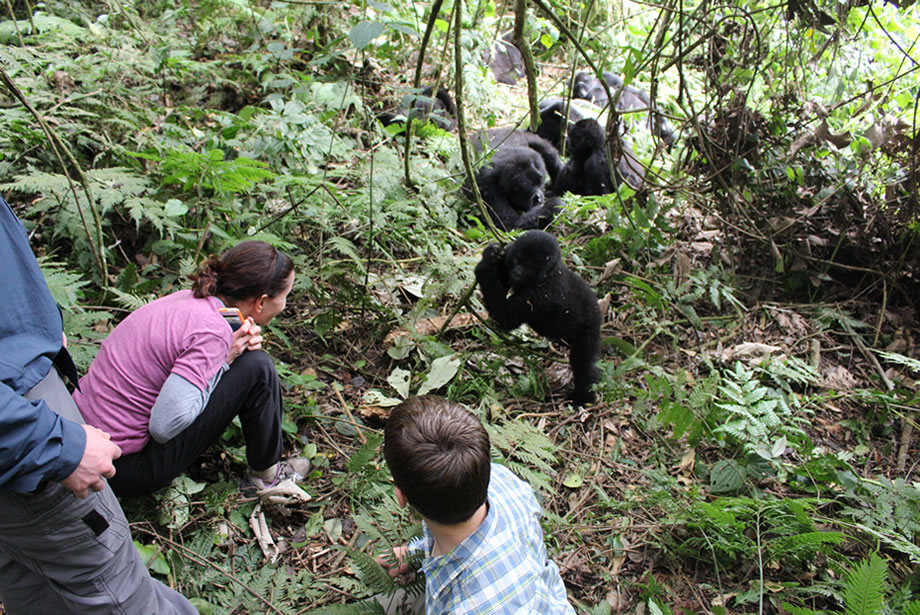
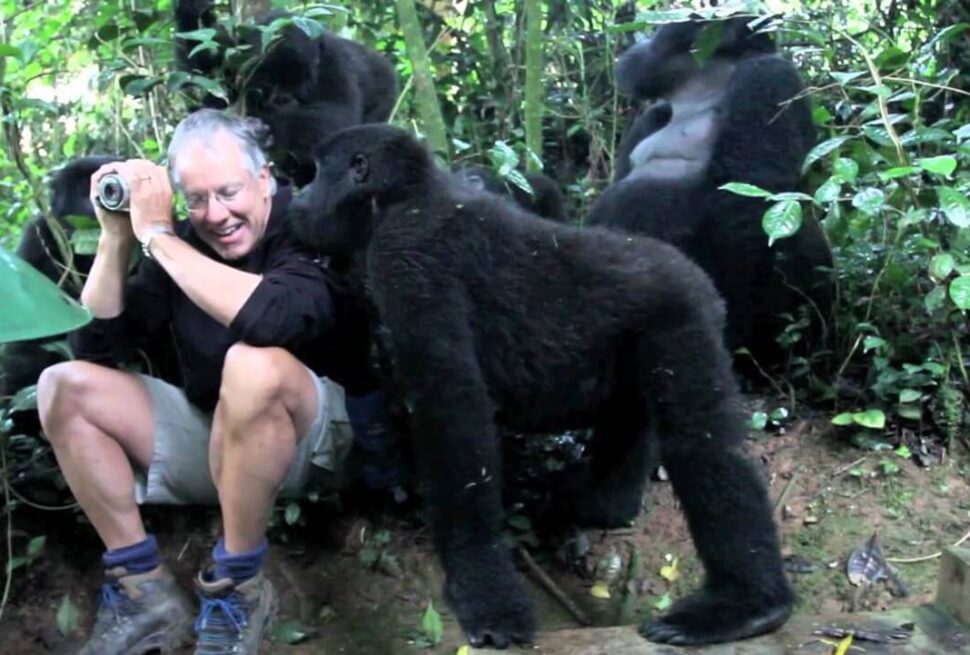
Reading about 220-kilogram silverbacks is one thing. Standing 7 meters from one as he surveys his family, beats his chest in a rhythmic thunder that echoes through the forest, and then resumes eating leaves with the delicacy of a surgeon — that is transformational travel.
What You Will Experience
- The approach: Your ranger stops. Whispers. Points through bamboo. And there — a silverback, 1.7 meters tall, 190 kg, silver saddle gleaming in the mist, eating thistles 5 meters away.
- The eye contact: He looks up. Not aggressive. Curious. Assessing. He has seen humans thousands of times. You are neither threat nor prey. You are a brief visitor in his kingdom.
- The family: Behind him, a female nurses twins. A juvenile somersaults down a slope. A blackback watches from the periphery, learning.
- The hour: 60 minutes that feel like 10. Your camera battery dies. You don’t care. You are memorizing the texture of his fur, the sound of his breathing, and the intelligence in his eyes.
- The return: You hike out in silence. No one speaks. Everyone is processing. Back at the lodge, over Rwandan coffee or Ugandan tea, you finally say, “That was the best hour of my life.”
Responsible Tourism
- Maintain 7–10 meters distance — protects gorillas from human diseases
- No flash photography — disturbs behavior
- Wear masks — mandatory since COVID-19
- Hire porters — supports local communities ($10–15 in Uganda, $20 in Rwanda)
- Book with ethical operators — GoSilverback Gorilla Safaris follows UWA and RDB guidelines strictly
Don’t just read about silverbacks. Stand in their presence. Book your gorilla trekking safari with GoSilverback Gorilla Safaris today.
Frequently Asked Questions About Silverback Gorilla Size
How tall is a silverback gorilla?
1.4–1.8 meters (4 ft 7 in–5 ft 11 in) when standing upright. Shoulder height (quadrupedal) is 1.0–1.2 meters.
How much does a silverback weigh?
140–220 kg (310–485 lbs) in the wild. The heaviest wild silverback recorded weighed 267 kg (589 lbs) in Cameroon.
Are silverbacks bigger than bears?
Black bears: Yes, comparable. Grizzly bears: No — grizzlies reach 300+ kg. Silverbacks are larger than most black bears but smaller than brown bears.
Can a gorilla stand 6 feet tall?
Yes. The tallest silverbacks reach 1.8 meters (5 ft 11 in), and the tallest ever recorded was 1.95 meters (6 ft 5 in).
How long are a silverback’s arms?
Arm span: 2.3–2.6 meters (7 ft 7 in–8 ft 6 in) — nearly double their standing height.
How strong is a silverback?
Dead-lift capacity: 800–1,000 kg (1,760–2,200 lbs). Bite force: ~1,300 PSI. Estimated 9–10x stronger than an average human male.
What is the biggest gorilla species?
Eastern lowland gorillas (Grauer’s gorilla) are the largest subspecies, with some males exceeding 250 kg (550 lbs). Mountain gorillas are slightly smaller but more frequently encountered on treks.
Do all male gorillas become silverbacks?
Physically, yes — all mature males develop silver hair. Socially, no — many remain subordinate or solitary and never lead a troop.
At what age does a gorilla become a silverback?
12–15 years is the typical age range when silver hair appears and social dominance is established.
Where can I see a silverback in the wild?
Uganda (Bwindi Impenetrable National Park, Mgahinga Gorilla National Park) and Rwanda (Volcanoes National Park) offer safe, regulated silverback encounters. DR Congo (Virunga National Park) also has mountain gorillas but with security considerations.
Are mountain gorillas larger than lowland gorillas?
No. Eastern lowland (Grauer’s) and western lowland gorillas are generally larger and heavier than mountain gorillas, though mountain gorillas have thicker fur and broader chests relative to their height.
Why do silverbacks have silver hair?
The silver saddle is driven by testosterone surges at maturity. It signals dominance, age, and breeding status to females and rivals.
How fast can a silverback move?
Up to 40 km/h (25 mph) in short bursts. They cannot sustain this speed but can cover 7 meters in under a second during a charge.
What do silverbacks eat?
Primarily leaves, stems, bamboo shoots, fruit, bark, and roots — 25–40 kg daily. They are herbivorous with occasional insect consumption.
Still have questions about silverback size, behavior, or trekking logistics? GoSilverback Gorilla Safaris offers free video consultations for travelers worldwide.
Final Thoughts — Size Is Only Part of the Story
A silverback gorilla is 220 kg of muscle, 2.6 meters of arm span, and 1,300 PSI of bite force. But those numbers miss the point.
What matters is the gentleness with which he cradles an infant. The patience with which he tolerates a curious juvenile climbing his back.
The intelligence in his eyes when he assesses your presence — not as a threat, but as a brief, harmless visitor in a forest he has ruled for 15 years.
The best way to understand a silverback’s size is not through tables and statistics.
It is through standing 7 meters away in the misty bamboo forests of Volcanoes National Park or the ancient rainforests of Bwindi, feeling your heart race as 190 kg of wild primate makes eye contact and then, deliberately, looks away — dismissing you as unworthy of his attention.
That is the moment you understand: he is not big. He is magnificent.
Book Your Silverback Gorilla Trekking Safari with GoSilverback Gorilla Safaris
✅ Guaranteed permit availability — even for 2026 peak season (June–September, December–February)
✅ Tailor-made itineraries for USA, North America, Latin America, United Kingdom, Europe, Canada, Asia, China, Oceania, and Middle East travelers
✅ Luxury and budget packages — from $1,300 budget treks to $5,000+ luxury safaris
✅ Family safaris, honeymoon packages, and photography-focused tours
✅ Expert guides with 10+ years experience tracking silverbacks in Bwindi Impenetrable National Park and Volcanoes National Park
✅ Free, no-obligation consultation — tell us your dream, we build the itinerary
Contact GoSilverback Gorilla Safaris Now — Your silverback is waiting. The forest is calling. And the clock ticks for every permit not yet claimed by a traveler who dreams of standing meters away from the largest primate on Earth.