Do Gorillas Sweat? The Biology & Trekker’s Survival Guide 2026
Do gorillas sweat? Discover how mountain gorillas cool down, plus expert tips to survive humid treks, pack right, and book your 2026 gorilla safari today.
Picture this: you are crouched in the dripping, mist-laced understory of Bwindi Impenetrable Forest, salt stinging your eyes, your shirt glued to your back.
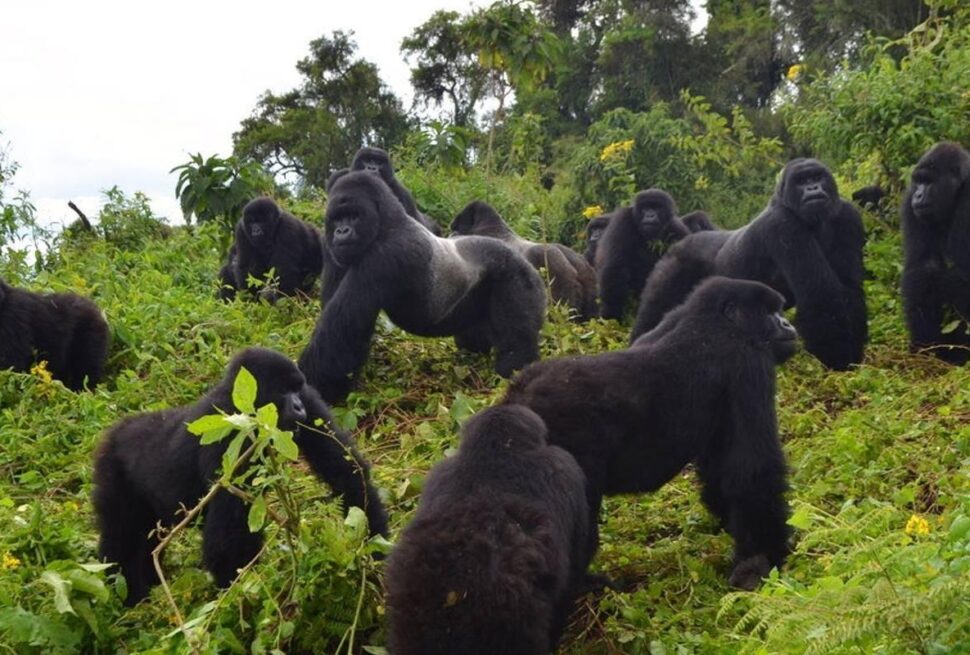
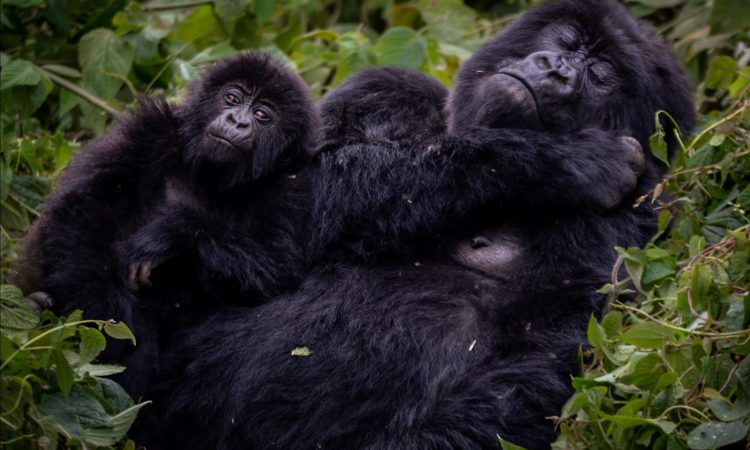
Three meters away, a 200-kilogram silverback lounges in dappled sunlight—utterly unfazed, completely dry-looking, radiating calm. Which begs the question every curious traveler eventually asks: do gorillas sweat like we do?
No, gorillas do not sweat the way humans do. While they possess some sweat glands, they lack the widespread eccrine glands humans use for full-body cooling.
Instead, gorillas rely on behavioral adaptations—resting in the shade, panting, and seeking water—to regulate their body temperature.
Gorillas have sweat glands, particularly in areas such as their hands, feet and armpits, but their thick body hair limits how effectively sweat can cool the skin.
Instead, gorillas primarily regulate heat through resting in shaded rainforest habitats, reducing activity, and behavioral adaptations.
Mountain gorillas living in Uganda and Rwanda are adapted to cool, high-altitude forests, where temperatures are generally moderate.
Understanding how gorillas regulate body temperature provides valuable insight into their behavior, physiology and adaptation to their natural habitat.
But here’s the twist: while the gorillas stay cool, you won’t. On a mountain gorilla trek in Uganda or Rwanda, your body will work—and sweat—overtime.
This guide decodes the science of gorilla thermoregulation, then shows you exactly how to prepare your body, your gear, and your booking for a humid jungle trek.
👉 Check 2026 Gorilla Permit Availability with GoSilverback Gorilla Safaris →
The Science: Do Apes and Gorillas Have Sweat Glands?
To understand gorilla sweat glands, you first need to understand the two gland types mammals use.
Humans are the sweating champions of the primate world. Our skin carries roughly 2 to 4 million eccrine glands, which secrete a watery fluid that evaporates off the skin and dumps excess heat—the process scientists call evaporative cooling.
It’s why you can run a marathon in daylight and survive.
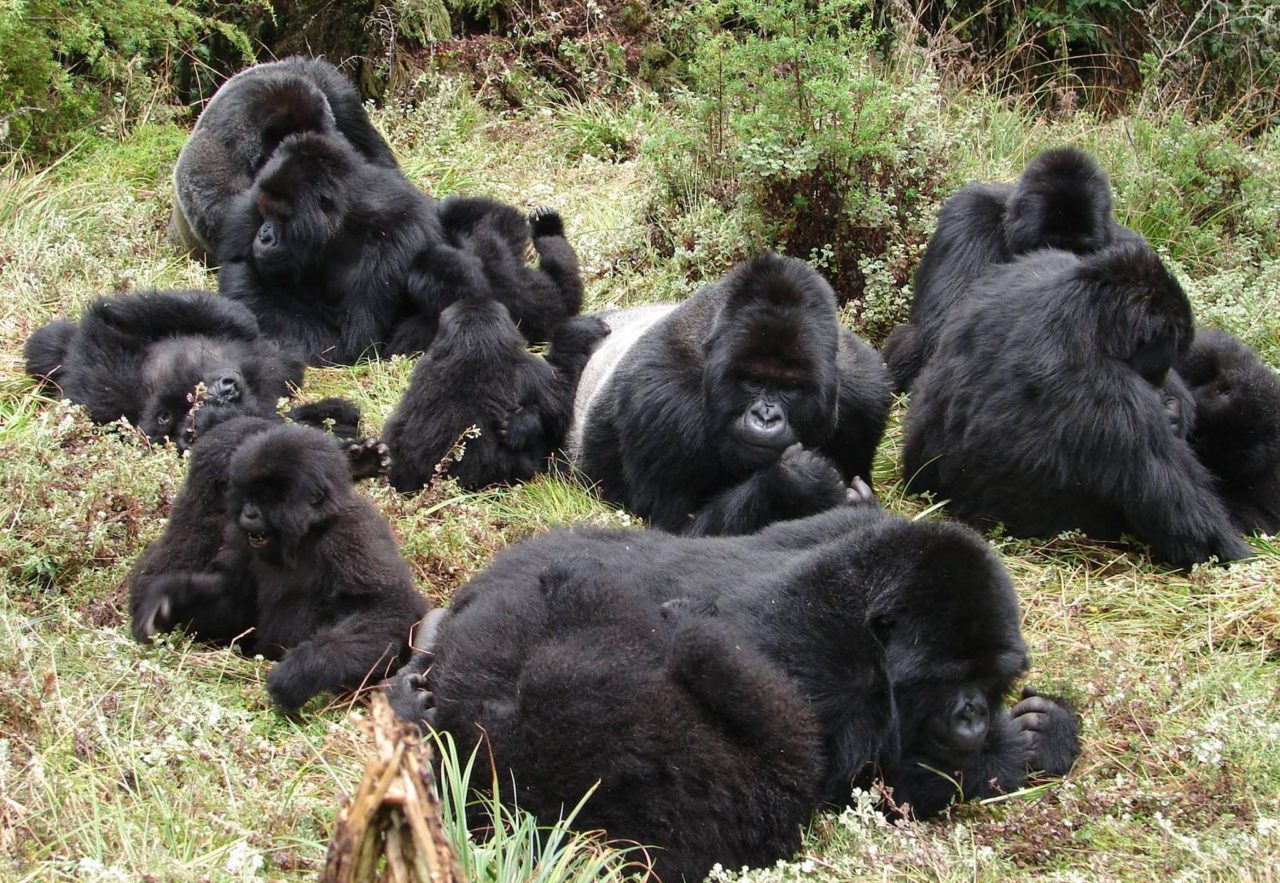
Gorillas, chimpanzees, bonobos, and orangutans play by different rules. Great apes carry predominantly apocrine glands—scent glands tied to hair follicles—plus only sparse eccrine glands confined to the palms, soles, and friction areas.
The result? A gorilla’s skin does not bead with cooling sweat the way yours does. Their fur-covered bodies simply were never engineered for full-body evaporative cooling.
Why Palms and Soles? Grip, Not Cooling
So why do gorillas have sweaty hands at all? Evolution assigned those glands a different job: grip enhancement.
A light film of moisture on the palms and soles increases friction for climbing, knuckle-walking, foraging, and infant clinging.
When a baby gorilla grips its mother’s fur or a silverback steadies himself on a slick branch, sweaty palms are the safety system—not the air conditioning.
Lowland vs. Mountain Gorillas: Two Climates, Two Strategies
- Eastern lowland gorillas (Gorilla beringei graueri) inhabit hot, humid lowland forests in the DR Congo, where they lean heavily on shade, water, and inactivity to manage heat.
- Mountain gorillas (Gorilla beringei beringei) live at 2,500m–4,000m elevation in the Virunga Massif and Bwindi Impenetrable Forest, where temperatures hover between 10°C and 25°C (50°F–77°F). In this cool, misty montane world, extreme heat stress is rare—which is precisely why full-body sweating never evolved as a survival necessity.
So if gorillas can’t sweat their way cool, how do they handle a hot afternoon? The answer is behavior, not biology.
How Do Gorillas Cool Down? (Behavioral Thermoregulation)
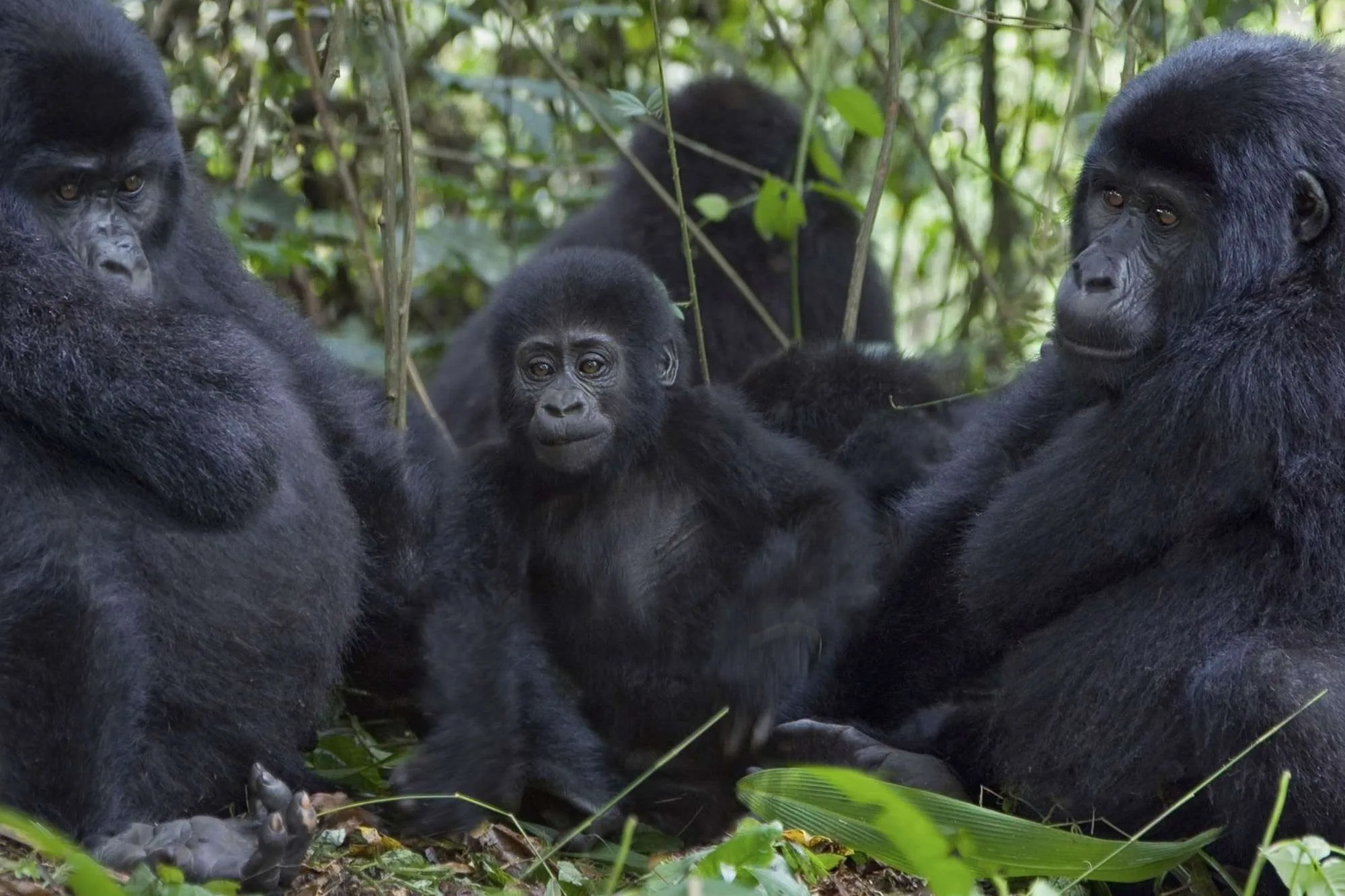
Without full-body evaporative cooling, gorillas practice behavioral thermoregulation—a daily toolkit of habits that manage heat load before it becomes dangerous.
- Shade seeking and inactivity. During the warmest hours (roughly 10:30 to 14:00), gorillas settle into their midday rest. Less movement means less metabolic heat production. This siesta is also prime viewing time for trekkers: grooming, play, and nursing happen now.
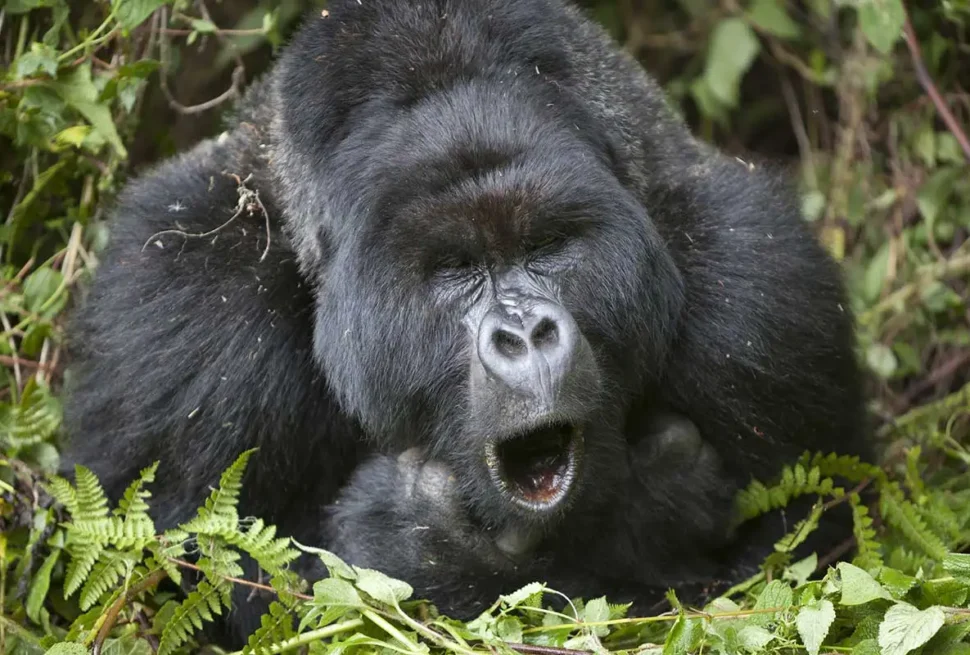
- Panting and respiration. Gorillas release excess heat through the lungs and moist surfaces of the mouth—open-mouth breathing and gentle panting act as a partial substitute for sweating.
- Water and mud. On warmer days, gorillas wade into streams or roll in mud. Mud works as a cooling evaporative layer, a natural sunscreen, and armor against biting insects—all in one.
- Postural changes. Gorillas sprawl in shade to radiate heat away from the body, or huddle together for warmth in the cold dawn mist. Body position is their thermostat.
Human Cooling vs. Gorilla Cooling: At a Glance
|
Cooling Method |
Humans |
Gorillas |
|
Full-body sweat glands |
Yes (2–4 million eccrine glands) |
No (palms/soles only) |
|
Primary cooling |
Evaporative sweat |
Shade, rest, panting |
|
Heat-of-day strategy |
Keep moving, keep sweating |
Midday siesta |
|
Water use |
Drink it |
Wade in it, wallow in mud |
|
Body positioning |
Minor role |
Major role (sprawl or huddle) |
Understanding these behaviors doesn’t just satisfy curiosity—it tells your ranger guide where the family will be, and tells you what you’ll witness during your one-hour gorilla encounter.
👉 Watch Gorilla Behavior Live — Book a Guided Trek with GoSilverback →
The Trekker’s Reality: Why YOU Will Sweat on a Gorilla Trek
Here is the pivot every first-time trekker misses: the gorillas have mastered staying cool without sweating. Your body has no such luxury.
1. The Jungle Microclimate
High altitude does not mean dry air. The montane rainforests of Bwindi Impenetrable National Park and Volcanoes National Park are wrapped in humidity that frequently exceeds 80%.
In high humidity, sweat refuses to evaporate efficiently—and evaporation is the only way human sweat cools you. The result: treks feel far more exhausting than their distance suggests, and sweat simply accumulates.
2. The Physical Exertion
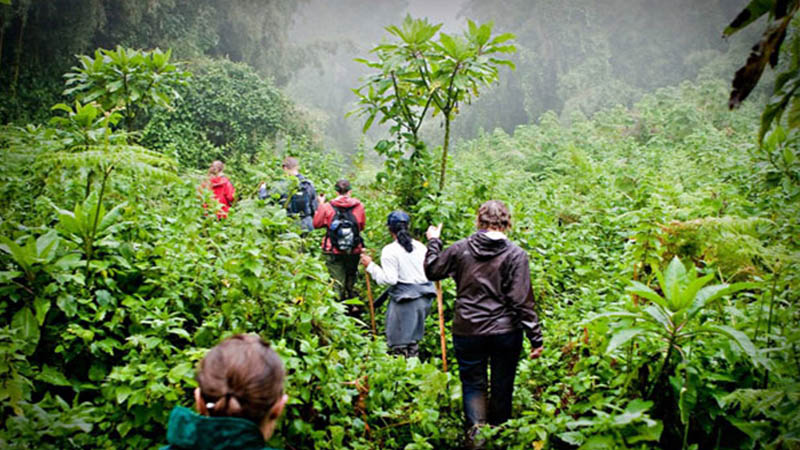
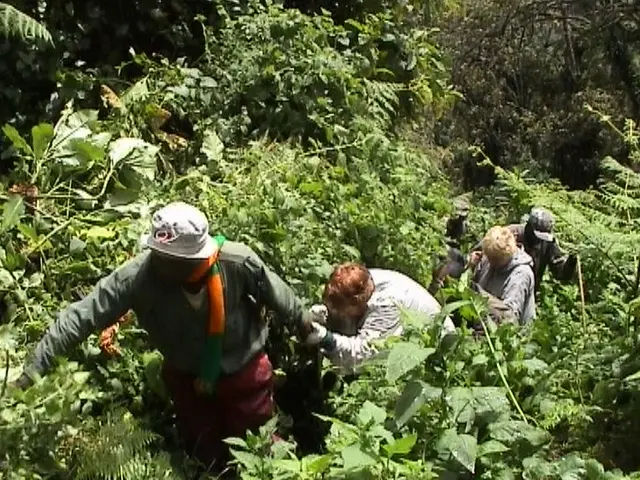
Now add the terrain. Gorilla trekking trails climb steep, muddy, 45-degree volcanic slopes through tangled undergrowth and stinging nettles, at elevations above 2,500 meters, where thinner air forces your heart and lungs to work harder.
Layer on the mandatory protective clothing—long sleeves, gaiters, boots—and a trek lasting anywhere from 2 to 8 hours, and heavy sweating is guaranteed. Most trekkers soak through a base layer before the first silverback sighting.
The consequences are real: chafing, blisters, dehydration, fogged camera lenses, and salt-crusted shirts. Preparation is not optional—it is the difference between a miserable hike and a magical encounter.
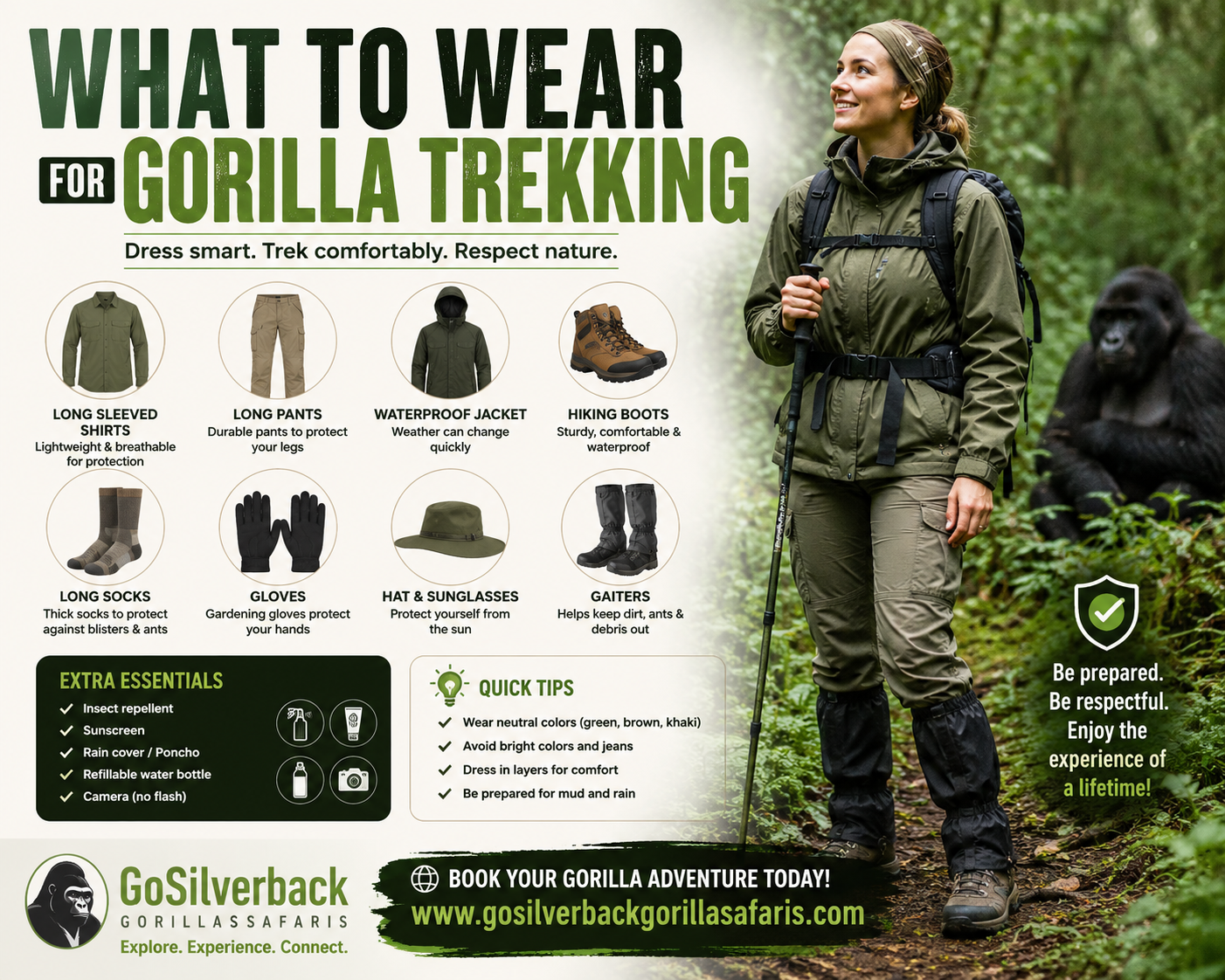
What to Wear: Beating the Jungle Heat & Humidity
Your wardrobe is your cooling system. Build it like a professional.
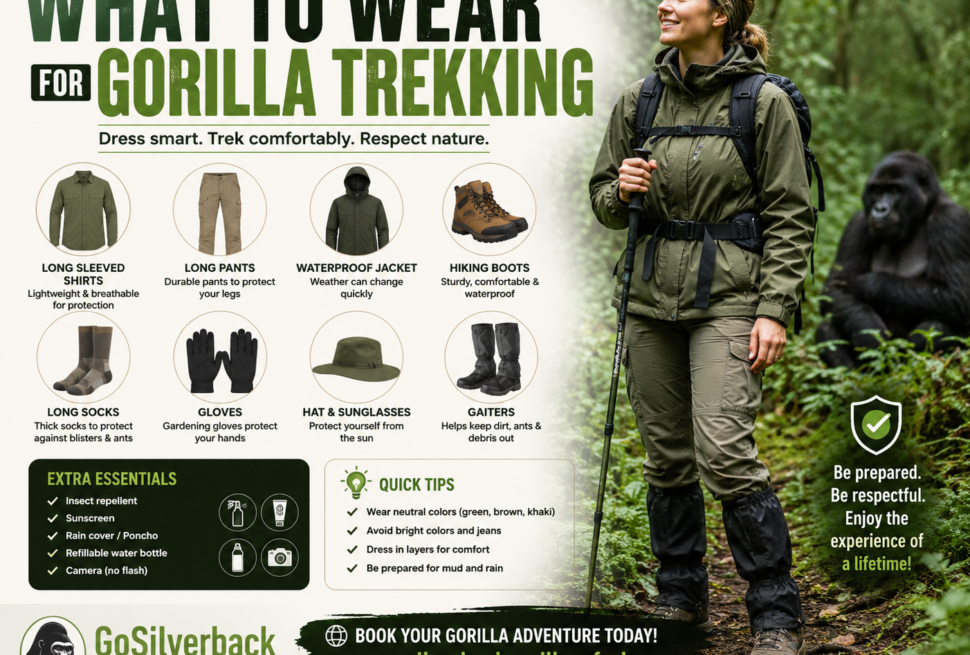
1. The Golden Rule: NO COTTON
Cotton traps sweat, stays wet for hours, causes chafing, and chills you at altitude. Choose moisture-wicking synthetics or merino wool instead.
2. Tops
Pack lightweight, moisture-wicking, long-sleeved shirts in neutral colors—khaki, olive, forest green.
Long sleeves shield you from sweat-induced chafing, stinging nettles, and equatorial sun. Avoid blue and black, which attract tsetse flies.
3. Bottoms
Choose quick-dry trekking trousers; zip-off convertibles let you regulate temperature as the trail climbs and descends. Reinforced knees help when you crouch on muddy slopes during the encounter.
4. Footwear
Waterproof, breathable hiking boots—broken in weeks before departure—paired with merino wool socks.
Wool regulates temperature, wicks moisture, and prevents blisters even when soaked. Add gaiters to block mud, nettles, and leeches.
5. Hydration Strategy
Carry a minimum of 2–3 liters of water in a hands-free hydration bladder, and add electrolyte powders to replace the sodium and potassium your sweat strips away. Sip continuously; never gamble on rest-stop gulping.
Recommended Gear at a Glance
|
Gear Item |
Why It Matters |
GoSilverback Tip |
|
Moisture-wicking long-sleeve shirt |
Moves sweat off skin fast |
Rentable at our Kigali & Kampala gear desks |
|
Quick-dry zip-off trousers |
On-trail temperature control |
Neutral colors only |
|
Merino wool socks |
Blister-proof even when wet |
Free pair with every permit package |
|
Waterproof breathable boots |
Grip on 45° mud slopes |
Break in 4–6 weeks pre-trek |
|
3L hydration bladder |
Hands-free sipping |
Filled fresh at trek briefing |
|
Electrolyte tablets |
Replaces salts lost to sweat |
Included in all GoSilverback kits |
Related Read | What to Wear for Gorilla Trekking
👉 Rent or Buy Trek-Ready Gear Through GoSilverback’s Prep Desk →
Best Time to Trek: Navigating Weather, Heat, and Rain
Season choice changes your sweat load more than any shirt you own.
- Dry seasons (June–September and December–February): Less rain, firmer trails, clearer photography light. But humidity still makes the midday sun feel hot on the climb—early-morning briefings are your friend. Peak demand: book permits 3–6 months ahead.
- Wet seasons (March–May and October–November): Cooler air, lush emerald forest, fewer crowds, and occasional gorilla permit discounts in Uganda. The trade-off: deeper mud, slipperier slopes, more leeches—and more exertion, which means more sweat.
The “Sweat Factor” by Sector
|
Destination |
Elevation & Climate |
Sweat Factor |
|
Bwindi – Rushaga (Uganda) |
Lower, hotter, more humid |
High |
|
Bwindi – Buhoma / Ruhija / Nkuringo |
Mid-elevation montane forest |
Medium–High |
|
Volcanoes NP (Rwanda) |
Higher, cooler volcanic slopes |
Medium |
Gorillas remain active year-round; what changes is your comfort. Match the season and sector to your fitness, photography goals, and heat tolerance.
Related Read | Best Time To Trel Gorillas
👉 Prefer a Cooler, Drier Trek? Check Permit Availability with GoSilverback →
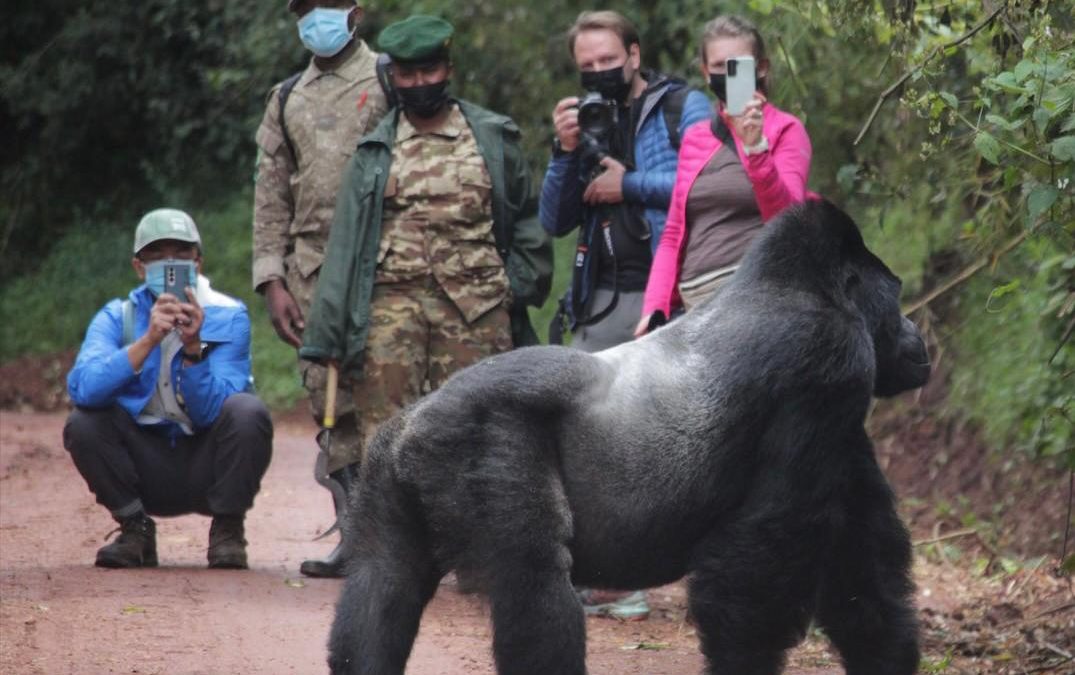
Health, Hydration, and Altitude Sickness
Sweat is not just uncomfortable—it is a physiological tax. Dehydration from sweating mimics and worsens altitude sickness: headache, nausea, dizziness, and fatigue all overlap.
Above 2,500 meters, faster breathing at thinner air adds respiratory water loss on top of sweat loss, compounding the deficit.
Your 48-Hour Pre-Trek Hydration Protocol
- 48 hours out: Drink 3–4 liters of water daily; cut alcohol and excess caffeine.
- 24 hours out: Add electrolytes to meals; eat potassium-rich local foods like bananas and avocados.
- Trek morning: Sip 500ml before the briefing—don’t chug.
- On the trail: Sip 150–250ml every 15–20 minutes from your bladder.
- Post-trek: Rehydrate with electrolytes plus protein; pale-straw urine means you got it right.
Finally, carry comprehensive travel insurance covering high-altitude trekking and emergency medical evacuation.
It is non-negotiable in montane terrain—and GoSilverback‘s safari experts can recommend trusted policies for travelers from every region.
👉 Ask a GoSilverback Expert About Fitness, Altitude & Insurance Prep →
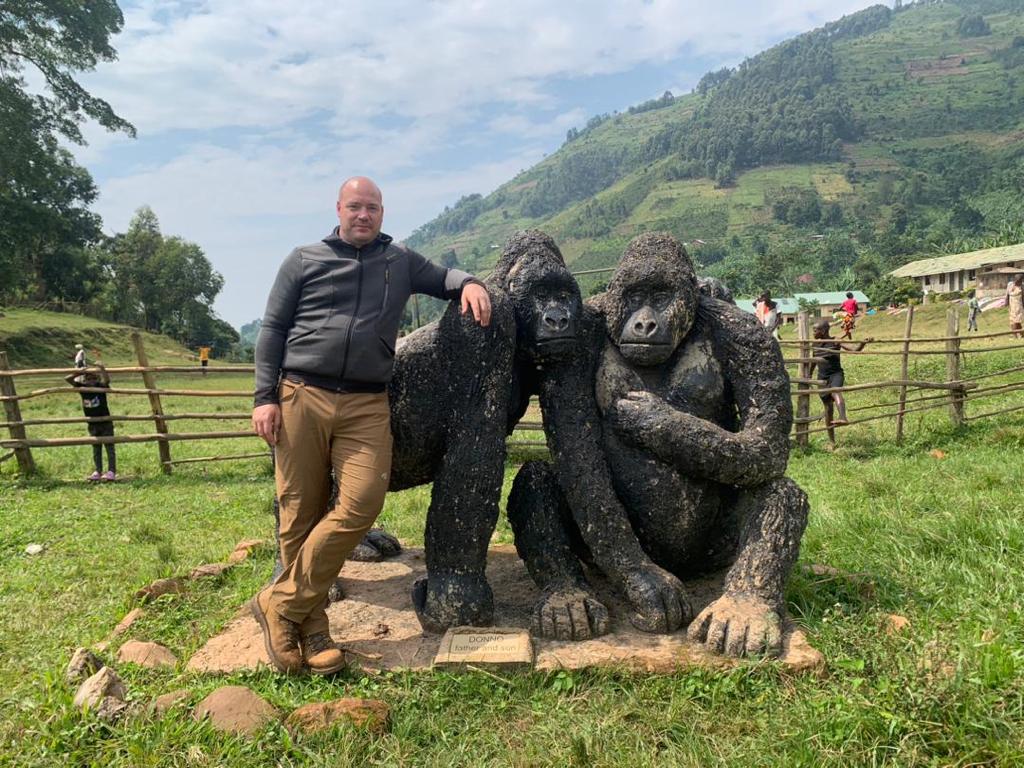
Conservation Angle: Climate Change and Gorilla Habitats
Heat matters beyond your hike. Shifting climate patterns and rising temperatures across the Virunga Massif and Bwindi are altering the vegetation mountain gorillas eat—bamboo shoots, celery herbs, and fruiting trees all respond to rainfall and temperature changes.
With only around 1,063 mountain gorillas left in the wild, climate resilience is now a frontline conservation issue.
This is where your trek becomes powerful. Gorilla permit revenue funds ranger patrols, veterinary intervention, habitat restoration, and community revenue-sharing that keeps local families invested in protection.
Booking with eco-conscious operators like GoSilverback Gorilla Safaris channels your travel spend directly into habitat preservation and climate-resilience research. You don’t just witness the jungle—you help keep it cool, wild, and alive.
Related Read | Mountain Gorilla Population | Gorilla Trekking Permit Explained
Frequently Asked Questions About Gorillas and Heat
Do gorillas drink water?
Yes—but they get most of their water from their herbivorous diet of leaves, stems, and shoots. Direct drinking is occasional, often from dew, rain-filled plants, or forest streams.
Do monkeys sweat?
Similar to gorillas, most monkeys lack full-body eccrine glands and rely on panting, shade-seeking, and behavioral cooling. Their sweaty palms serve grip, not temperature control.
What temperature do mountain gorillas live in?
Typically between 10°C and 25°C (50°F–77°F), in montane forest at 2,500m–4,000m elevation in Uganda, Rwanda, and the DR Congo.
Can gorillas get heatstroke?
Rare in the wild thanks to behavioral adaptation—shade, rest, and water. Heatstroke is mainly a risk in captive environments without proper shade, hydration, and cooling.
Ready to Brave the Jungle? Book Your Trek Today
Gorillas have mastered the art of staying cool in the jungle without breaking a sweat. Now it’s your turn to master the trek: wick the sweat, hydrate smart, pace the climb, and book with people who know these forests intimately.
The GoSilverback Promise: we handle gorilla permits, ground transfers, accommodation, expert ranger coordination, and gear guidance—so you can focus on the hike and that magical, silent hour with the silverback.
Whether you’re flying in from the USA, Canada, the UK, Europe, Latin America, Asia, China, Oceania, or the Middle East, our team builds your journey door-to-door.
Remember the hard number: only 8 permits are issued per gorilla family, per day. Peak-season dates vanish months in advance. Curiosity brought you here—the forest is waiting.
🦍 SECURE YOUR 2026 GORILLA PERMIT →
🦍 TALK TO A SAFARI EXPERT ABOUT TREK DIFFICULTY →
🦍 VIEW UGANDA & RWANDA ITINERARIES →
Book your gorilla permit through GoSilverback Gorilla Safaris today. Wipe your brow, lace your boots, and come stand—sweating, smiling, speechless—in the presence of the gentle giants who never break a sweat.
Last updated: September 2026. Climate, permit, and seasonal data verified against Uganda Wildlife Authority (UWA) and Rwanda Development Board (RDB) guidance.