
Are Gorillas Aggressive Towards Humans? Expert Answer 2026 Guide
No. Gorillas are not naturally aggressive towards humans. In over 60 years of regulated gorilla tourism across Rwanda, Uganda, and the DR Congo, there has been zero recorded fatal gorilla-on-human attacks in the wild.
Mountain gorillas are gentle, highly social herbivores that avoid confrontation unless they feel their family is directly threatened.
When gorilla trekking safety rules are followed, the risk of injury is statistically near zero.
Last updated: September 2026. Reviewed by licensed safari guides and primatology sources.
If you are weighing whether to book a gorilla trekking safari—whether you’re flying in from New York, London, Toronto, Sydney, São Paulo, Dubai, Tokyo, or Beijing—this guide walks you through the science, the statistics, the gorilla body language, and the exact safety protocols that make gorilla encounters one of the safest wildlife experiences on Earth.
Check Gorilla Trek Permit Availability with GoSilverback Gorilla Safaris.

The Short Answer: Gorilla Temperament by the Numbers
Let’s put the fear to rest with hard data before anything else. When evaluating mountain gorilla safety, the statistics speak for themselves:
- ~1,063 mountain gorillas remain in the wild (2024 IUCN census), split across the Virunga Massif and Bwindi Impenetrable Forest.
- Roughly 100,000+ tourists trek to see them every year across Rwanda, Uganda, and the DRC.
- Zero fatal attacks on humans have been recorded during regulated treks since tourism began in the 1970s.
- Non-fatal incidents (a playful juvenile swat, a curious infant grabbing a backpack strap) occur fewer than 5 times per year across all three countries combined, and none result in serious injury.
- Gorillas spend 30% of their day eating, 30% resting, and 20% socialising. Aggression accounts for less than 1% of observed behaviour in habituated gorilla families.
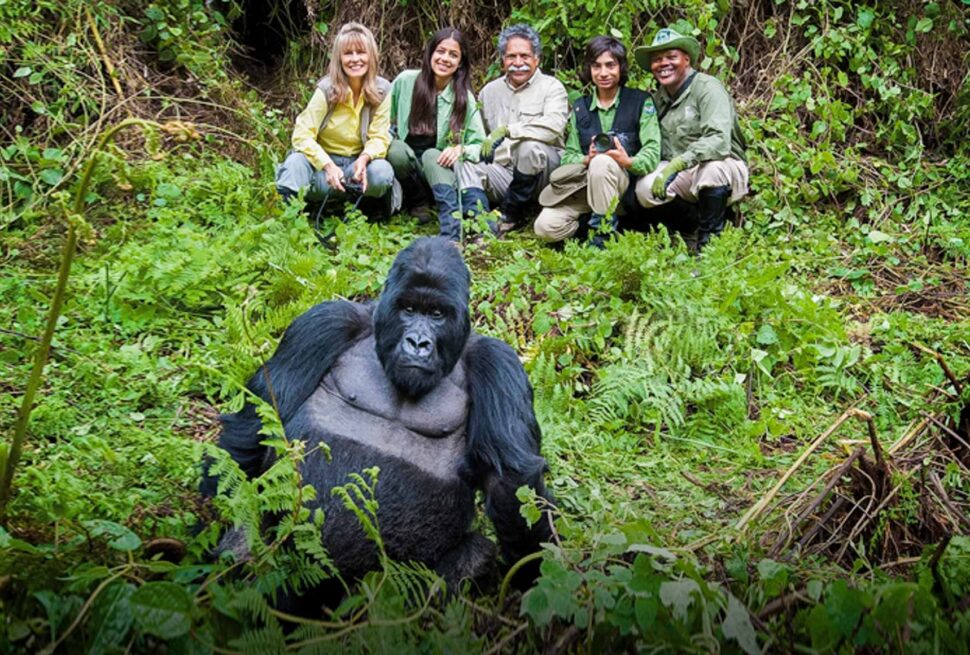
Gorillas are not aggressive towards humans. In 60+ years of regulated gorilla trekking, no human has been killed by a wild gorilla. Mountain gorillas are herbivores that avoid confrontation. Strict park rules—8-visitor caps, armed rangers, and a 7-metre distance—keep encounters safe.
Read the full safety breakdown below, or jump straight to booking.
Why Gorillas Are NOT Naturally Aggressive
Understanding gorilla biology dismantles the “King Kong” myth Hollywood built. To truly understand gorilla behaviour towards humans, we must look at their evolutionary makeup.
- They are herbivores. Mountain gorillas eat wild celery, stinging nettles, bamboo shoots, and fruit. They have no predatory drive, no chase instinct, and no reason to view a human as prey. Their teeth are designed for grinding vegetation, not tearing flesh.
- They are socially cautious, not territorial. A gorilla troop’s home range overlaps with neighbouring families. Disputes are settled through vocalisations, chest-beating displays, and bluff charges—not physical combat. Actual lethal fights between gorillas are themselves rare, documented only in extreme cases of competing silverbacks vying for a group.
- They fear humans more than we fear them. Unhabituated gorillas flee at the sound of footsteps. Decades of anti-poaching patrols mean wild gorillas associate humans with potential threat, not opportunity. Their default response is avoidance, not attack.
- Silverbacks are protectors, not predators. A silverback’s primary role is to mediate family disputes, choose feeding sites, and shield infants. Aggression is a last resort, deployed only when the family unit is cornered and no retreat path exists.
Dian Fossey, who lived among mountain gorillas for 18 years in the Virungas, wrote: “The gorilla is the most maligned of the great apes… in reality, they are gentle, contemplative creatures.” Modern primatology confirms her observation with six decades of additional field data.
The bottom line: everything about gorilla evolution, diet, and social structure points away from aggression and toward coexistence.
Related Read | Silverback Gorilla vs Human | Silverback Gorilla Behaviour | Silverback Gorilla Facts and Biology.
Silverback Charges: What Triggers Them & What They Mean
The single behaviour that frightens trekkers most is the silverback charge. Here’s what’s actually happening when a 400-pound silverback beats his chest and rushes forward.
What triggers a charge?
- A human (or another gorilla) breaks the 7-metre / 23-foot distance rule.
- Direct, prolonged eye contact, which gorillas interpret as a dominance challenge.
- Sudden loud noises, flash photography, or a trekker standing over the silverback.
- A person mimicking gorilla vocalisations or beating their own chest.
What does a charge look like?
- The silverback stands bipedal (up to 1.7 m / 5.5 ft tall), beats his chest, roars, and rushes forward.
- In over 95% of observed charges, he stops short, veers away, or slams the ground a few feet from the perceived threat. It is a bluff display designed to intimidate, not injure.
What it does NOT mean
- It is not a hunting behaviour.
- It is not “rage.” It is a calculated warning: “Back away from my family.”
Book a Trek Led by Certified Rangers – GoSilverback Gorilla Safaris.
Has a Gorilla Ever Killed a Human? The Real Record
No. There is no verified case of a wild mountain gorilla killing a human during a regulated trek in Rwanda, Uganda, or the DRC.
The incidents people sometimes confuse with “gorilla attacks” fall into three distinct categories:
1. Captivity incidents.
Zoo or sanctuary gorillas—the 1986 Jersey Zoo event, the 2016 Cincinnati Zoo shooting of Harambe—involve captive animals in artificial, high-stress enclosures. These are not representative of wild gorilla behaviour and cannot be extrapolated to a forest trek.
2. Poacher conflicts.
Historically, gorillas injured by wire snares or cornered by armed poachers have lashed out defensively. This is a trauma response, not natural temperament. It has no bearing on a regulated tourism encounter.
3. Habituation-period encounters.
During the multi-year habituation process, before gorillas accept human presence, researchers occasionally receive warning swats. These occur before tourism begins and are managed by experienced primatologists with protocols far stricter than any trekking briefing.
For the tourist stepping off a transfer vehicle at Volcanoes National Park or Bwindi, the risk profile is comparable to a guided forest walk in any national park. The data is unambiguous.
Related Read | Gorilla Poaching Statistics | Gorilla Habituation Experience.

Gorilla Body Language: Reading the Warning Signs
Gorillas communicate constantly. Learning a few cues makes your gorilla safari richer and safer.
|
Signal |
Meaning |
Your Response |
|
Relaxed grooming, feeding, infants playing |
Content; you are welcome |
Observe quietly, enjoy the moment |
|
Silverback stands upright, beats chest |
Alert / mild warning |
Lower your gaze, step back slowly |
|
Loud hoot + ground slap |
Escalating irritation |
Follow ranger instruction immediately |
|
Direct, unbroken stare from silverback |
Dominance challenge perceived |
Break eye contact, look down |
|
Gorilla turns its back and walks away |
“I’m done; leave me alone” |
Do not follow; let the ranger redirect |
|
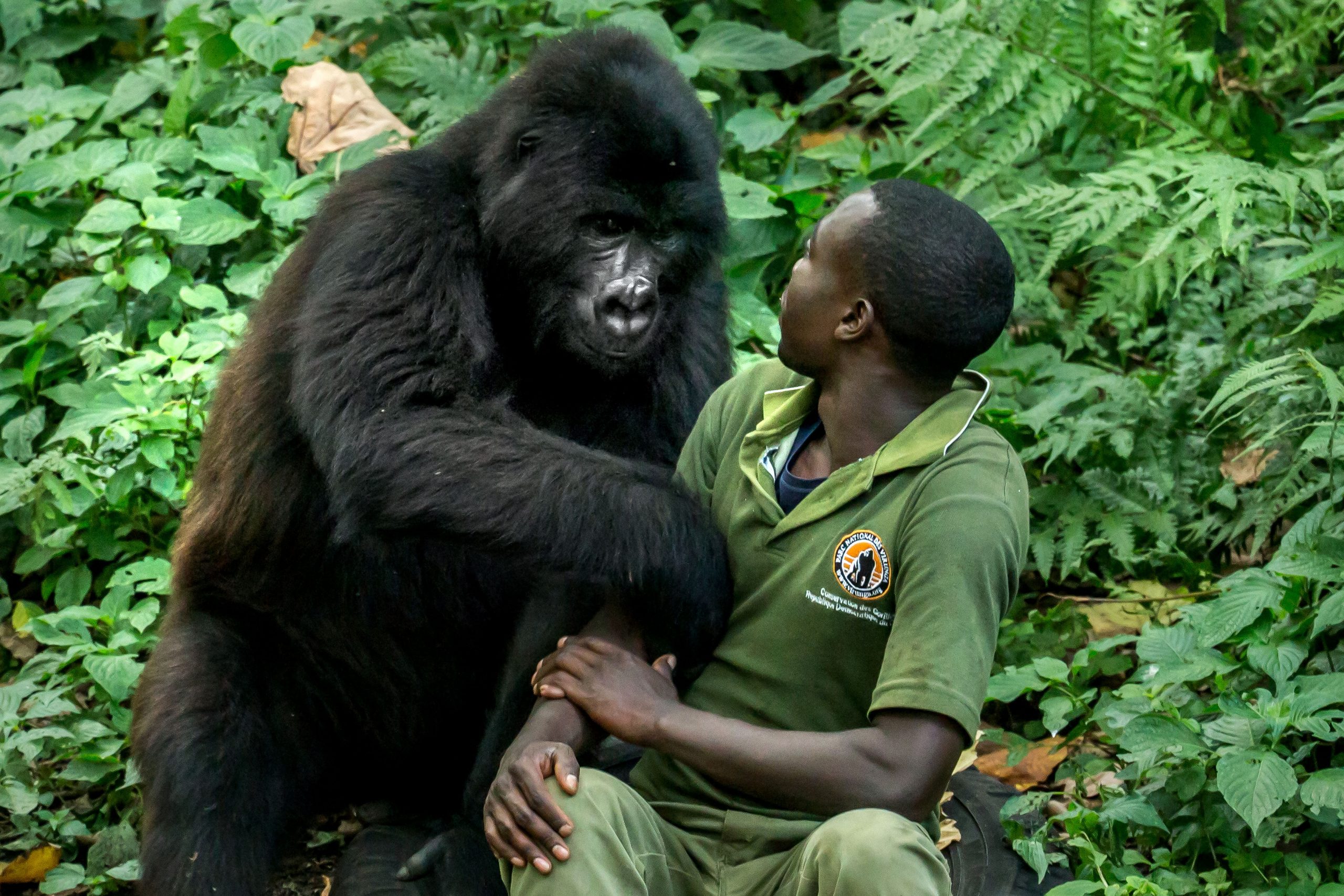
Juvenile approaches and touches your boot |
Curiosity, not aggression |
Stay still; do not grab or pull away sharply |
Key rule: Your ranger reads these signals in real time. They have logged thousands of hours with their assigned gorilla family. Trust them completely. You do not need to become a primatologist; you simply need to follow the person who already is one.
Related Read | Gorilla Communication Sounds | Gorilla Family.

The 7 Rules That Keep You Safe on a Gorilla Trek
- Maintain a 7-metre (23-foot) minimum distance from the nearest gorilla at all times. This protects both you and the gorillas from disease transmission.
- Group size is capped at 8 visitors per gorilla family per day. Fewer humans equal less stress on the animals and a more intimate experience for you.
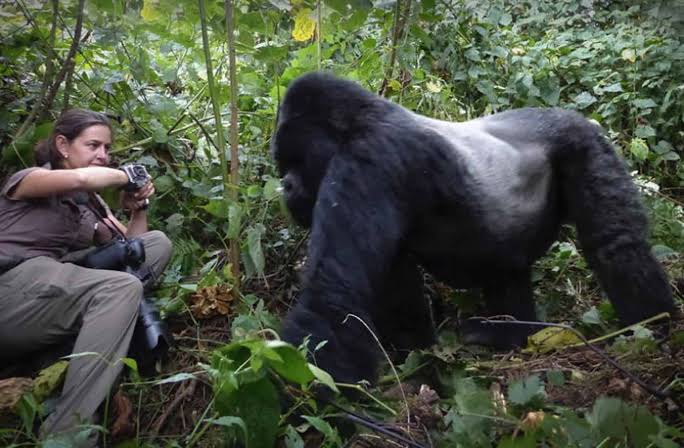
- No flash photography. Turn off autofocus-assist beams. Use a lens of 200 mm or longer to capture stunning close-ups without invading their space.
- Do not eat, drink, or smoke within the gorilla vicinity. Food scents provoke curiosity and break the distance rule.
- If you are ill—especially with a cold, flu, or respiratory infection—you must not trek. Gorillas share 98.3% of human DNA and are highly susceptible to our pathogens. A common cold can be lethal to an infant gorilla.
- Speak in whispers. No sudden movements. No pointing. Crouch to appear smaller if a gorilla approaches you.
- Follow your ranger’s instructions instantly and without question. They carry a sidearm as a precaution but have never needed to use it on a gorilla during a tourist trek.
These rules are briefed at park HQ before every single trek. You will be reminded again at the trailhead. There is no ambiguity, no guesswork. You will know exactly what to do before you take your first step into the forest.
Related Read | Gorilla Trekking Rules and Regulations
Book Your Trek and Receive a Pre-Trek Safety Briefing – GoSilverback Gorilla Safaris.
What To Do If a Gorilla Charges You
On the extraordinarily rare chance a silverback bluff-charges in your direction, follow these exact steps:
- Do NOT run. Running triggers a chase instinct and signals fear. You cannot outrun a gorilla (they can reach speeds of 40 km/h / 25 mph).
- Crouch low. Make yourself small. Lower your head, bend your knees, and make yourself look non-threatening.
- Avert your eyes. Look at the ground. Direct eye contact is a challenge in primate body language. Do not stare back.
- Stay silent or hum softly. Do not scream. Do not shout. Soft, steady sound signals you are not a threat.
- Slowly back away only once the gorilla has stopped and turned. Do not turn your back while he is still facing you.
- Follow your ranger’s lead. They will position themselves between you and the animal and guide the group out calmly.
Here is the critical context: trekkers who follow the 7 rules above never reach this scenario.
The charge sequence is a response to a rule violation, not a random event. Follow the rules, and the silverback will return to chewing celery before your heart rate does.
Habituation: Why Trekking Gorillas Behave Differently
The gorillas you visit are not “wild” in the way an uncontacted troop is. They are habituated: a process that takes 2–5 years during which researchers and trackers spend increasing time near the family until the gorillas accept calm human presence as neutral.
- Rwanda’s Volcanoes National Park has 12 fully habituated families.
- Uganda’s Bwindi Impenetrable Forest has 19 habituated families across four sectors (Buhoma, Ruhija, Rushaga, Nkuringo).
- The DRC’s Virunga National Park has 8 habituated families.
Habituated gorillas have been exposed to hundreds of calm, rule-following humans per year for decades. They associate trekkers with quiet, non-threatening observation.
This is why encounters are serene, not tense. The gorillas you meet have, in many cases, been hosting visitors since before you were born. You are a guest in a routine they have long accepted.
Related Read | Gorilla Habituation Experience.

Gorilla Attacks in Captivity vs the Wild
It is essential to separate these two contexts, because conflating them is the single biggest source of misplaced fear.
1. Captivity:
Zoo gorillas live in confined spaces, cannot retreat, and may experience chronic stress.
The handful of well-known incidents—Harambe (Cincinnati, 2016), Binti Jua (Chicago, 1996)—occurred in artificial enclosures and do not reflect wild behaviour. A zoo gorilla that cannot climb away or disappear into dense forest has fewer options than its wild counterpart.
The wild: Gorillas can flee, climb, and create distance. They choose avoidance over confrontation.
With trekking rules in place, the human is a passive observer, not an intruder in a cage. The forest gives the gorilla every option to leave. It simply chooses to stay because you are not a threat.
If your mental image of gorilla aggression comes from zoo footage or films, discard it. The wild mountain gorilla you will meet in Bwindi or the Virungas is a fundamentally different animal in a fundamentally different context.
Is Gorilla Trekking Safe for Families, Solo Travelers & Seniors?
This question arrives in our inbox weekly from travelers across the USA, Canada, UK, Europe, Australia, Latin America, Asia, and the Middle East.
The answer is consistent:
- Families with children 15+: Safe and profoundly educational. The minimum age for gorilla trekking in Rwanda and Uganda is 15 years to ensure children can follow strict safety protocols.
- Solo travelers (including solo women): You trek in a group of 8 with armed rangers. The solo-safety rating is very high in Rwanda and Uganda, making it a top choice for solo female travelers.
- Seniors and moderate-fitness travelers: Request an easier, shorter trail at the morning briefing. Local porters ($10–$15) carry your daypack and physically assist you on steep, muddy sections.
- Travelers with mobility concerns: Rwanda’s Volcanoes NP offers the shortest, most accessible trails, sometimes allowing wheelchair access to the forest edge. Uganda’s Buhoma sector is the gentlest in Bwindi.
The universal truth: the rules protect you more than your own fitness does. The system is designed so that compliance—not athleticism—is what keeps you safe.
Explore Family, Solo & Senior-Friendly Gorilla Trek Packages

Conservation Angle: Why Protecting Gorillas Protects You
Every gorilla permit you purchase funds a conservation ecosystem that directly contributes to your safety:
- Anti-poaching patrols remove wire snares that injure gorillas and provoke defensive behaviour. Fewer injured gorillas means calmer families.
- Veterinary care via the Gorilla Doctors programme treats sick or injured individuals before stress escalates.
- Community revenue-sharing ensures local populations protect rather than hunt gorillas, reducing human-wildlife conflict at the forest boundary.
Mountain gorillas were downlisted from Critically Endangered to Endangered on the IUCN Red List in 2018—the only great ape whose population is rising.
Your trek fee directly sustains that trajectory. A healthy, well-funded conservation system produces calm, well-managed gorilla families and, by extension, safer treks for you.
Conservation and safety are not separate goals. They are the same goal, funded by the permit in your hand.
Related Read | Gorilla Trekking Conservation Impact | Gorilla Conservation Organizations | Mountain Gorilla Conservation Success | Mountain Gorilla Consevation Funding
Frequently Asked Questions – Are Gorillas Aggressive Towards Humans?
Are gorillas aggressive towards humans?
No. Wild mountain gorillas are gentle herbivores. In 60+ years of regulated trekking, there have been zero fatal attacks on tourists.
Can a gorilla kill a human?
Physically, a silverback possesses immense strength—estimated at 4 to 9 times that of an adult man. However, no wild gorilla has killed a human during a regulated trek. Aggression is a last-resort bluff, not a hunting behaviour.
What should I do if a silverback charges?
Crouch low, avert your eyes, stay silent, and do not run. Your ranger will manage the situation. Charges are almost always bluffs triggered by a broken distance rule.
Is gorilla trekking safe for children?
Yes, for ages 15 and above (the legal minimum in Rwanda and Uganda). Children must follow the same 7-metre and noise rules as adults.
Are gorillas in zoos more dangerous than wild gorillas?
Captivity increases stress and removes the gorilla’s ability to retreat, which can elevate defensive behaviour. Wild, habituated gorillas encountered on regulated treks are markedly calmer.
Can I touch a gorilla?
No. The 7-metre rule is absolute. Even habituated gorillas should not be touched, for your safety and theirs (disease transmission risk).
How close do gorillas actually get during a trek?
The rule is 7 m / 23 ft. In practice, curious juveniles occasionally wander closer. If one does, stay still and let the ranger guide the interaction.
Do I need travel insurance for gorilla trekking?
Yes. Choose a policy that covers emergency medical evacuation at altitude. It is a precaution, not an expectation of danger.
Final Verdict & Your Next Step
Gorillas are not aggressive towards humans. They are cautious, intelligent, family-oriented herbivores whose default response to a stranger is to look, assess, and return to eating celery.
Sixty years of tourism data, peer-reviewed primatology, and the daily testimony of hundreds of rangers all point to the same conclusion: a gorilla trek is one of the safest, most awe-inspiring wildlife encounters available anywhere on the planet.
The silverback will not charge you. He will sit, groom his infant, chew a stalk of wild celery, and—perhaps—glance up and hold your gaze for three long seconds.
And in those three seconds, you will understand why every person who has ever made that trek calls it the single most powerful hour of their life.
The only question left is not “Are gorillas aggressive?”
It’s “When are you going?”
BOOK YOUR GORILLA TREK PERMIT NOW – GoSilverback Gorilla Safaris.
GoSilverback Gorilla Safaris is a licensed, conservation-first safari operator specialising in gorilla trekking in Rwanda, Uganda, and the DRC.
We handle your permit, lodge, airport transfers, and trekking-group placement so you can focus on the encounter, not the logistics.
🦍 Permits secured directly with RDB, UWA & ICCN—no middlemen, no markups.
🌍 Serving travelers from the USA, Canada, UK, Europe, Latin America, Australia, Asia, China, and the Middle East.
🛡️ Every trek includes a certified ranger briefing, porter option, and 24/7 on-ground support.
⚡ Free, no-obligation quote delivered within 24 hours.
Whether you’re a solo traveler from Toronto, a family from London, a couple from São Paulo, a group of friends from Sydney, or an adventurer from Dubai—your silverback is waiting, and he is not aggressive.
He is simply, magnificently, himself.
Come and see.
Secure Your Gorilla Trekking Permit.
Check Free Gorilla Trek Safety & Packing Guide.
© 2026 GoSilverback Gorilla Safaris. Data sourced from the IUCN Red List, Dian Fossey Gorilla Fund, Rwanda Development Board (RDB), and Uganda Wildlife Authority (UWA). Last reviewed September 2026.