Do Gorillas Play? Discover the Fascinating Play Behavior of Mountain Gorillas Guide 2026
Yes, gorillas play. Mountain gorillas, especially infants and juveniles, engage in wrestling, chasing, tumbling, mock fighting, climbing, and other playful activities.
Gorilla play behavior is more than mere entertainment—it helps young gorillas develop physical coordination, communication skills, and vital social relationships within their family group.
Have you ever wondered whether the enormous, powerful mountain gorilla can behave like a playful child? During an Uganda gorilla trekking safari, visitors may witness young gorillas chasing one another, wrestling on the forest floor, climbing vegetation, or playfully interacting with adults.
Understanding these behaviors transforms a simple wildlife sighting into a profound window into primate intelligence.
Do Gorillas Really Play?
If you are asking, do gorillas play or do mountain gorillas play? The answer is an absolute yes. While all gorillas engage in social bonding, young gorillas are the most active players.
Their gorilla play behavior includes a wide array of energetic activities:
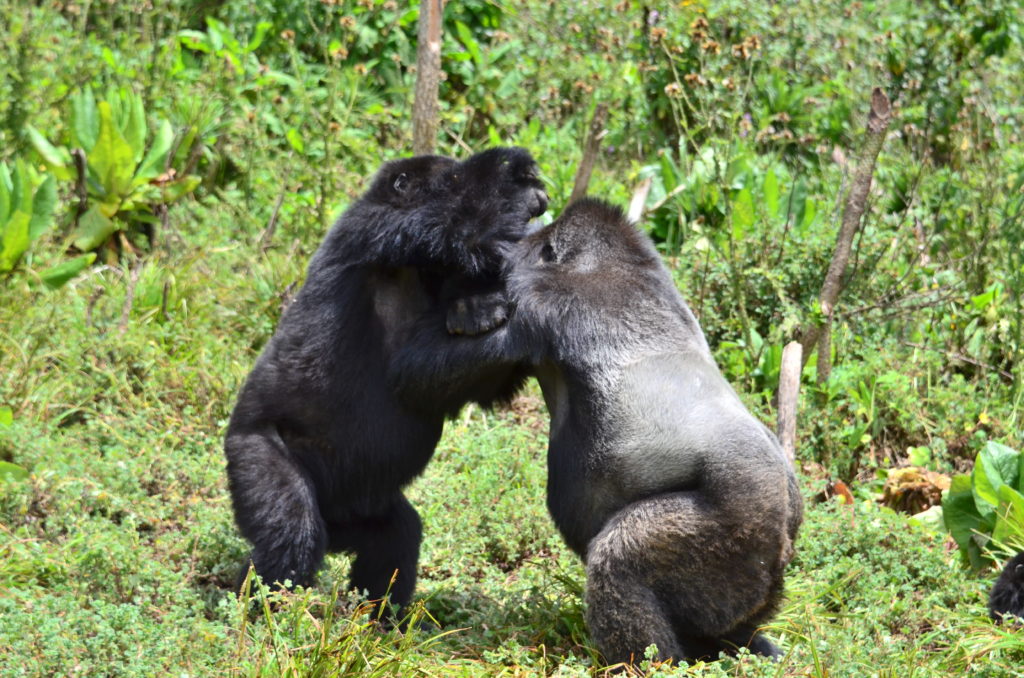
- Wrestling and mock fighting
- Chasing and tumbling
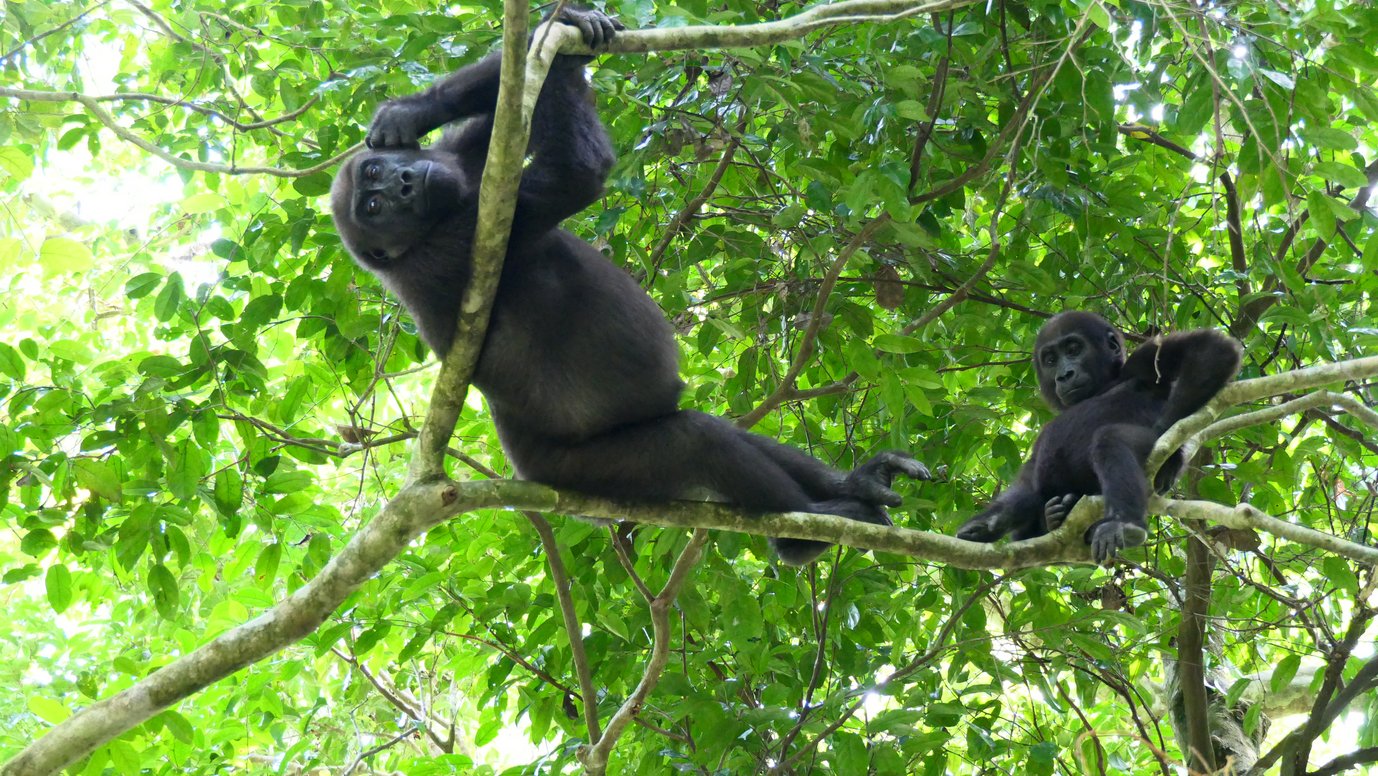
- Climbing and swinging through vegetation
- Rolling on the forest floor
- Playful biting and pulling
- Physical interaction with siblings and adults
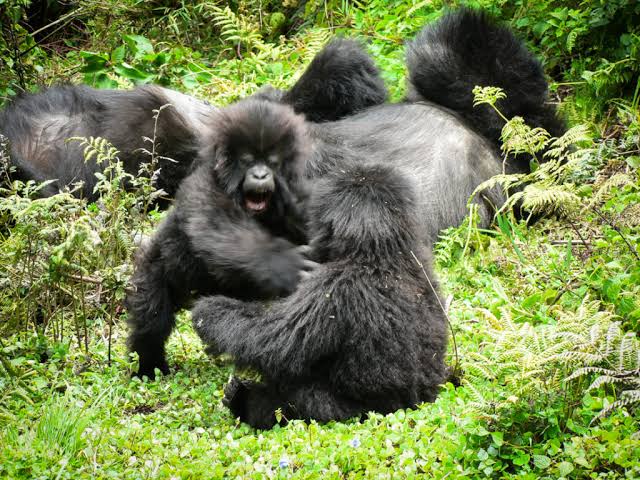
It is crucial to understand the difference between play fighting and genuine aggression. While mountain gorilla behavior can look intense to the untrained eye, play is characterized by relaxed body language and a lack of intent to harm.
These gorilla facts highlight that what looks like a fierce battle is often just a lively game.
Why Do Gorillas Play?
Gorilla play behavior serves several critical biological and social purposes. It is a vital developmental tool, not just a way to pass the time.
1. Play Helps Young Gorillas Develop Physical Skills
Through constant movement, play helps young gorillas develop essential physical traits, including:
- Strength and agility: Building the muscle required to navigate steep volcanic terrain.
- Balance and body control: Mastering the coordination needed for knuckle-walking and climbing.
- Climbing ability: Practicing the skills needed to forage in the canopy.
- Physical confidence: Learning the limits of their own bodies in a safe environment.
2. Play Teaches Gorillas Social Skills
Beyond physical fitness, play is a form of learning. It teaches young gorillas how to integrate into their social group by helping them learn:
- How to communicate effectively using subtle body language.
- How to cooperate with troop members.
- When physical contact becomes too rough and how to apologize.
- How to respond to social signals from adults and peers.
- How to establish and maintain lifelong relationships.
How Do Gorillas Play?
To understand mountain gorilla behavior, it helps to break down the specific ways they interact.
1. Gorilla Wrestling
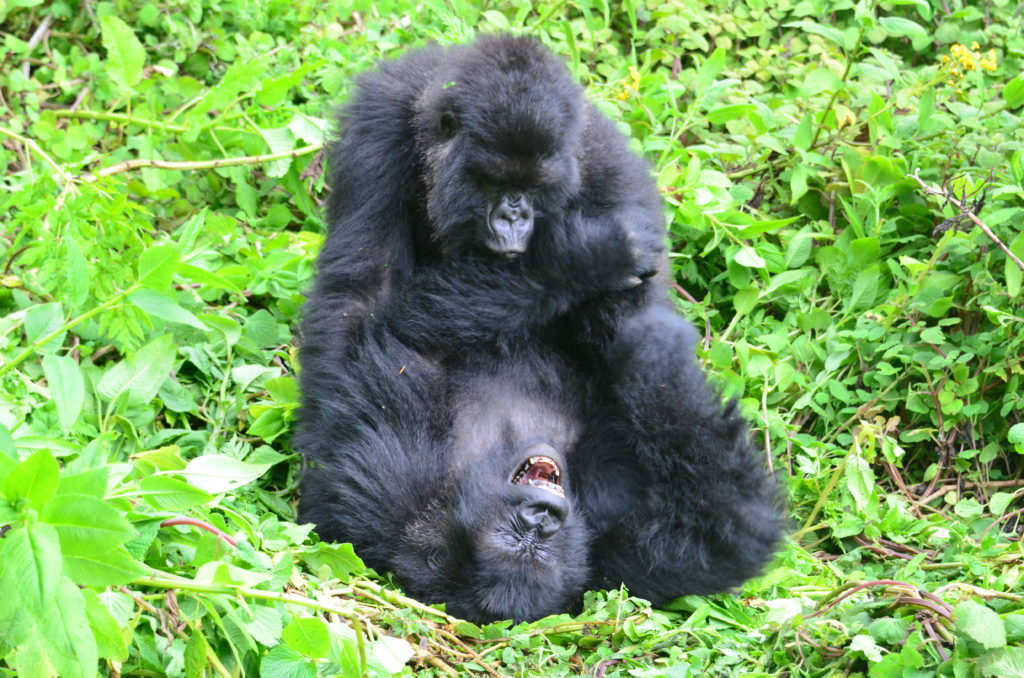
Juveniles frequently grab, roll, push, and wrestle with one another. This builds immense upper body strength and teaches them how to gauge their own power.
2. Gorilla Chasing Games
Young gorillas love running after each other around the family group. These high-speed pursuits through the dense forest improve their cardiovascular health and agility.
3. Tumbling and Rolling
You will often see juveniles roll across the forest floor or tumble together in the vegetation. This helps them develop spatial awareness and core strength.
4. Mock Fighting
Playful fighting can resemble genuine conflict, but it lacks the aggressive vocalizations and intent to injure. It is a safe way for young males to practice dominance and submission dynamics.
5. Climbing and Swinging
While adult mountain gorillas spend most of their time on the ground, young gorillas use vegetation for exploration and play, swinging from branches and climbing small trees.
6. Playing With Adults
Adults, including the dominant silverback, generally tolerate juvenile play. Research notes that adults can tolerate infant play and may even participate in gentle interactions with older juveniles and blackbacks.
Do Baby Gorillas Play More Than Adult Gorillas?
Yes. Young gorillas are generally much more playful than adults. As they mature, their focus shifts from play to foraging, social management, and reproduction.
|
Gorilla Age/Class |
Typical Play Behaviour |
|
Infants |
Exploration, climbing, and simple physical interaction with mothers. |
|
Juveniles |
The most active players; engage in wrestling, chasing, tumbling, and mock fighting. |
|
Blackbacks |
More advanced physical and social interactions; transitioning to adult roles. |
|
Adult females |
Less frequent play; focused on foraging, nursing, and grooming. |
|
Silverbacks |
Mostly protective and social, but may tolerate or occasionally join juvenile play. |
Do Silverback Gorillas Play?
The silverback is the undisputed leader of the troop. He spends the vast majority of his time:
- Protecting the family from threats.
- Managing complex social relationships and resolving disputes.
- Feeding to maintain his massive size.
- Resting and conserving energy.
- Moving with the group to new foraging sites.
- Responding to environmental changes.
Because of these heavy responsibilities, silverbacks are far less playful than juveniles. However, a good silverback will patiently tolerate juvenile play and sometimes participate in gentle, playful interactions to bond with the younger members of his family.
How Can You Tell If Gorillas Are Playing or Fighting?
Not every physical interaction between gorillas is play. Knowing the difference is key to understanding mountain gorilla behavior.
Playing may involve:
- Relaxed, loose body language.
- Repeated wrestling without escalation.
- Chasing and rolling.
- Returning to the same play partner.
- No sustained injury or distress.
- Playful, soft vocalizations (like belches and grunts).
Genuine aggression may involve:
- Rigid, tense body language and threat displays.
- Loud chest beating and aggressive vocalizations (roars, barks).
- Charging or bluff charges.
- Strong defensive behavior.
- Attempts to drive another individual away or inflict harm.
When Do Gorillas Usually Play?
Gorilla play varies depending on several factors, including age, family composition, weather, feeding schedules, rest periods, individual personality, and the presence of other juveniles.
A useful traveler-focused insight is that families containing several juveniles offer more opportunities to observe energetic play.
However, gorilla play is a natural behavior, but wildlife sightings are unpredictable. Your guide can help interpret the behavior you encounter without guaranteeing a particular activity.
Can You See Gorillas Playing During Gorilla Trekking?
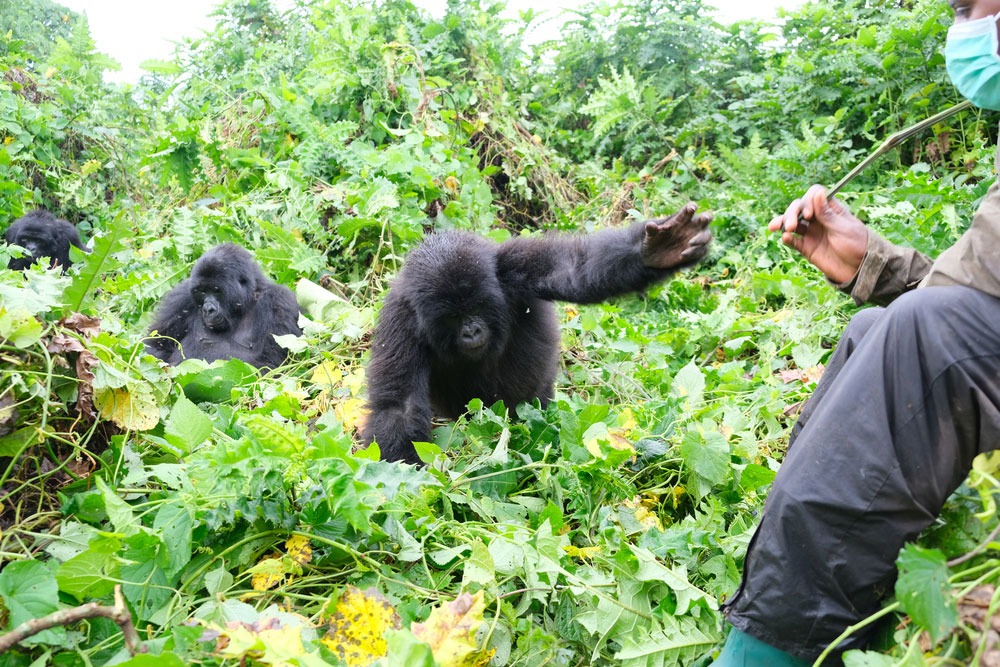
Yes, Travelers trekking in the wild can potentially observe a wide range of natural behaviors, including feeding, grooming, resting, moving, social interactions, infant care, and playing.
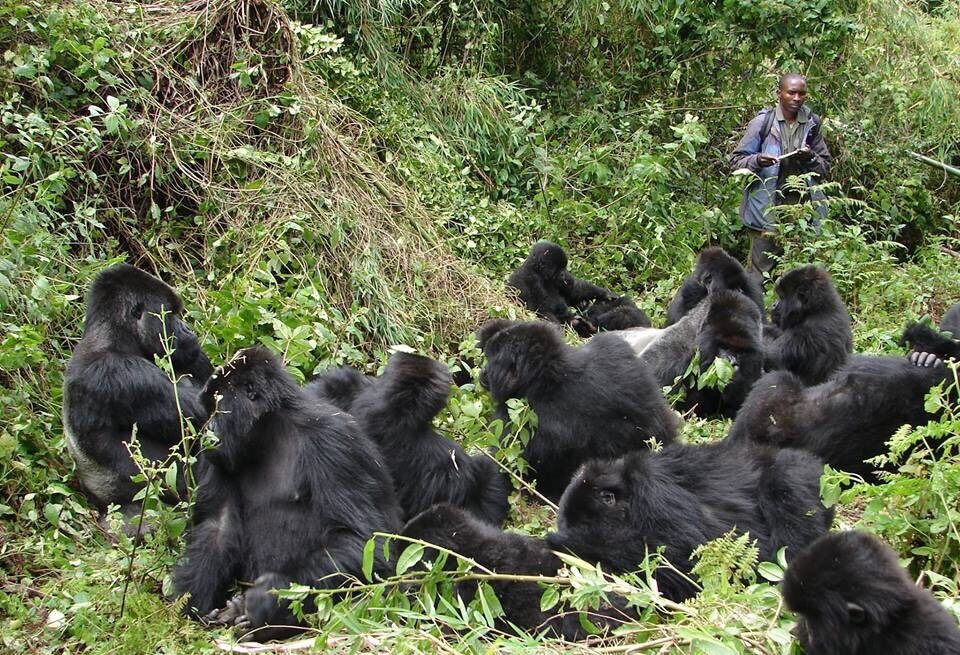
Habituated gorillas continue their normal activities while visitors observe from regulated distances. It is vital to remember that habituation is not domestication; it is simply a process through which gorillas become accustomed to the silent, passive presence of humans.
Want to see mountain gorillas in their natural habitat? Explore our Uganda gorilla trekking packages and start planning your Bwindi adventure with GoSilverback Gorilla Safaris.
Related Read | Gorilla Habituation Experience
Where Can You See Playful Mountain Gorillas?
To witness gorilla play behavior in the wild, you must visit their natural habitat.
1. Bwindi Impenetrable National Park, Uganda
Home to roughly half the world’s mountain gorillas, Bwindi offers incredible viewing. Its habituated families are distributed across four major trekking sectors: Buhoma, Ruhija, Rushaga, and Nkuringo.
2. Mgahinga Gorilla National Park, Uganda
Located in southwestern Uganda, Mgahinga is part of the greater Virunga conservation landscape. It offers a smaller, more intimate trekking experience, often featuring the Nyakagezi group.
3. Volcanoes National Park, Rwanda
Rwanda’s Volcanoes National Park is another premier destination for observing mountain gorillas. Its rolling bamboo forests provide a stunning backdrop for watching juvenile gorillas at play.
Related Read | Bwindi Impenetrable National Park Guide | Mgahinga Gorilla National Park Guide | Volcanoes National Park Guide
What Is the Best Gorilla Trekking Experience for Observing Gorilla Behavior?
If your goal is to study mountain gorilla behavior, you should consider the difference between Standard Gorilla Trekking and the Gorilla Habituation Experience.
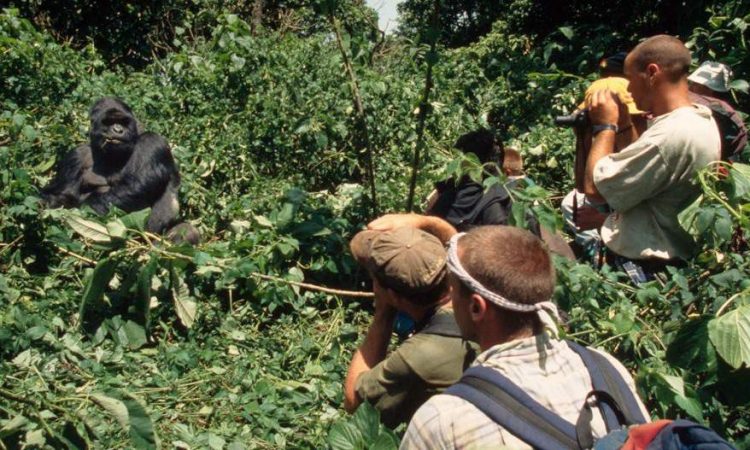
Standard trekking provides a strict one-hour encounter with a fully habituated family. In contrast, the Gorilla Habituation Experience in Uganda (available in the Rushaga sector of Bwindi) allows up to four hours with a semi-habituated family.
This extended time is particularly attractive to travelers interested in deep behavioral observation, wildlife photography, and research-style experiences.
If observing gorilla behavior is your priority, ask GoSilverback Gorilla Safaris about a Gorilla Habituation Experience in Bwindi’s Rushaga sector.
Gorilla Trekking Rules for Watching Gorilla Behavior
To protect the gorillas and ensure authentic behavior, strict rules apply. You cannot simply approach playful gorillas.
You must:
- Keep the required minimum distance (7 to 10 meters).
- Never touch the gorillas.
- Don’t feed them or leave food scraps.
- Don’t imitate their behavior or vocalizations.
- Don’t shout or make loud noises.
- Don’t make sudden movements.
- Follow your ranger’s instructions at all times.
- Avoid visiting if you are sick.
- Respect the strict time limit.
For Uganda, current park regulations dictate a maximum of eight visitors per habituated family per day and a one-hour standard viewing period.
Can Gorillas Play With Humans?
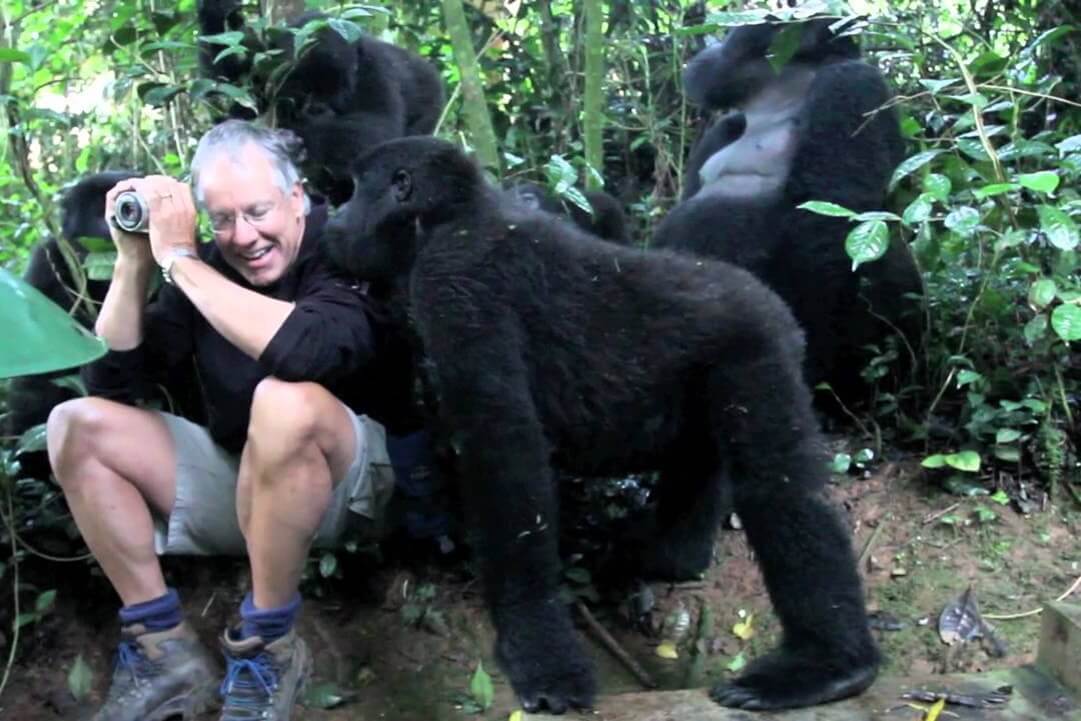
No. Wild mountain gorillas should never be treated as pets or encouraged to play with people.
Even when a curious juvenile approaches, travelers must maintain the required distance and allow the animal to decide its own movements.
Watching gorillas play with each other is far more meaningful, ecologically responsible, and safe than trying to interact with them.
What Does Gorilla Play Tell Us About Mountain Gorilla Intelligence?
Gorilla play behavior provides deep insights into their cognitive abilities. It demonstrates advanced learning, excellent memory, complex communication, and high social awareness.
Through play, they exhibit problem-solving skills, emotional expression, and a deep understanding of family relationships and individual personalities. Their sophisticated social behavior proves they possess complex cognition and social learning capabilities.
Fascinating Facts About Gorilla Play
- Young gorillas are generally the most playful members of a group.
- Wrestling is one of the most recognizable forms of gorilla play.
- Play helps young gorillas develop physical coordination and strength.
- Play teaches social communication and behavioral boundaries.
- Silverbacks can tolerate juvenile play and occasionally join in.
- Gorilla play can include chasing, tumbling, and mock fighting.
- Not every physical interaction is playful; knowing the difference is key.
- Families with several juveniles may offer more opportunities to observe play.
- Gorillas can play while living completely naturally in the wild forest.
- Seeing gorilla play during trekking is possible but never guaranteed.
Do Gorillas Play Like Humans?
There are striking similarities and distinct differences between human and gorilla play.
Similarities:
- Both engage in wrestling and chasing.
- Both use play for social interaction and bonding.
- Both learn physical and social boundaries through play.
- Both test their physical abilities in a safe environment.
Differences:
- Gorilla play is deeply embedded within their natural, wild social structure.
- Their communication and body language are entirely different from ours.
- Human visitors should never participate in their play.
- Gorilla play serves critical, immediate survival and social-development functions in the wild.
Frequently Asked Questions About Gorilla Play
Do gorillas play?
Yes. Particularly young and juvenile gorillas engage in wrestling, chasing, tumbling, and other physical games to develop skills and bond.
Why do gorillas play?
Gorilla play helps develop physical coordination, communication, and vital social skills needed to integrate into the troop.
Do baby gorillas play?
Yes. Baby and juvenile gorillas are among the most playful and energetic members of their family groups.
Do silverback gorillas play?
Silverbacks are less playful than juveniles due to their leadership duties, but they may tolerate or occasionally participate in juvenile play.
Do gorillas wrestle?
Yes. Wrestling is one of the most common and recognizable forms of gorilla play, helping them build strength.
Do gorillas play fight?
Yes. Juveniles frequently engage in mock fighting that helps them learn physical limits and social boundaries without causing harm.
Can gorillas play with humans?
No. Tourists should never attempt to touch, chase, or play with wild gorillas; strict distance rules must be maintained.
Can I see gorillas playing in Uganda?
Yes, it is possible to observe natural play behavior during an Uganda gorilla trekking safari, although specific wildlife behavior cannot be guaranteed.
Where can I see mountain gorillas in Uganda?
The principal trekking destinations are Bwindi Impenetrable National Park and Mgahinga Gorilla National Park.
How long can I watch gorillas during normal trekking?
Standard gorilla trekking provides a limited viewing period once the family is located. Uganda‘s current guidance specifies a maximum of one hour.
Is Gorilla Habituation better for observing behavior?
Yes, it can be particularly valuable for travelers who want more time to observe behavior, as the experience provides up to four hours of observation time.
Plan Your Uganda Gorilla Trekking Safari
Witnessing the playful antics of juvenile mountain gorillas is a highlight of any African wildlife journey. To make this dream a reality, meticulous planning is required.
Securing gorilla permits is the first step, as they are highly limited and sell out months in advance. You will need to choose your preferred trekking sectors (such as Buhoma or Rushaga in Bwindi) and select from a range of accommodation options, from rugged budget lodges to ultra-luxury retreats.
Logistics are equally important. You will need reliable transport either via domestic flights or scenic road transfers, and arranging porters on the day of the trek is highly recommended for a comfortable experience.
Many travelers opt for safari combinations, pairing their gorilla trek with wildlife drives in Queen Elizabeth National Park or chimpanzee tracking in Kibale.
You can fly into Entebbe for a classic Uganda gorilla safari packages or fly into Kigali for a cross-border gorilla trekking from Kigali itinerary.
Whether you are looking for a private/customized tour, a mid-range group safari, or the exclusive gorilla habituation experience, timing your visit during the dry seasons ensures the best trekking conditions.
Do gorillas play? Yes—and seeing young mountain gorillas wrestle, chase, and tumble through the misty forest can be one of the most memorable, heartwarming moments of your life.
Ready to experience mountain gorilla behavior for yourself? Explore our Uganda gorilla trekking packages and speak with GoSilverback Gorilla Safaris about permits, accommodation, transport, and a customized itinerary.
Let us turn your wildlife dream into an unforgettable reality!