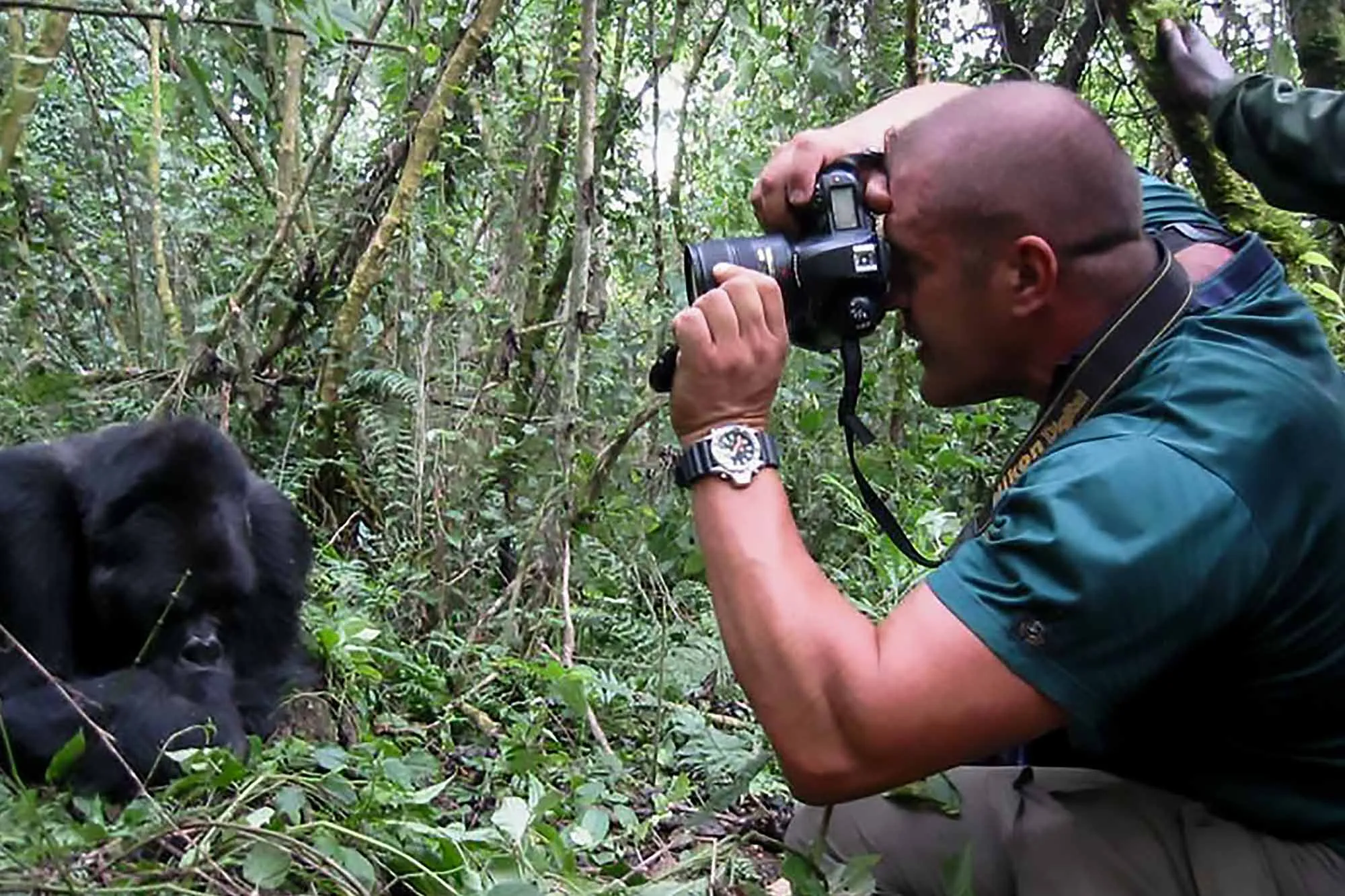
Gorilla Trekking Photography Tips: The Ultimate 2026 Field Guide
Gorilla Trekking Photography Tips help you capture stunning images of endangered mountain gorillas while respecting wildlife conservation guidelines.
Use a camera with excellent low-light performance, a fast telephoto zoom lens (70–200mm or similar), and increase your ISO instead of using flash, which is strictly prohibited.
Keep your camera ready, focus on the gorillas’ eyes, and shoot in burst mode to capture natural behavior. Wear neutral-colored clothing and protect your equipment with a waterproof cover.
Follow your ranger’s instructions, maintain a safe distance, and enjoy an ethical photography experience during your unforgettable gorilla trekking adventure.
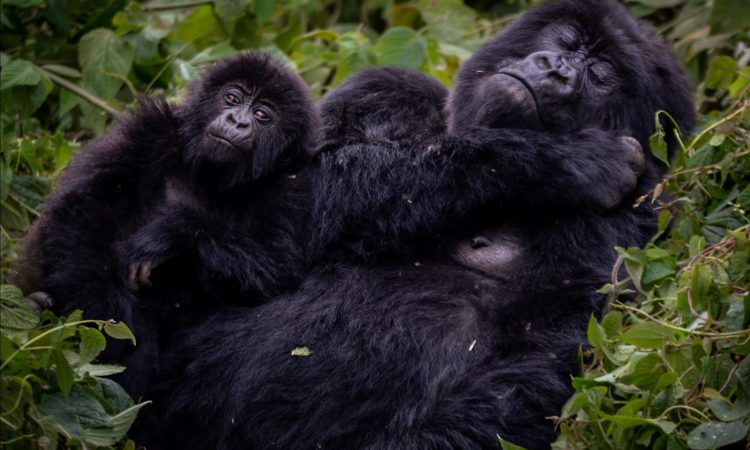
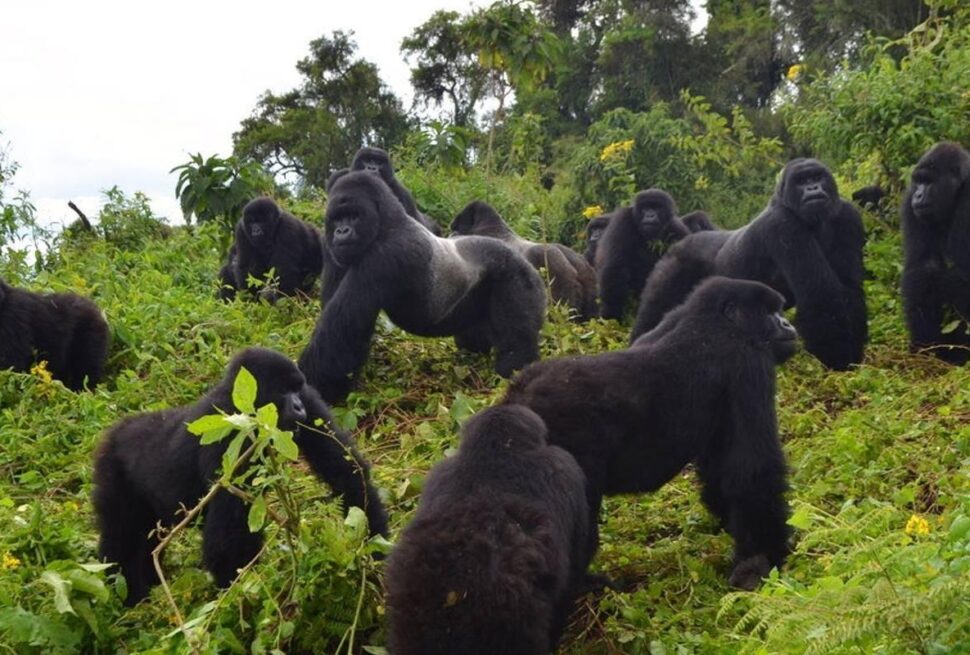
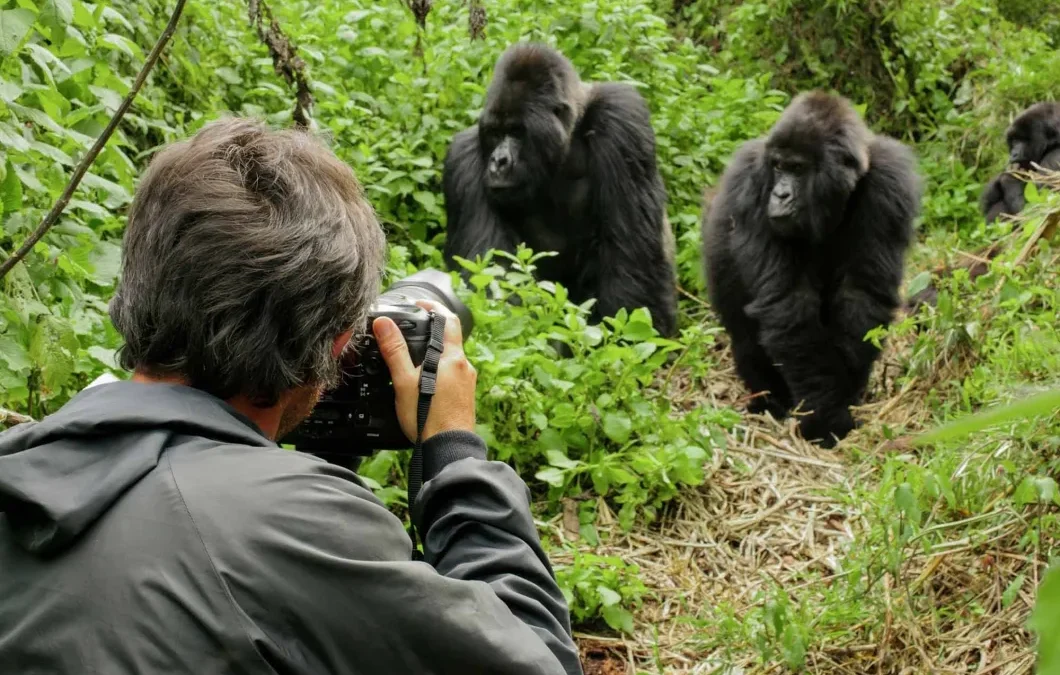
The mist clings to the bamboo like wet silk. Your boots sink two inches into volcanic mud. Then, through a curtain of hagenia leaves, a 400-pound silverback lifts his massive head, locks eyes with your lens, and exhales.
In that single, electric second, every gorilla trekking photography tip you’ve ever read either saves the shot—or fails you.
This is the definitive 2026 field guide to bringing home portfolio-grade mountain gorilla photography without compromising the welfare of Earth’s last 1,063 wild mountain gorillas.
Whether you’re flying in from New York, London, São Paulo, Sydney, Dubai, or Beijing, this guide arms you with the exact gear, settings, and on-trail techniques that separate a blurry souvenir from a frame worthy of National Geographic.
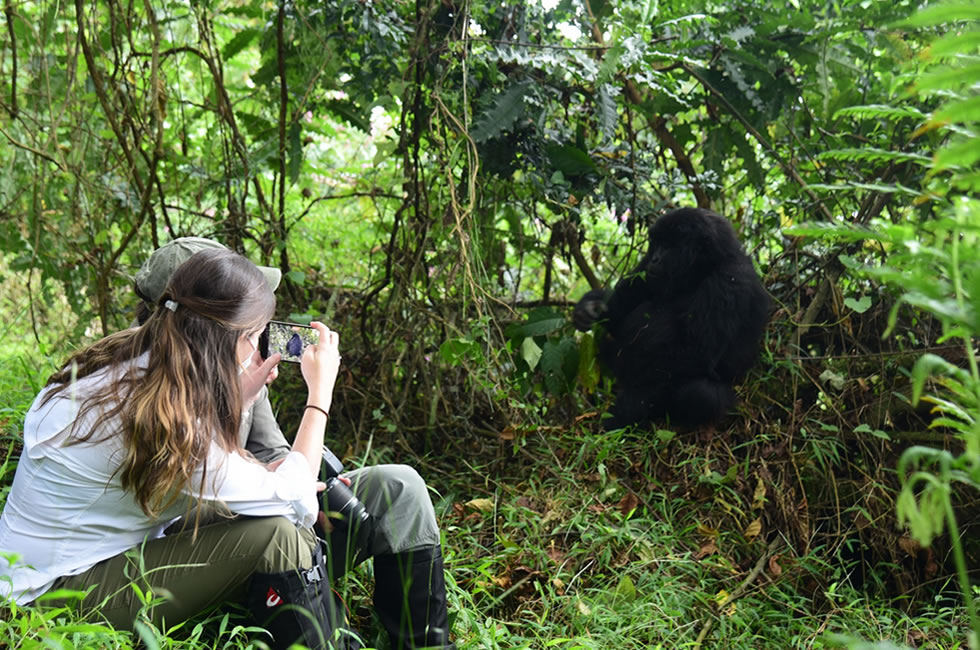
Why Gorilla Photography Demands a Different Playbook
Forget the open savannah. Gorilla safari photography inside equatorial rainforest is a discipline unto itself.
Here’s why your standard wildlife approach collapses the moment you cross the park gate:
- Light levels drop to EV 4–7 beneath dense canopy—equivalent to deep twilight.
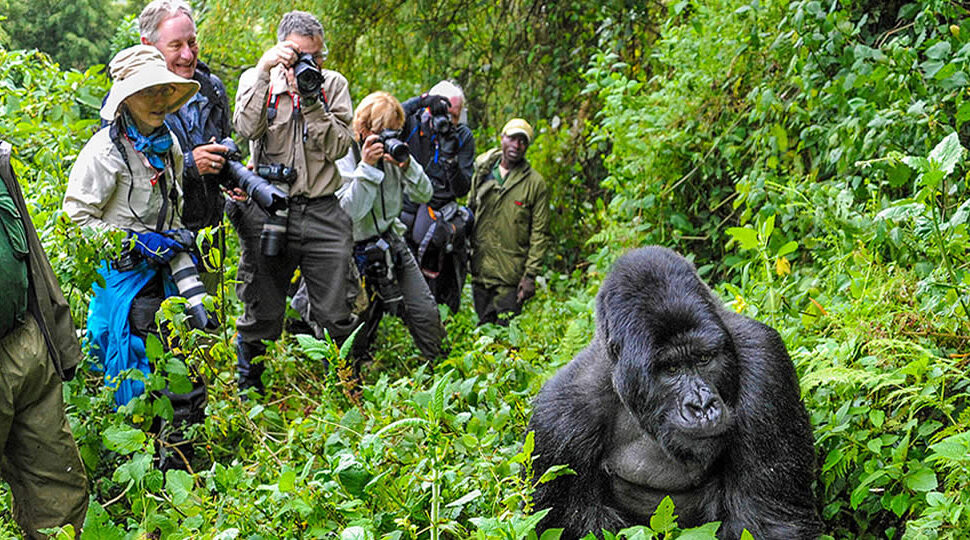
- Subjects move unpredictably at a mandated 7-metre minimum distance, yet can close to 3 metres in seconds.
- Humidity exceeds 90 %, rain arrives without warning, and mud swallows tripods.
- Park regulations enforce a strict one-hour viewing window, no flash, and no drones.
- After 2–5 hours of climbing at 2,500–4,000 m altitude, your hands shake.
In short: mountain gorilla photography rewards preparation over luck. The sections below deliver that preparation in full.
📸 Ready to put these tips into practice? [Explore GoSilverback’s 2026 Gorilla Trekking Packages →] and secure one of only 8 permits per family per day.
Best Camera Gear for Gorilla Trekking (2026 Updated List)
Choosing the right gorilla trekking camera gear before you fly to Kigali, Entebbe, or Goma is the single biggest determinant of image quality. Below is the 2026-verified kit list our guides recommend to every client.
Camera Bodies
Mirrorless is non-negotiable in 2026. Silent electronic shutters prevent startling the troop, and superior high-ISO performance conquers the dim understory.
- Sony A7 IV / A7R V – Best-in-class animal eye-AF, 10 fps burst, IP5X dust/moisture sealing.
- Canon EOS R6 Mark II – 40 fps electronic burst; excels in near-darkness.
- Nikon Z6 III – 120 fps at reduced resolution for ultra-fast behavioural bursts.
- Budget pick: Fujifilm X-T5 – 40 MP, weather-sealed, lighter for steep treks.
Key fact: Weather-sealing is not optional. A single downpour in Bwindi can destroy an unsealed body in under ten minutes.
Lenses That Actually Work in the Forest
- 70–200 mm f/2.8 – Your workhorse. Delivers 80 % of all usable gorilla frames at the regulated distance.
- 100–400 mm or 200–600 mm – Ideal when the family rests in a clearing and you want tight silverback portraits.
- 24–70 mm f/2.8 – Environmental context: misty trails, porter processions, volcanic ridgelines.
- Why primes fail here: An 85 mm or 135 mm prime locks your framing. You cannot “zoom with your feet” past the 7-metre boundary enforced by armed rangers.
Essential Accessories
- Rain cover + 20 L dry bag (non-negotiable)
- Two spare batteries – cold altitude drains them 40 % faster; no charging mid-trek
- 128 GB+ CFexpress or V90 SD cards – RAW bursts fill 64 GB in 20 minutes
- Carbon-fibre monopod / trekking-pod – stabilises on 35° muddy slopes
- Microfibre cloths + rocket blower – humidity fogs glass within seconds
- Silica-gel packs tucked in every pocket of your daypack
🎒 Download our free printable Gorilla Photography Gear Checklist → and never leave a critical item at the lodge.
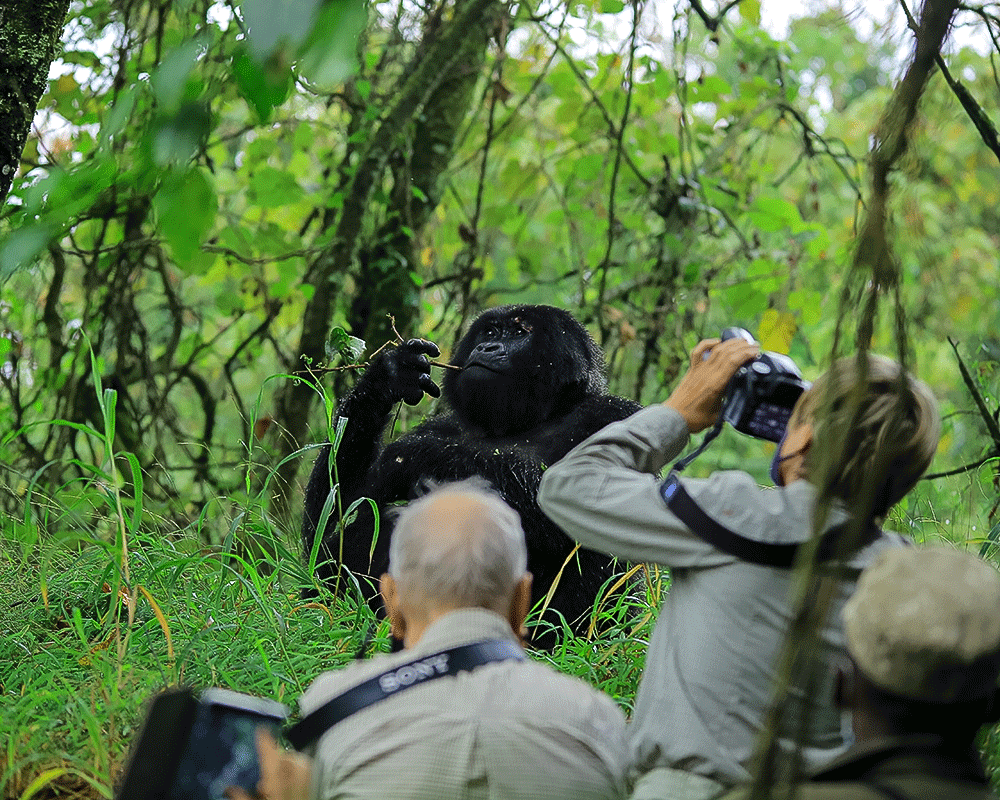
Dial-In Camera Settings Before You Step on the Trail
Best gorilla photography settings (2026): Aperture f/2.8, Shutter 1/250 s or faster, Auto ISO capped at 12,800, Continuous AF with animal eye-detect, shoot RAW. Set these at the trailhead briefing—not when the silverback appears.
Exposure Triangle for Dense Canopy
- Aperture: Open to f/2.8–f/4. You need every photon the canopy denies you, and shallow depth-of-field separates the gorilla from chaotic foliage.
- Shutter speed: Never drop below 1/250 s; jump to 1/500 s for chest-beating or mock charges.
- ISO: Set Auto ISO, max 12,800. Modern sensors handle noise gracefully; a sharp noisy frame beats a clean blur every time. Always shoot RAW.
Focus & Drive Mode
- Switch to Continuous / AI-Servo AF with Animal Eye-Detect enabled.
- Engage burst mode at 10–20 fps for behavioural sequences.
- Assign back-button focus so recomposing doesn’t hunt.
White Balance & Metering
- Set 5,500–6,000 K or the Cloudy preset to neutralise the green canopy cast.
- Use spot metering on the gorilla’s face; dark fur fools evaluative/Matrix metering by 1.5–2 stops.
What NOT to Do
- Never use flash or AF-assist beams. It is illegal in Volcanoes NP, Bwindi, and Virunga, and it visibly distresses the animals.
- Never rely on single-shot AF. You will miss a yawn, a charge, or an infant somersault.
🔒 Permits sell out 6–9 months ahead for peak season. [Check live 2026 gorilla permit availability with GoSilverback Gorilla Safaris →] before your preferred dates vanish.
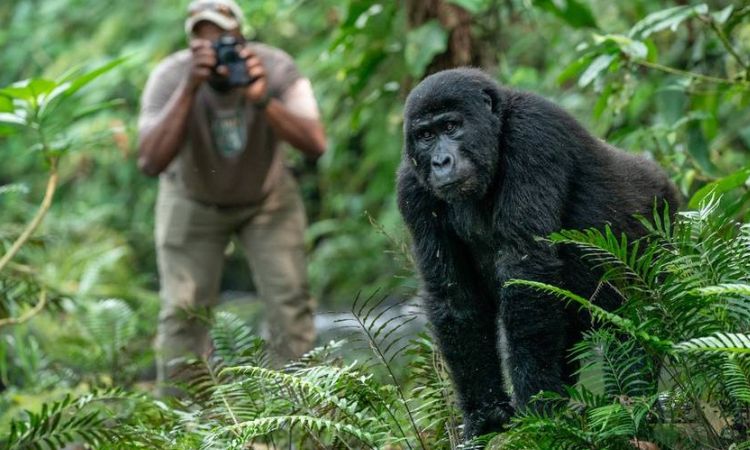
Shooting Techniques: Composition, Light & Behaviour
Gear gets you the frame; technique makes it unforgettable. These gorilla photography techniques are battle-tested across 200+ treks in Rwanda, Uganda, and the DRC.
Read the Light
- Early-morning treks (07:00–09:00) produce soft, directional god-rays through mist—prime portrait light.
- Position yourself so canopy gaps backlight the gorilla’s fur, creating a luminous halo around the silhouette.
- Overcast days act as a giant softbox, delivering even, shadow-free illumination perfect for detailed fur texture.
Composition Rules That Elevate a Snapshot
- Place the eyes on the upper-third line; leave negative space in the direction of the gorilla’s gaze.
- Include habitat context—bamboo stalks, fig roots, volcanic soil—to tell a location story.
- Get low. Kneel or lie prone to shoot at gorilla eye-level; it transforms a “looking down” snap into an intimate portrait.
- Capture interaction: grooming, nursing, play. Behavioural frames outsell static portraits 3-to-1 in editorial markets.
Anticipate Behaviour
- Chest-beat sequence: Hooting → standing → beat. You get roughly 3 seconds’ warning. Pre-focus, hold breath, fire a burst.
- Silverback mock charge: Keep the camera raised, shoot wide (24–70 mm) to include the environment and convey scale.
- Infant play: Fast, erratic, adorable. Bump shutter to 1/640 s minimum and track with continuous AF.
🌍 Travelling from the USA, UK, Europe, Asia, or the Middle East? GoSilverback Gorilla Safaris arranges end-to-end logistics—flights, visas, transfers, and permits. [Request a free custom itinerary →].
Ethical & Responsible Gorilla Photography
Great images never justify compromising the gorillas. Every responsible gorilla photography practice below is enforced by park rangers and protected under IUCN guidelines:
- Maintain the 7-metre distance. Never step forward for a tighter crop.
- If a gorilla approaches you: freeze, lower your gaze slightly, and let it pass. Do not back away rapidly—it triggers a chase instinct.
- No flash. No selfie sticks. No drones. Drones are illegal in all three national parks and carry fines exceeding $5,000.
- Limit post-processing. Do not over-saturate or misrepresent the habitat for social-media clout.
- Your permit funds conservation: 10 % of every permit fee directly finances community schools, clinics, and anti-poaching patrols. Frame your trip as an act of conservation support.
Authoritative sources: Dian Fossey Gorilla Fund | IUCN Red List – Gorilla beringei beringei
Choosing Your Trek: Rwanda vs Uganda vs DR Congo (Photographer’s Lens)
Where you trek shapes the light, the mood, and the story your images tell.
|
Factor |
Rwanda – Volcanoes NP |
Uganda – Bwindi / Mgahinga |
DR Congo – Virunga NP |
|
Light quality |
Open bamboo; brighter, golden |
Dense rainforest; moody, atmospheric |
Variable; volcanic clearings |
|
Terrain |
Moderate |
Steep, muddy, root-heavy |
Moderate–steep |
|
2026 permit cost |
$1,500 |
$800 (foreign) |
~$450 |
|
Best photographic style |
Clean portraits, backlit fur |
Misty, cinematic frames |
Raw, adventurous storytelling |
🗺️ Compare all three destinations side-by-side in our [Ultimate Gorilla Trekking Destination Guide →] and match the park to your photographic vision.
Fitness, Trekking-Day Logistics & Protecting Your Gear
- Arrive at park HQ by 06:30 for the 07:00 briefing; latecomers forfeit permits—no refunds.
- Wear gaiters, waterproof boots, long sleeves; pack a 30 L dry daypack.
- Wrap your camera in a dry bag inside the pack; mount the lens only at the trailhead.
- Hydrate aggressively. Altitude (2,500–4,000 m) saps stamina and amplifies hand tremor.
- Hire a porter ($15–$20). They carry your pack, support the local economy, and free your hands for the camera.
Post-Processing Tips for Gorilla Images
- Shoot RAW. Recover 2–3 stops of shadow detail in Lightroom or Capture One.
- In the HSL panel, drop green luminance by −15 to neutralise canopy colour-cast.
- Sharpen eyes selectively with a radial mask; avoid over-sharpening fur into digital artefacts.
- Convert select frames to black-and-white for dramatic, timeless silverback portraits.
- Export at 300 dpi for print, 72 dpi / sRGB for web and social media.
Frequently Asked Questions
Can I use a smartphone for gorilla trekking photos?
Yes, but low-light performance is limited. Switch to Pro/Manual mode, use the 2× telephoto lens, and never activate flash.
How close will I actually get to the gorillas?
The regulated minimum is 7 metres, though curious juveniles occasionally close to 3 metres. Hold your position and shoot.
Is a 400 mm lens too heavy for the trek?
Manageable with a monopod, but most guides recommend capping at 200 mm for mobility on steep, muddy trails.
Do I need a permit to photograph gorillas?
Yes. One permit = one hour with one habituated family. There are no exceptions in Rwanda, Uganda, or the DRC.
What month gives the best photography light?
June–September and December–February offer drier trails and more dramatic light shafts through the canopy.
Book Your Gorilla Photography Safari Today
Here is the reality: each habituated gorilla family receives only 8 visitors per day. Peak-season permits for June–September 2026 are already 70 % sold out across Volcanoes, Bwindi, and Virunga. Every week you wait, options narrow.
GoSilverback Gorilla Safaris handles everything—permits, flights from any continent, luxury or mid-range lodges, private photography guides, porter arrangements, and post-trek image-review sessions.
🎁 Exclusive offer: Mention code GORILLALENS26 at booking and receive a complimentary 1-hour private photography briefing with our resident safari-photographer guide before your trek.
[View Rwanda Gorilla Packages] · [View Uganda Gorilla Packages] · [Speak to a Safari Expert Now]
ATOL-protected · IATA-accredited · Rated 4.9/5 on TripAdvisor (1,200+ reviews)
Your silverback portrait is waiting. The forest won’t hold it forever. [Book your gorilla permit with GoSilverback Gorilla Safaris →] and turn a once-in-a-lifetime trek into a lifetime of images.
© 2026 GoSilverback Gorilla Safaris. Last updated: 5 August 2026. All photography regulations referenced align with RDB, UWA, and ICCN guidelines.