

Why Silverbacks Beat Their Chest? The Real Meaning Behind Gorilla Chest-Beating (Uganda, Rwanda & Congo).
Why Do Silverbacks Beat Their Chest?
Silverback gorillas beat their chests primarily to assert dominance, intimidate rivals, and protect their group without physical fights.
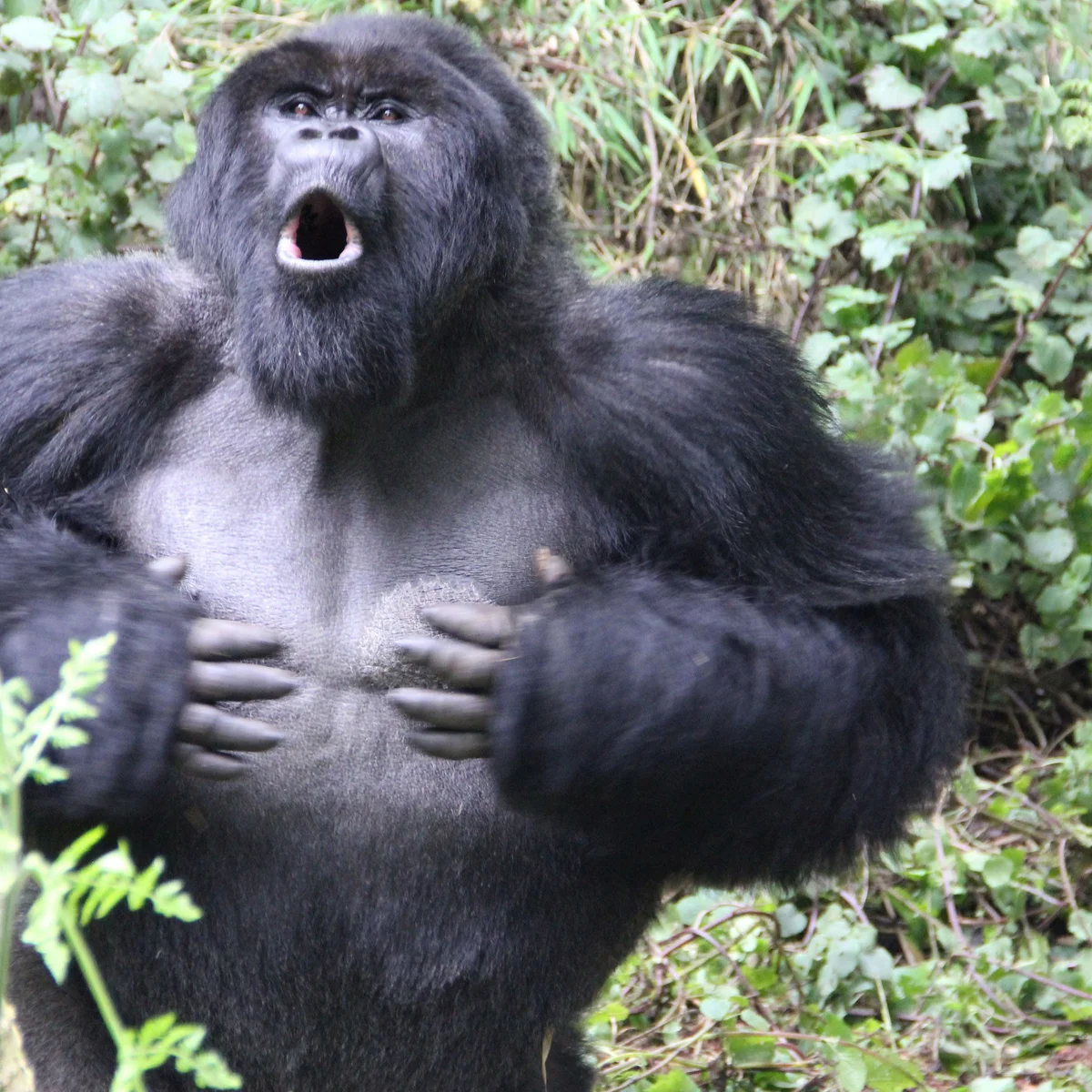
This dramatic display—cupped hands striking the chest rapidly—produces a deep, resonant sound amplified by their large chest cavity, audible up to 1 km in dense rainforests.
The behavior serves multiple purposes: warning intruders or rival males, reinforcing hierarchy within the troop, and signaling strength to females during mating.
Accompanied by hooting, charges, and vegetation tearing, it deters threats like leopards or other gorillas, maintaining peace through intimidation rather than violence.
Chest-beating also fosters group cohesion, marking territory, and expressing excitement or frustration.
Studies show no direct link to size, but longer displays signal confidence and individual identity, reducing actual conflicts among these powerful primates.
In gorilla trekking safaris, witnessing this avoids provoking aggression—stay calm and follow guides. This non-verbal communication highlights silverbacks’ intelligent leadership in Bwindi or Virunga forests.
Deep in the misty forests of Bwindi Impenetrable National Park in Uganda, a silverback gorilla rises to his full height, pounding his massive chest with thunderous force.
The vibrations ripple through the forest, startling birds into flight and sending a clear signal to anyone nearby: this is his domain. Such dramatic displays, often captured in jaw-dropping viral videos, are more than just awe-inspiring—they are a vital part of gorilla communication.
So, why do silverbacks beat their chest? Simply chest-beating is primarily a display of strength and dominance, but it also serves crucial roles in communication, expressing excitement, and warning others of potential threats.
Each beat communicates volumes to the troop and rival males alike, conveying power, status, and intent without a single word spoken.
Silverbacks are found across central Africa, with the most accessible populations for wildlife enthusiasts located in three key countries: Uganda (Bwindi Impenetrable Forest and Mgahinga Gorilla National Park), Rwanda (Volcanoes National Park), and the Democratic Republic of Congo (Virunga National Park).
Across these regions, chest-beating can be observed during courtship displays, territorial disputes, or moments of playful excitement within the group.
In this ultimate guide, we will explore everything you need to know about silverback gorillas and their iconic chest-beating behavior:
from the science behind the display, its variations across regions, and what it tells us about gorilla intelligence and social dynamics, to the best places to witness this unforgettable spectacle safely in the wild.
Whether you’re a wildlife enthusiast, a traveler planning a gorilla trek, or simply curious about the animal kingdom, this guide will give you an insider’s look into one of nature’s most powerful and fascinating primates.
Who Are Silverbacks? Basic Biology
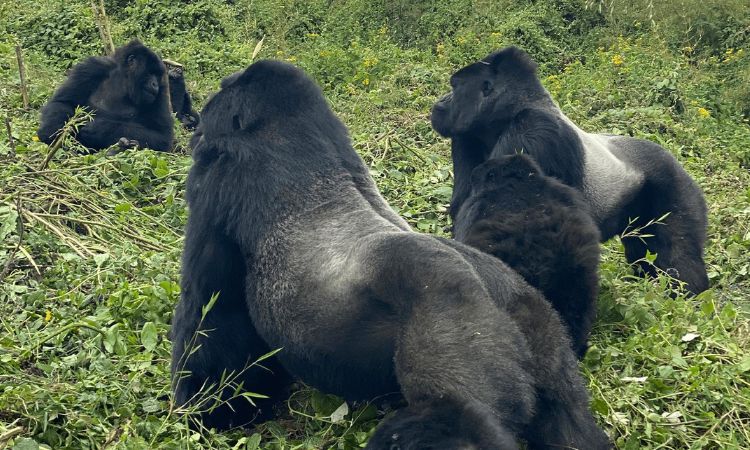
A silverback is a mature male gorilla, typically over 12 years old, recognized by the distinctive patch of silver or gray hair that develops on their back.
This silver coat signals sexual maturity and social dominance, earning them the name “silverback.” These males are the leaders of their groups, called troops, responsible for protecting females and offspring, mediating conflicts, and guiding foraging and movement.
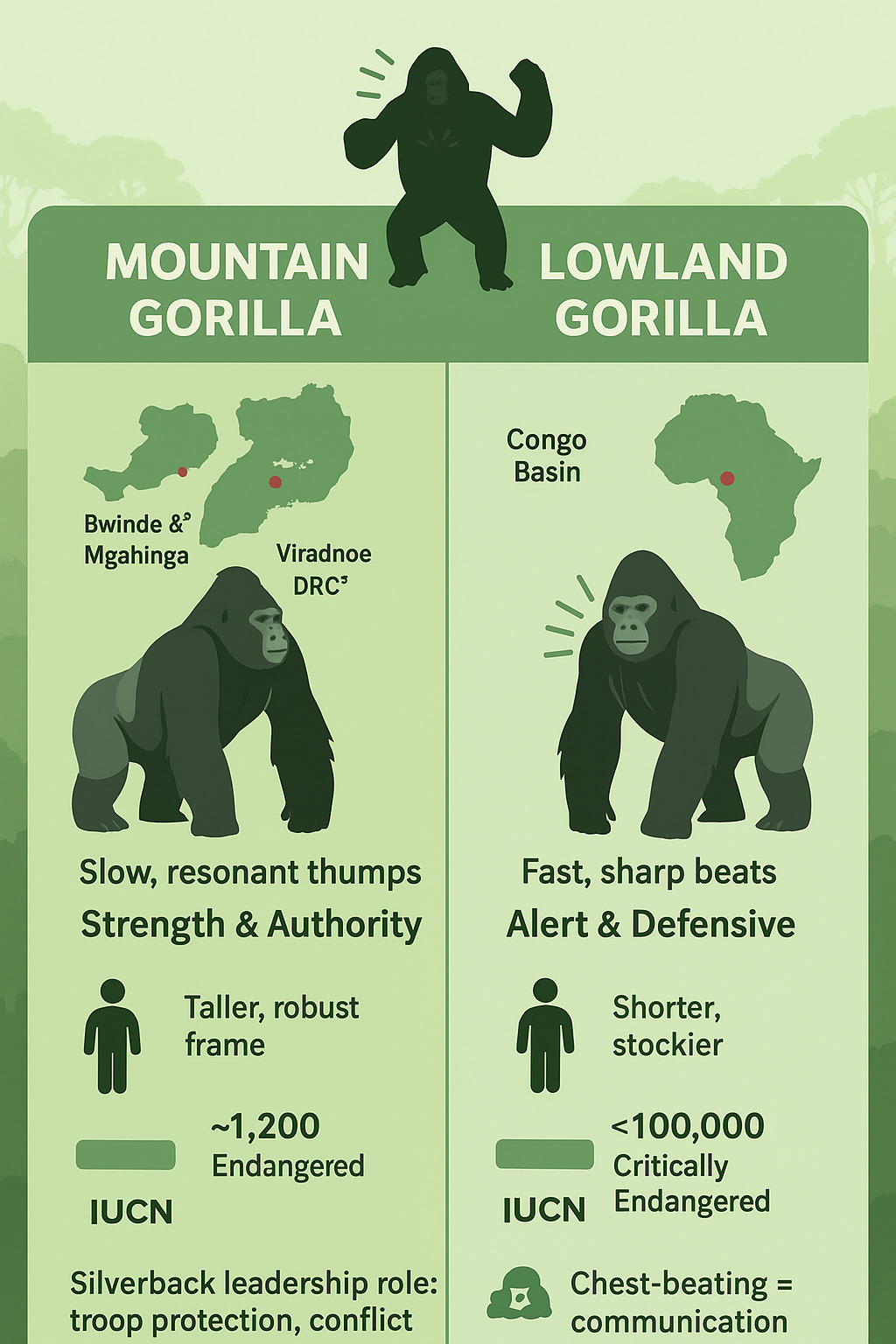
There are two main species of gorillas: mountain gorillas and lowland gorillas, and silverbacks exhibit subtle behavioral differences between them.
For example, mountain gorillas—found in Uganda’s Bwindi and Mgahinga, Rwanda’s Volcanoes National Park, and DR Congo’s Virunga—often chest-beat more slowly but with longer, resonant thumps, signaling strength and calm authority.
In contrast, lowland gorillas in West and Central Africa display faster, sharper chest-beats, often associated with heightened alertness or stress. Both behaviors serve similar purposes: dominance, communication, and deterrence of rivals.
Currently, mountain gorillas are endangered, with about 1,200 individuals remaining, while lowland gorillas are critically endangered, numbering fewer than 100,000 in fragmented habitats.
The IUCN Red List classifies both as at risk due to poaching, habitat loss, and disease. Conservation efforts, such as anti-poaching patrols, habitat protection, and eco-tourism initiatives in Uganda, Rwanda, and DR Congo, have stabilized and even slightly increased mountain gorilla populations over the last decade—a rare wildlife success story.
Understanding who silverbacks are, their biology, and their crucial role in gorilla society not only enriches our knowledge of these iconic primates but also highlights the importance of protecting these gentle giants for future generations.
The Chest-Beating Behavior: What It Actually Looks & Sounds Like
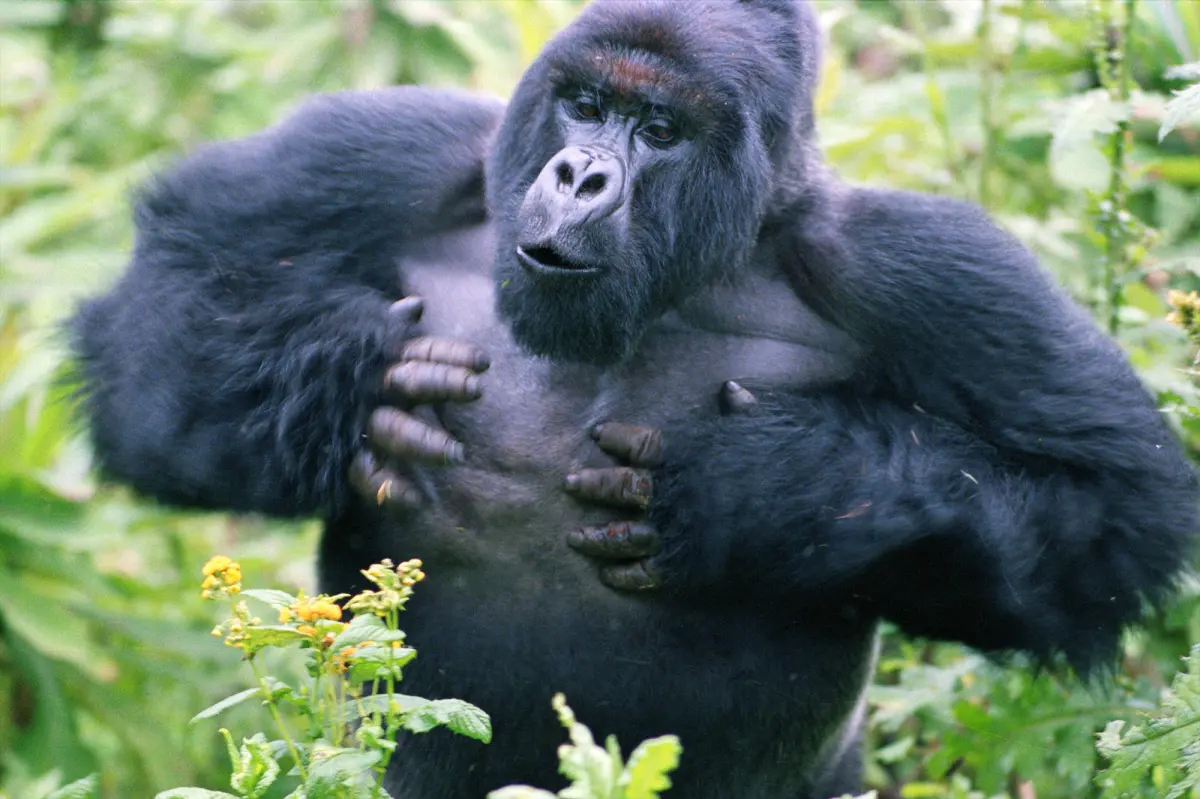
When a silverback gorilla beats his chest, it is one of the most iconic and powerful displays in the animal kingdom.
Typically, the behavior begins with the gorilla standing upright or slightly hunched, palms cupped against the pectoral muscles, before delivering a rapid series of 9–12 chest-thumping beats.
The rhythm can vary depending on the gorilla’s mood and purpose: a slow, deliberate beat signals authority and confidence, while a faster, sharper sequence warns rivals or expresses excitement.
The sound of chest-beating is astonishing. It produces a low-frequency resonance that can travel up to 1 kilometer through dense forest, making it an effective long-distance communication tool.
These beats carry subtle variations that troop members recognize, conveying information about the silverback’s size, strength, and emotional state.
Unlike vocal calls, chest-beating combines visual, auditory, and physical cues, giving other gorillas instant, multi-sensory information about the silverback’s intent.
For those curious to see and hear this behavior in action, there are numerous viral and research videos from Uganda (Bwindi and Mgahinga), Rwanda (Volcanoes National Park), and DR Congo (Virunga National Park).
To put chest-beating in context, it’s helpful to compare it with other primates’ displays:
| Primate Species | Display Type | Frequency & Sound Range | Purpose |
|---|---|---|---|
| Silverback Gorilla | Chest-beating | 9–12 beats, audible 1 km | Dominance, communication, warning |
| Chimpanzee | Drumming on tree trunks | Rapid beats, <500 m | Excitement, threat display |
| Bonobo | Chest or ground thumping | Irregular, <200 m | Play, social bonding |
| Orangutan | Branch shaking | Low-frequency, <100 m | Threat or mating display |
This combination of visual, auditory, and social context makes silverback chest-beating a truly unique communication method among primates, reinforcing their role as leaders, protectors, and dominant figures in the wild.
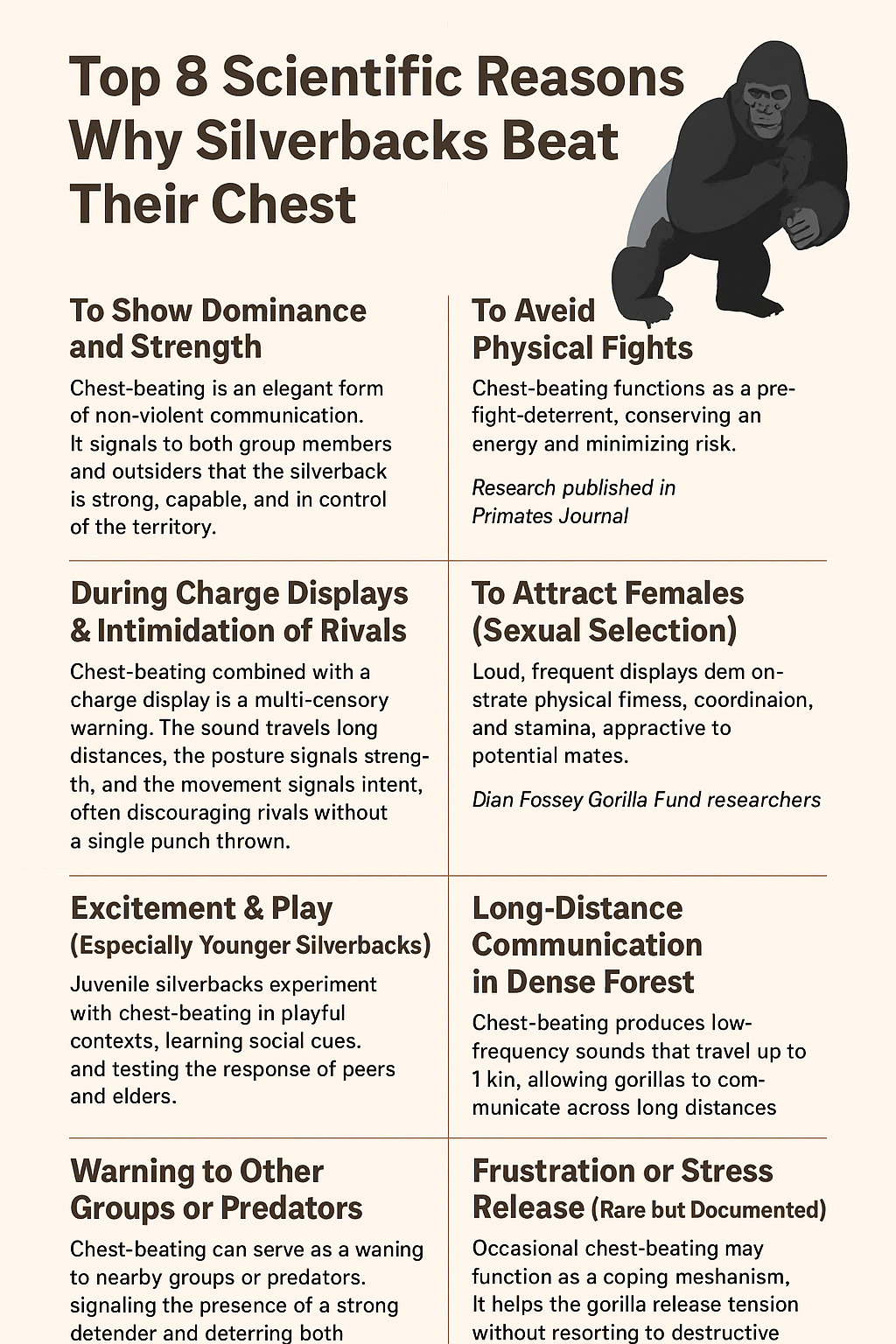
Top 8 Scientific Reasons Why Silverbacks Beat Their Chest
Silverback gorillas are among the most powerful primates on Earth, and their chest-beating behavior is one of the most iconic and misunderstood aspects of their communication.
Scientists have studied this display extensively, revealing multiple functional purposes beyond sheer intimidation.
Below are the eight core scientific reasons why silverbacks beat their chest, with expert insights from leading primatologists.
1. To Show Dominance and Strength
The most common reason silverbacks beat their chest is to assert dominance within their group and over rivals. A loud, rhythmic chest-beat communicates the silverback’s physical power without resorting to direct confrontation.
Dr. Tara Stoinski, President and CEO of the Gorilla Doctors and Dian Fossey Gorilla Fund, explains:
“Chest-beating is an elegant form of non-violent communication. It signals to both group members and outsiders that the silverback is strong, capable, and in control of the territory.”
By displaying strength audibly and visually, silverbacks reduce the need for risky fights, maintaining their leadership and protecting their family group efficiently.
2. To Avoid Physical Fights
Silverbacks are immensely strong, and even a minor fight can lead to serious injury or death. Chest-beating often prevents physical altercations by making rivals aware of the silverback’s dominance.
According to research published in Primates Journal:
“Most aggressive interactions in gorillas are resolved through displays rather than combat. Chest-beating functions as a pre-fight deterrent, conserving energy and minimizing risk.”
This energy-efficient behavior is crucial in dense forests where hunting or large territorial battles are impractical.
3. During Charge Displays & Intimidation of Rivals
Chest-beating is often combined with a charge display—a dramatic movement involving running forward, hooting, and striking the ground. This amplifies the threat, making the silverback appear larger and more intimidating.
Primatologist Dr. Martha Robbins notes:
“When a silverback charges while chest-beating, it creates a multi-sensory warning. The sound travels long distances, the posture signals strength, and the movement signals intent, often discouraging rivals without a single punch thrown.”
Such displays maintain social hierarchy while minimizing actual violence.
4. To Attract Females (Sexual Selection)
Chest-beating also serves as a sexual signal. Loud, frequent displays demonstrate physical fitness, coordination, and stamina—qualities attractive to potential mates.
Dian Fossey Gorilla Fund researchers highlight:
“Females are more likely to remain close to or choose males who demonstrate vigor and leadership through chest-beating and other displays. It is an evolutionary tool for sexual selection.”
This behavior emphasizes the silverback’s role as a protector and provider, reinforcing reproductive success.
5. Excitement & Play (Especially Younger Silverbacks)
While adult silverbacks use chest-beating primarily for dominance, younger silverbacks may beat their chests during play or excitement, often mimicking older males.
Dr. Tara Stoinski observes:
“Juvenile silverbacks experiment with chest-beating in playful contexts, learning social cues and testing the response of peers and elders.”
Playful chest-beating helps develop muscle coordination, social awareness, and early leadership skills.
6. Long-Distance Communication in Dense Forest
Gorilla habitats are often dense tropical forests, where visual signals are limited. Chest-beating produces low-frequency sounds that travel up to 1 km, allowing gorillas to communicate across long distances.
According to field studies:
“Chest-beating functions as an acoustic beacon. It informs other gorillas of the silverback’s location, alerting both allies and potential competitors.”
This ability is critical for maintaining group cohesion and defending territories without constant visual contact.
7. Warning to Other Groups or Predators
Beyond intraspecies communication, chest-beating can serve as a warning to nearby groups or predators. It signals the presence of a strong defender and can deter both rival gorillas and predatory animals.
Dr. Robbins explains:
“Chest-beating may act as a psychological deterrent. Predators often avoid confrontations with healthy adult males capable of such displays.”
By broadcasting their presence audibly, silverbacks enhance safety for the entire troop.
8. Frustration or Stress Release (Rare but Documented)
Though less common, some studies have recorded silverbacks chest-beating as a response to frustration or stress—for instance, when unable to access food, or when a rival is nearby.
Dian Fossey Gorilla Fund notes:
“Occasional chest-beating may function as a coping mechanism. It helps the gorilla release tension without resorting to destructive behavior.”
Such instances are rare but illustrate that chest-beating is multifaceted, combining social, reproductive, and emotional functions.
Conclusion
Silverback chest-beating is far more than a display of brute force. From asserting dominance and avoiding conflict to attracting mates and communicating over long distances, this behavior is a sophisticated, multi-purpose form of communication.
By understanding the science behind it, we gain insight into gorilla intelligence, social structure, and evolutionary adaptation. As Dr. Stoinski emphasizes:
“Observing chest-beating gives us a window into the complexity of gorilla societies—where strength, strategy, and subtle social cues intertwine.”
Famous Chest-Beating Moments in Uganda, Rwanda & Congo
Chest-beating is not just a scientific behavior—it’s also a spectacle that has fascinated tourists, researchers, and wildlife enthusiasts across East and Central Africa.
Some silverbacks have become almost legendary for their dramatic displays, often captured in stunning video footage.
Titus (Rwanda) – The Most Filmed Silverback
Titus, a dominant silverback in Rwanda’s Volcanoes National Park, is arguably the most photographed and filmed gorilla in the world.
Over the past decade, Titus has been the subject of countless documentaries, viral clips, and trekking footage, largely due to his powerful, rhythmic chest-beats.
Observers note that his displays are exceptionally deliberate—each sequence of 9–12 beats followed by a roar that echoes through the misty forest valleys.
Tourists often describe feeling the vibrations in their chest while watching him, an unforgettable reminder of nature’s raw power.
Bwindi Impenetrable Forest (Uganda) – Viral Sensations
Uganda’s Bwindi Impenetrable Forest is home to several habituated silverback families, each with chest-beating moments that have gone viral.
Recent footage from 2024 shows a silverback in the Rushegura family beating his chest during a morning patrol, sending a clear warning to neighboring groups.
These viral videos, shared widely on social media, showcase the gorilla’s physical strength and social intelligence, captivating audiences worldwide.
Many trekkers report that witnessing a chest-beat in person is far more impressive than any video.
Virunga National Park (DRC) – Rangers & Gorilla Interactions
In the Democratic Republic of Congo, Virunga National Park rangers have documented chest-beating incidents during both research and patrols.
Some displays occur when gorillas sense humans nearby or respond to potential rival groups. These interactions highlight how chest-beating functions as both a territorial and communication tool.
One memorable 2023 encounter captured a silverback charging and beating his chest near rangers, who stayed at a safe distance while observing the behavior for conservation research.
Personal Gorilla Trekking Stories
Many travelers recount heart-pounding experiences of chest-beating firsthand. One trekker in Bwindi described:
“We were sitting quietly, and suddenly the silverback pounded his chest. The sound shook the forest floor, and I felt it reverberate through my body. It was a moment of awe and respect I’ll never forget.”
These personal stories add depth to scientific observation, showing how chest-beating combines power, communication, and emotional impact.
Whether captured on film or experienced in person, these moments continue to reinforce why silverbacks are among the most iconic animals on the planet.
Differences Between Mountain Gorilla Troops (Uganda, Rwanda, Congo)
Mountain gorilla troops vary significantly across Rwanda, Uganda, and the Democratic Republic of Congo, shaped by geography, habitat, and human interactions.
These differences are particularly noticeable in chest-beating behavior, social dynamics, and territorial patterns.
Rwanda – Volcanoes National Park
In Rwanda’s Volcanoes National Park, troops such as those led by famous silverbacks like Titus tend to occupy smaller, well-defined territories in bamboo and montane forest zones.
The dense, layered forest encourages frequent chest-beating, as silverbacks assert dominance over nearby groups or respond to occasional human presence.
Observers often note that chest-beating here is deliberate and resonant, echoing across the steep slopes, signaling both authority and territorial boundaries.
Uganda – Bwindi Impenetrable Forest
Bwindi’s gorilla troops inhabit a more fragmented, densely vegetated landscape. Troop ranges are often larger, and visibility is limited by thick undergrowth.
As a result, chest-beating is more sporadic but intense, typically occurring during encounters with rival males or unexpected disturbances.
The challenging terrain means silverbacks rely on sound to communicate over distance, making chest-beating a crucial tool for maintaining cohesion and asserting leadership within their extended groups.
DRC – Virunga National Park
In Virunga, gorilla families navigate rugged volcanic slopes and open meadows, exposing them to both forested cover and open spaces.
Chest-beating here often appears more defensive and reactive, particularly in response to nearby humans or neighboring groups.
The terrain allows displays to be highly visible, serving both as intimidation and social signaling, but the vast ranges reduce overall frequency compared to Rwanda.
Terrain and Chest-Beating Frequency
Overall, geography plays a key role in how often gorillas chest-beat. Dense, enclosed forests like Bwindi encourage fewer but louder, more targeted beats, while steep volcanic slopes in Rwanda lead to frequent, echoing displays.
Open or mixed terrain in Virunga results in visual as well as auditory displays, making chest-beating both a communication and a territorial tool adapted to local conditions.
These subtle but important differences highlight how habitat shapes both behavior and social dynamics in mountain gorilla troops across East and Central Africa.
Conservation Angle: Why Understanding This Behavior Helps Save Gorillas
Chest-beating is more than a dramatic display—it is a vital behavior that aids conservation efforts across Uganda, Rwanda, and the Democratic Republic of Congo.
For conservationists and rangers, understanding when and why silverbacks beat their chests provides key insights into troop dynamics, territorial boundaries, and potential conflicts.
By monitoring chest-beating patterns, rangers can track silverback movements, anticipate encounters between rival groups, and intervene when necessary to prevent injuries or stress within habituated gorilla families.
This behavioral knowledge directly supports the protection of gorilla populations.
For instance, rangers in Bwindi Impenetrable Forest often interpret chest-beating as a signal of a silverback’s presence in dense forest areas where visual contact is difficult.
Similarly, in Rwanda’s Volcanoes National Park, observing chest-beating sequences helps guides predict troop interactions and maintain safe distances during trekking activities.
Tourism, fueled by gorilla trekking experiences, provides crucial revenue for conservation programs.
Chest-beating moments—often the highlight of a trek—attract wildlife enthusiasts from around the world, generating funds for anti-poaching patrols, habitat restoration, and community-based initiatives.
In the DRC’s Virunga National Park, eco-tourism revenue contributes to both ranger salaries and local community support, incentivizing protection of these endangered primates.
By combining behavioral understanding with responsible tourism, conservationists can safeguard mountain gorillas while offering visitors unforgettable, educational experiences.
In this way, chest-beating is not just a natural spectacle—it is a bridge between science, safety, and sustainable conservation.
Why Choose Go Silverback Safaris Ltd for Your Gorilla Adventure
Choosing the right tour operator can make or break your wildlife experience, and Go Silverback Safaris Ltd stands out as the premier choice for unforgettable gorilla trekking and safari adventures in Uganda, Rwanda, and the DRC.
Here’s why travelers, nature enthusiasts, and adventure seekers trust us:
1. Expert-Led Gorilla Treks and Wildlife Tours
Our team of experienced guides and rangers know the forests and mountains like the back of their hands. From Bwindi Impenetrable Forest to Volcanoes National Park, we ensure you get up close and personal with silverbacks safely, responsibly, and memorably.
2. Tailor-Made Itineraries
Every traveler is unique, and so is every safari. Whether you’re looking for a luxury trek, a family-friendly adventure, or a wildlife photography expedition, we craft itineraries that suit your pace, interests, and comfort.
3. Responsible and Sustainable Tourism
We are committed to conservation and local communities. Your safari supports gorilla protection, anti-poaching initiatives, and local livelihoods, so your adventure also leaves a positive impact on nature and people.
4. Comfort, Safety, and Convenience
From reliable transport to top-notch accommodations, we take care of all the logistics so you can focus on the experience. Our guides are trained in safety and first aid, ensuring peace of mind throughout your journey.
5. Unforgettable Experiences, Every Time
From witnessing chest-beating silverbacks to exploring scenic volcanoes and lush forests, every moment with Go Silverback Safaris Ltd is designed to leave you in awe.
Book Your Safari Today!
Don’t just dream about the wild—live it. Contact Go Silverback Safaris Ltd now to plan your ultimate gorilla trekking and wildlife adventure. Your next great story starts here!