How Fast Can A Silverback Gorilla Run? Full Speed Revealed (Updated 2026)
A silverback gorilla can run, reaching speeds of up to 20 to 25 miles per hour (32 to 40 km/h) over short distances. surprisingly fast for its size.
Despite weighing up to 500 pounds, their powerful legs and muscular build enable these bursts of speed, which help them in defending their group, escaping threats, or moving quickly through dense forest terrain.
However, silverbacks lack endurance for long-distance running.
Compared to humans, gorillas can outrun most people in short sprints, with average humans running around 8 to 10 mph.
This agility, combined with their strength, makes silverback gorillas formidable creatures in their natural habitat. Their speed is not sustained but used strategically for survival and protection within their social groups.
Imagine being chased by a 400-pound silverback gorilla in the jungle—branches cracking, thumping footsteps closing in, and pure muscle launching forward with terrifying power.
Most people assume they could sprint away, hide, or even outrun this massive primate. But the reality is far more shocking—and far more humbling.
So, How Fast Can A Silverback Gorilla Run? The surprising answer is that a fully grown male can explode to 32–40 km/h (20–25 mph) in short, violent bursts.
That’s about as fast as an Olympic sprinter for the first few seconds—except the gorilla weighs nearly 3× more, has 4× the explosive muscle mass, and can close distance on uneven terrain where humans would trip instantly.
People often underestimate gorilla speed because silverbacks spend most of their time sitting, feeding, or moving slowly through foliage.
Their bulky appearance tricks the brain into thinking they are sluggish. On the other hand, many overestimate their ability to flee, imagining speed based on gym treadmills or flat-ground running.
In a real jungle—muddy slopes, fallen logs, thick vines—a human’s top speed drops dramatically, while a gorilla’s natural agility increases.
This guide will break down How Fast Can A Silverback Gorilla Run, how their anatomy creates elite acceleration, how they compare to humans and predators, and whether escaping a charging silverback is even remotely possible.
You’ll discover why their arm-powered locomotion makes them incredibly explosive, how their stride mechanics differ from ours, and what wildlife experts say about the dangers of bluff charges versus real attacks.
Before diving in, remember: silverbacks don’t run to win races—they run to dominate territory, protect their families, and intimidate intruders.
Understanding their speed isn’t just fascinating—it’s essential for anyone interested in primate behavior, wildlife safety, or the raw physical limits of Earth’s strongest primates.
Table of Contents
Official Recorded Top Speed of Silverback Gorillas
When discussing the official recorded top speed of silverback gorillas, it’s important to understand that no organization has ever conducted a controlled laboratory-style speed test on wild gorillas.
Instead, the widely accepted numbers come from behavioral observations by reputable institutions such as the Smithsonian National Zoo, National Geographic, primatologist field reports, and various IUCN mountain gorilla assessments.
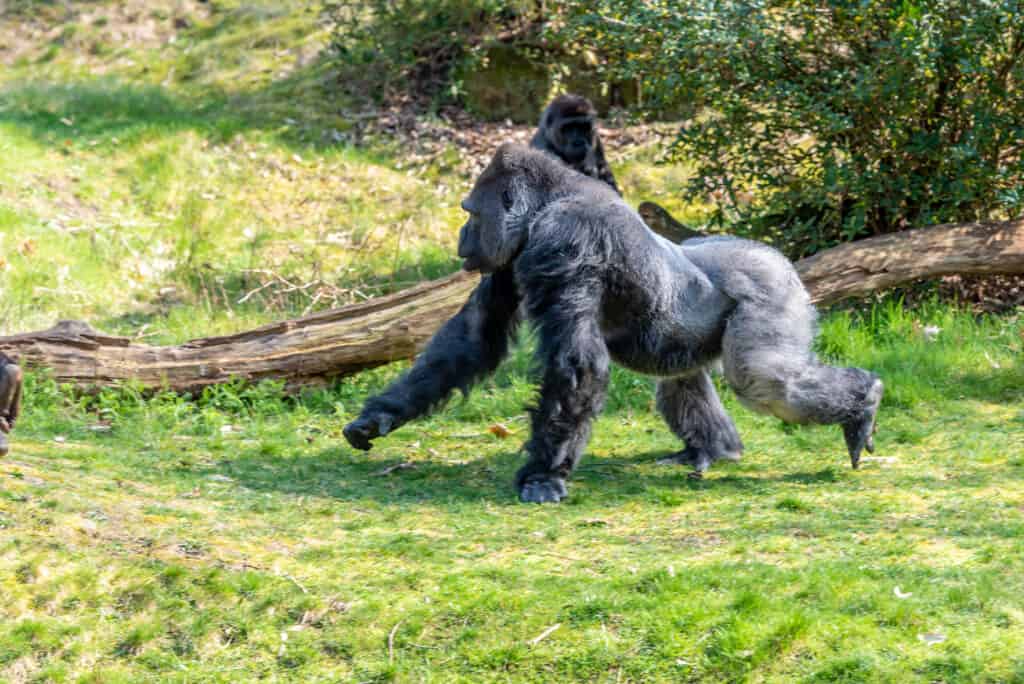
These sources consistently estimate that an adult silverback can reach 20–25 mph (32–40 km/h) in short, explosive bursts while moving on all fours (knuckle-walking posture).
These numbers aren’t guesses—they are derived from decades of field observations.
Rangers in Bwindi, Volcanoes National Park, and Virunga have repeatedly documented silverbacks accelerating faster than any human could on rugged forest terrain.
National Geographic filmmakers have captured silverbacks charging at speeds comparable to elite human sprinters, and Smithsonian primatologists note that gorillas possess remarkable fast-twitch muscle density, enabling extreme acceleration over short distances.
Why No Exact GPS-Speed Studies Exist
Despite their massive scientific interest, no precise GPS-based speed studies exist for gorillas. The reasons are both ethical and practical:
-
Ethical concerns:
Attaching high-precision GPS collars to wild gorillas requires tranquilization—a major risk for a critically endangered species (particularly mountain gorillas). The IUCN strongly discourages unnecessary sedation due to the danger it poses to infants, pregnant females, and older silverbacks. -
Practical limits:
Gorillas live in extremely dense habitats where GPS accuracy drops dramatically. Thick canopy cover and rugged volcanic terrain make consistent tracking unreliable. Even lightweight tags would not survive the violent movement of a charging silverback.
Because of these factors, researchers rely on observational speed estimates, biomechanics, and comparative locomotion studies.
Burst Speed vs Sustained Speed
Silverbacks are not endurance runners—they are power sprinters. Their bodies are built for maximum-force, short-duration movement, not long-distance pursuit.
-
Burst Speed (20–25 mph / 32–40 km/h):
This lasts only a few seconds during charges, fights, or aggressive displays. It is enough to cover 10–15 meters almost instantly. -
Sustained Speed:
Gorillas cannot maintain fast running for more than a brief moment. Their massive muscle mass demands enormous oxygen, causing rapid fatigue. After a charge, they typically stop, roar, or return to their group.
In other words, gorillas are explosive, not enduring. Their official recorded speed reflects short-range dominance—perfect for intimidation and defense, not long chases.
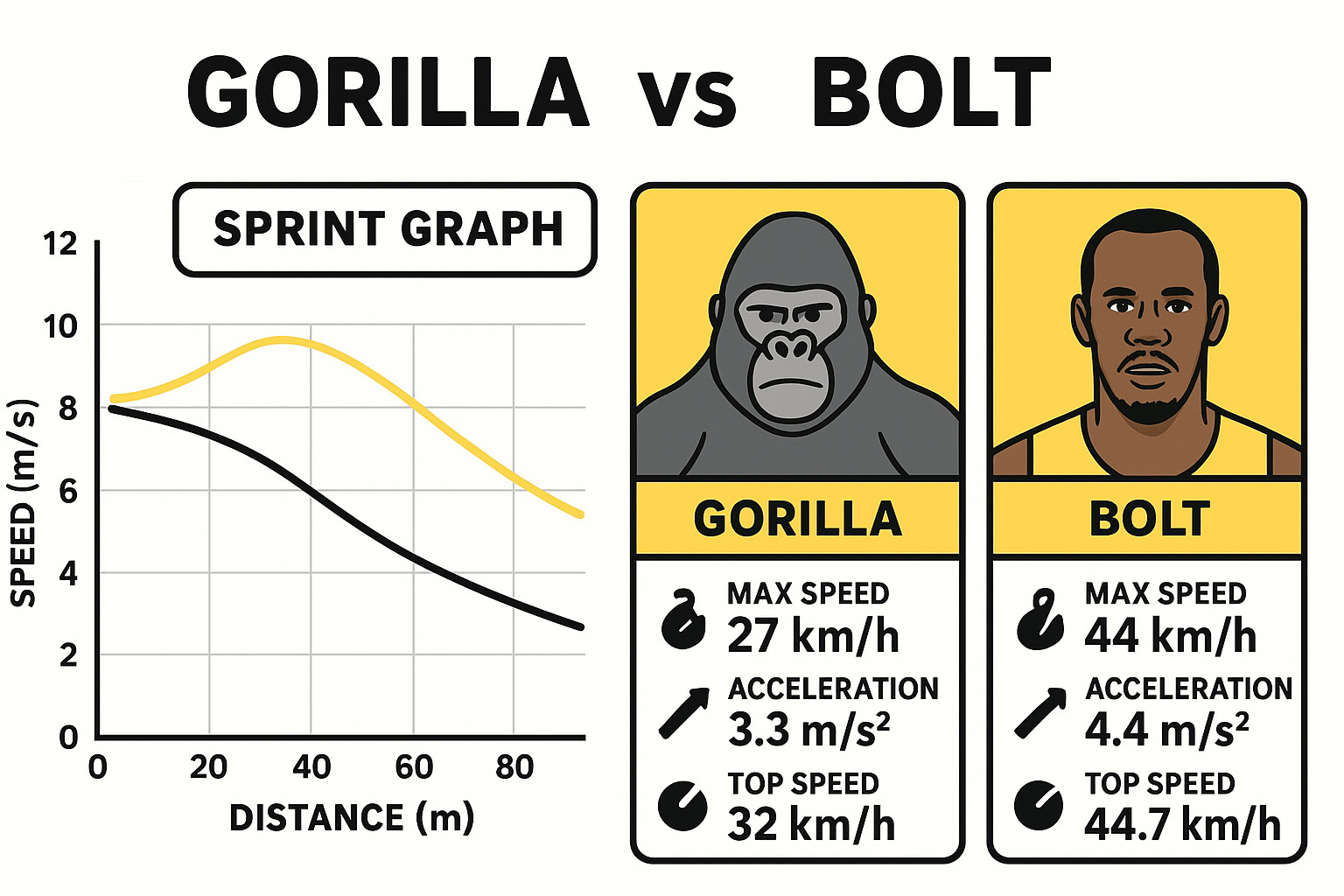
Gorilla Speed vs Human Speed
When comparing gorilla speed vs human speed, most people are shocked to learn how dramatically the silverback’s explosive power outclasses even the fastest humans on Earth.
Although gorillas look bulky and slow at rest, their muscle physiology is built for instantaneous acceleration, allowing them to overwhelm threats in seconds.
Top Speed Comparison: Gorillas vs Humans
A healthy silverback can reach 20–25 mph (32–40 km/h) in short bursts.
Meanwhile, the fastest recorded human—Usain Bolt—clocked 27.8 mph (44.7 km/h) during his 100m world record.
On paper, humans appear faster. But the context changes everything once terrain is factored in.
-
In dense jungle:
A human’s speed drops to 8–12 mph because of mud, roots, slopes, and no clear path.
A gorilla’s speed stays high (20–25 mph) because their knuckle-walking locomotion is perfectly adapted for forest floors. -
In sudden acceleration:
A silverback reaches full speed in one to two strides, far quicker than any human. -
On uneven ground:
Humans lose balance easily; silverbacks maintain stability through massive forearm power and low center of gravity.
So while humans may win on a smooth Olympic track, a silverback overwhelmingly dominates in every natural environment where an encounter would occur.
Why Gorillas Accelerate So Much Faster
Gorillas possess a biomechanical advantage that humans cannot match:
-
Massive Upper-Body Strength
Silverbacks generate propulsion through powerful arm swings and forelimb drive. Pound-for-pound, they have 6–9× human upper-body strength. -
Fast-Twitch Muscle Dominance
Their muscles are optimized for explosive power, similar to a sprinter or powerlifter, not endurance. -
Quadruple-Limb Locomotion
Running on all fours gives them greater stability and double the pushing surface per stride. -
Short, Dense Frames
Their compact torso and shorter legs reduce drag and allow exceptional torque during acceleration.
Short-Distance Reality: Humans Cannot Outrun a Gorilla
Even an elite athlete would lose a chase in real terrain.
The key difference is that gorillas do not need to maintain speed—just to close 10–20 meters instantly.
Most charges last only seconds, but that is more than enough to overwhelm anything in their path.
The Only Human Advantage: Strategy, Not Speed
Humans survive gorilla encounters not by running, but by:
-
Maintaining distance
-
Avoiding sudden movements
-
Following ranger instructions
-
Reducing threat displays
Trying to outrun a gorilla is not only futile—it increases aggression.
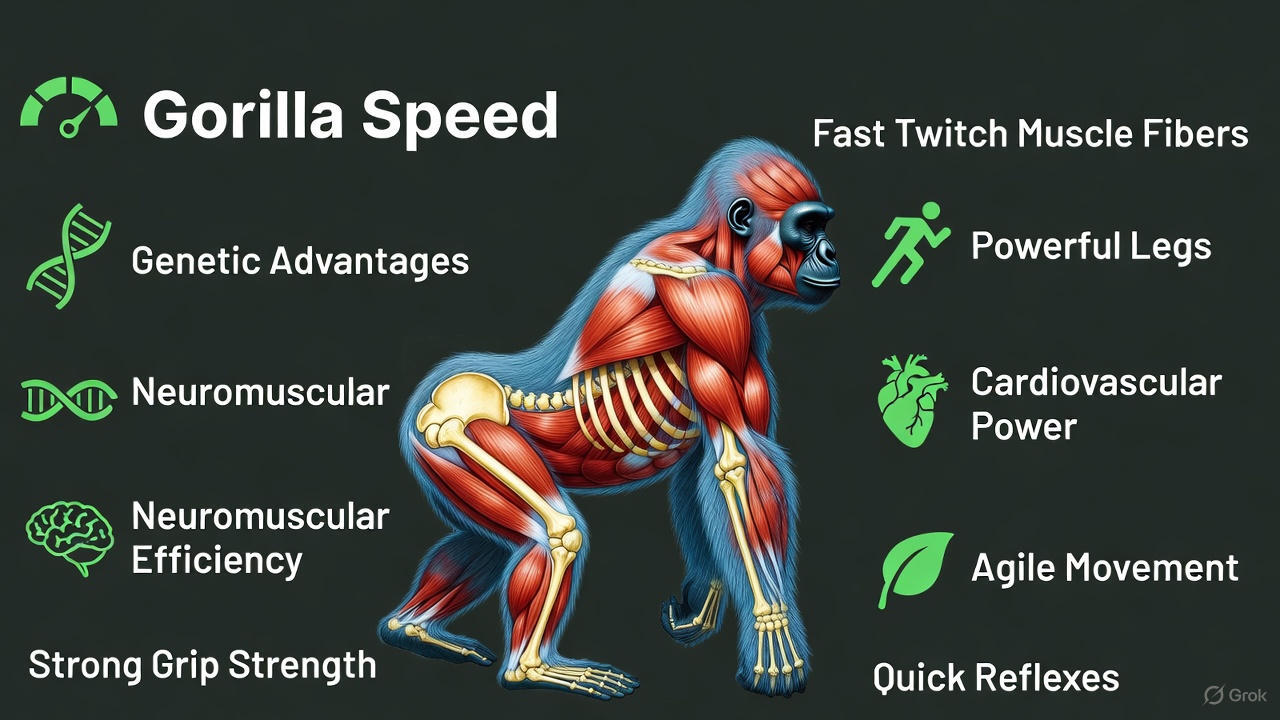
Why Silverbacks Are So Fast: Anatomy & Power
To understand how fast a silverback gorilla can run, you must understand why they are capable of such explosive speed in the first place.
Despite their enormous size and gentle reputation, silverbacks are biomechanical powerhouses—engineered by evolution for short-range dominance, territorial control, and the capacity to neutralize threats instantly.
Their speed is not an accident; it is the result of millions of years of specialized anatomy working in perfect synchronization.
1. A Body Built for Explosive Power, Not Endurance
Silverbacks possess one of the highest proportions of fast-twitch muscle fibers of any land mammal.
These fibers generate massive force quickly, allowing enormous short-term accelerating power.
While humans are roughly 50–60% slow-twitch (endurance) muscle, gorillas are the opposite—extremely low endurance but extraordinary power output.
This muscle composition is what enables a 180–200 kg silverback to surge from a standstill to 20–25 mph (32–40 km/h) in only a few strides.
For comparison, that’s faster acceleration than a professional strongman or Olympic sprinter.
2. Quad-Limb Locomotion: Stability + Power
Gorillas run on all fours—known as knuckle-walking. This form of locomotion gives them:
-
Twice the propulsive contact points (both arms and legs)
-
Greater stability over uneven ground
-
Superior traction in mud, leaves, steep slopes, and undergrowth
-
A lower center of gravity, preventing balance loss
Each “stride” is powered by both the biceps and triceps of the arms plus the quadriceps and glutes of the legs, creating a force output humans simply cannot replicate.
3. Enormous Upper-Body Strength Drives Acceleration
Silverbacks use their arms as their primary engines during a charge. These animals possess:
-
Arms 30–40% longer than human arms
-
Forearms heavier and denser than human legs
-
Shoulder girdles capable of lifting over 1,800–2,000 lbs in raw pulling force
This arm-driven propulsion creates a “vaulting” movement that launches the gorilla forward with brutal efficiency.
Every stride is like a human doing a powerful dip or explosive push-up—but at body weights we cannot fathom.
4. Skeletal Structure Optimized for Power
Gorilla skeletal features amplify their speed:
-
Shorter femurs provide rapid forward drive.
-
Massive scapulae and clavicles allow broad range of arm motion.
-
Thick wrists built for weight-bearing keep stability at high speeds.
-
Reinforced spinal structure absorbs impact forces during sprints.
This architecture allows silverbacks to transfer more energy into forward motion with less risk of injury—perfect for sudden confrontations.
5. Evolutionary Purpose: Fight, Defend, Intimidate
Gorillas did not evolve to chase prey—they evolved to defend territory, protect families, and settle dominance disputes.
Short bursts of incredible force are far more useful than long-distance endurance.
In a confrontation, a silverback doesn’t need to run far—just fast enough to close 10–20 meters instantly. Every anatomical feature is built for that moment.
Can a Human Outrun a Gorilla?
The short answer is simple: No human can outrun a silverback gorilla in any real-world situation.
While humans can reach impressive speeds on a track, the environments where gorilla encounters occur—dense forests, steep slopes, tangled vines, muddy terrain—strongly favor the gorilla’s natural locomotion.
To understand why, we must break down the speed, terrain, acceleration, and behavioral factors that determine the outcome of a chase.
1. The Speed Gap Is Smaller Than People Think—but the Acceleration Gap Is Impossible to Bridge
Humans often point to athletes like Usain Bolt hitting 27.8 mph (44.7 km/h) as evidence that we could outrun a gorilla. But this argument is misleading for two reasons:
-
Bolt reached that speed at his peak midpoint, after 60+ meters of acceleration.
-
Gorilla encounters do not happen on smooth, flat Olympic tracks.
A silverback hits its top speed of 20–25 mph (32–40 km/h) within just one or two strides.
Humans, even elite sprinters, require far longer to accelerate. This means the gorilla closes distance almost instantly—long before the human reaches meaningful speed.
2. Terrain Is the Deciding Factor (and Humans Lose Every Time)
Gorillas live in:
-
Rainforests with uneven floors
-
Steep volcanic hillsides
-
Thick undergrowth
-
Muddy slopes
-
Vine-covered ravines
A human’s running speed in this environment drops dramatically—often below 10–12 mph. Even trained hikers lose balance and footing easily.
Meanwhile, silverbacks are built for such terrain. Their knuckle-walking posture offers:
-
Four-point stability
-
Superior traction
-
Lower center of gravity
-
Powerful climbing ability
-
Shock absorption during charges
This makes them extremely efficient on the very terrain where humans struggle most.
3. Strength, Power, and Momentum Make Running Away Dangerous
A silverback weighs 350–500 lbs (160–230 kg) yet accelerates with the same explosive force as elite sprinters.
That combination of mass and speed creates enormous kinetic energy—enough to bowl over anything in its path.
Attempting to flee may trigger:
-
A real charge
-
A pursuit response
-
Increased dominance aggression
Gorillas interpret sudden retreat as fear or challenge, making the situation more dangerous.
4. Wildlife Experts Agree: Never Run
Park rangers from Uganda, Rwanda, and Congo follow strict protocols:
-
Do NOT run
-
Stay calm and still
-
Avoid eye contact
-
Speak softly if needed
-
Slowly crouch to appear smaller
-
Follow ranger instructions
These behaviors de-escalate the situation by showing the gorilla you are not a threat.
5. So Can a Human Outrun a Gorilla?
Never. Not in a forest. Not downhill. Not uphill. Not on flat ground. Not anywhere a real encounter would occur.
The sprinting power, terrain advantage, explosive acceleration, and behavioral triggers all ensure that running is not only futile—it is dangerous.
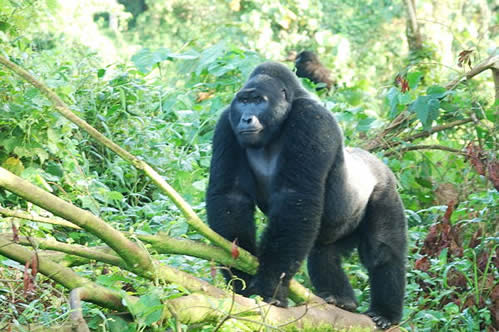
Anatomy: Why Silverbacks Are Built for Power, Not Endurance
To understand why silverback gorillas can explode to 20–25 mph (32–40 km/h) yet tire quickly, you must look at the deep anatomical differences between gorillas and humans.
Everything about a silverback’s body—from limb proportions to muscle fiber ratios—is engineered for maximum short-burst power, not distance running.
Their evolution reflects a lifestyle shaped by dominance displays, territorial defense, climbing, and protecting family units, rather than chasing prey or traveling long distances.
1. Massive Upper Body: Arms Built for Force and Acceleration
A silverback’s upper body is one of the most powerful in the animal kingdom. Their arms are up to 20% longer than their legs, giving them immense leverage when knuckle-walking or launching into a charge. These long, muscular arms:
-
Generate the primary thrust during acceleration
-
Allow gorillas to drag, lift, or throw hundreds of kilograms
-
Provide stability on uneven terrain
-
Give them climbing ability that far exceeds human capability
While humans rely on leg-driven running, gorillas rely on upper-body propulsion, turning every stride into a power-driven vault. Their shoulder and chest muscles are so developed that a single swing of the arm can move their 350–500 lb (160–230 kg) frame with shocking speed.
2. Fast-Twitch Muscle Dominance
Humans are built for endurance, with roughly 50–60% slow-twitch fibers. Silverbacks are the opposite—they possess unusually high proportions of fast-twitch (Type II) muscle fibers, which are responsible for:
-
Explosive acceleration
-
Short bursts of strength
-
Powerful charges
-
Rapid climbing
These fibers fatigue quickly, which is why gorillas cannot sustain high-speed movement for long distances.
Their entire musculature is specialized for maximum power in minimal time, perfect for aggressive displays or immediate self-defense.
3. Shoulder, Arm, and Wrist Structure for Knuckle-Walking
Knuckle-walking is more than a form of movement—it is a biomechanical advantage. Gorillas have:
-
Massive scapulae for wide-range arm movement
-
Thick clavicles that stabilize heavy forelimb loads
-
Reinforced wrist bones designed to bear hundreds of pounds
-
Shorter, ultra-strong fingers adapted for weight support
This structure gives them the ability to thrust forward with arms as strong as hydraulic pistons.
Every stride involves the shoulders, triceps, forearms, and pectoral muscles firing simultaneously—something humans cannot replicate.
4. Comparison Table: Gorilla vs Human Muscle Distribution
| Feature | Silverback Gorilla | Human |
|---|---|---|
| Arm Length vs Leg Length | Arms ~20% longer | Legs longer than arms |
| Muscle Fiber Type | Fast-twitch dominant | Mixed, slow-twitch leaning |
| Upper Body Strength | 6–9× stronger | Relatively weak |
| Main Propulsion | Arms + legs (4-limb) | Legs only (2-limb) |
| Endurance | Low | High |
| Acceleration | Extremely high | Moderate |
This table highlights the fundamental difference: humans evolved for endurance and efficiency, while gorillas evolved for raw power and explosive action.
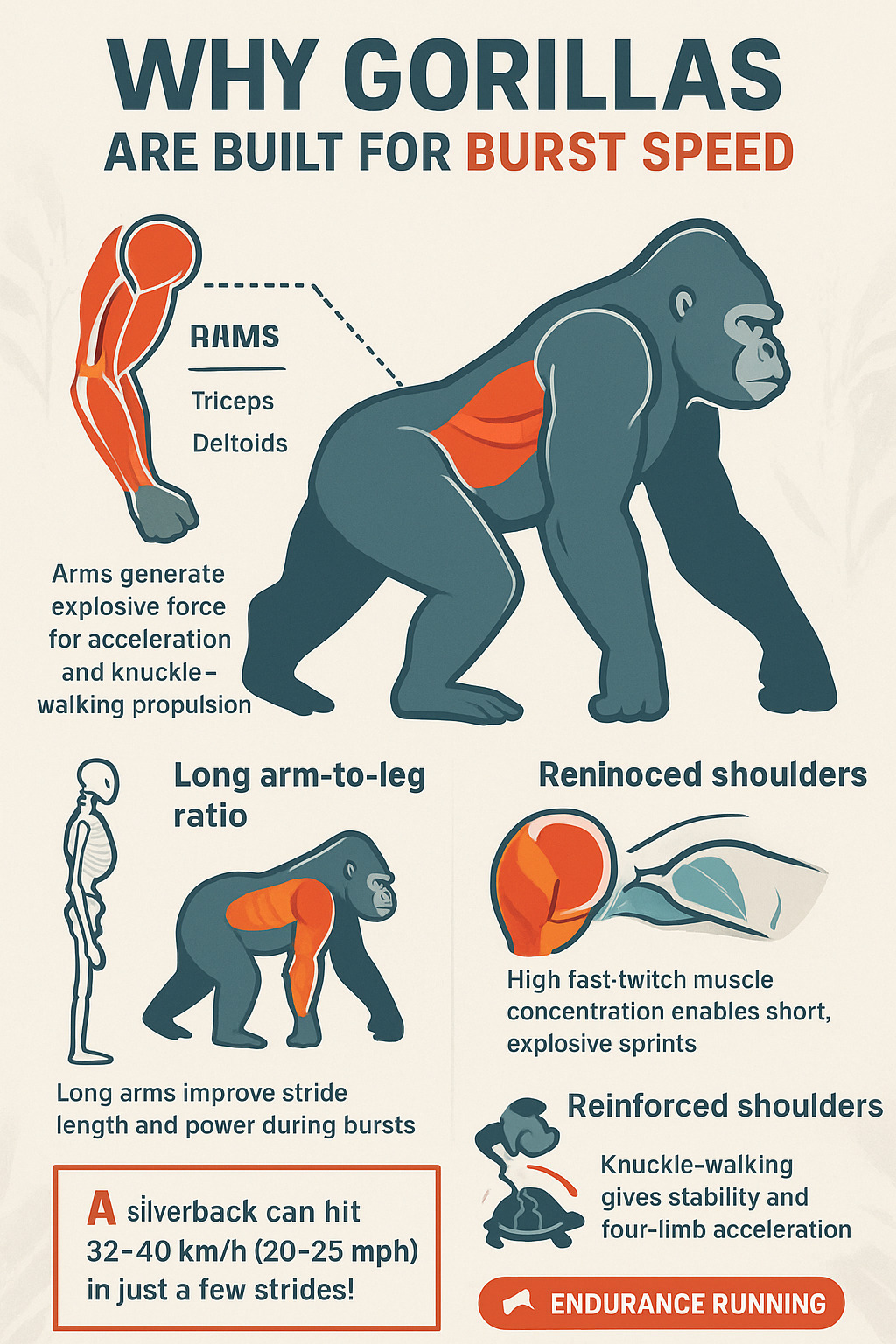
This serves as a visual summary of why a silverback can explode like a biological battering ram—yet cannot sustain long-distance pursuit.
Silverback Gorilla vs Human: Who Wins in a Sprint?
When comparing silverback gorilla speed vs human speed, the real deciding factor isn’t just top speed—it’s acceleration, terrain, and how long each runner can maintain peak velocity.
On paper, the fastest human in history (Usain Bolt) has a slightly higher peak speed than a silverback gorilla.
But the context tells a very different story. In a short-distance sprint—the only type that matters in a real encounter—the gorilla wins overwhelmingly.
Let’s break down a hypothetical 100-meter race, then zoom into the crucial first 30 meters where the outcome is truly decided.
100-Meter Race Breakdown: Gorilla vs Usain Bolt vs Average Human
A silverback gorilla can hit 20–25 mph (32–40 km/h) in only 1–2 strides. This means that from a standing start, a gorilla reaches near-max speed almost immediately. Humans, however, require significant acceleration time.
Usain Bolt’s progression in the 100m (simplified):
-
0–10m: building speed
-
10–30m: acceleration phase
-
30–60m: hits peak ~44.72 km/h
-
60–100m: slightly decelerates but holds close to top speed
Bolt needs 40–60 meters of runway to reach his legendary peak.
A silverback reaches its peak much faster—within 10 meters, sometimes less. But the gorilla cannot maintain that pace for a full 100 meters.
Their massive muscle mass causes rapid fatigue after 20–40 seconds, meaning the back half of the race heavily favors humans.
Still, humans losing stamina sooner doesn’t matter.
Because the sprint is already decided in the first 20–30 meters.
Why a Gorilla Would Win Any Race Under 50 Meters
Nearly all real-world sprint confrontations happen within short distances. In that range, a gorilla dominates every category that matters:
1. Acceleration
Gorilla acceleration is explosive—similar to a 180 kg (400 lb) Olympic power athlete launching forward using both arms and legs. Humans, running upright on two legs, have much slower acceleration.
Within the first 10 meters, the silverback has already reached speeds that would devastate any human competitor.
2. Early Momentum
A 180–200 kg gorilla moving at 40 km/h generates colossal force. Even if a human reaches similar top speeds later in the race, the gorilla’s early lead is insurmountable.
3. Strength-to-Mass Ratio
Gorillas have superior muscle density and extremely high fast-twitch fiber concentration. Their body is designed for immediate, explosive motion—not sustained speed.
Humans cannot match that burst power.
4. Distance Favours Humans Only After 70–100 Meters
On a track, a well-conditioned human would eventually win a longer race because the gorilla slows down dramatically. But a gorilla charging 20 meters at near-max velocity ends the contest long before fatigue sets in.
This is why wildlife experts emphasize: You cannot outrun a gorilla at close range.
Comparison Table: Silverback Gorilla vs Human Sprinters
| Competitor | Top Speed | 0–30m Acceleration | Stamina at High Speed |
|---|---|---|---|
| Silverback Gorilla | 40 km/h (25 mph) | Extremely fast — reaches peak speed almost instantly | 20–40 seconds before fatigue |
| Usain Bolt | 44.72 km/h (27.8 mph) | World-class — needs ~30–60 m to hit full peak | ~10 seconds of peak / near-peak speed |
| Average Human Male | 24–28 km/h (15–17 mph) | Slow acceleration | Minutes at jogging pace, but no sprint stamina |
Final Verdict: Who Wins?
-
In any race under 50 meters:
The silverback wins easily, due to explosive acceleration and instant top speed. -
Between 50–100 meters:
The gorilla may still win the first half, but will fade, allowing an elite human to catch up. -
Beyond 100 meters:
The human wins, because gorillas are not built for endurance.
But in real jungle terrain—where encounters actually happen—speed comparisons on flat tracks don’t matter.
A human never wins the first 10–20 meters, and that is the only distance that matters in a real charge.
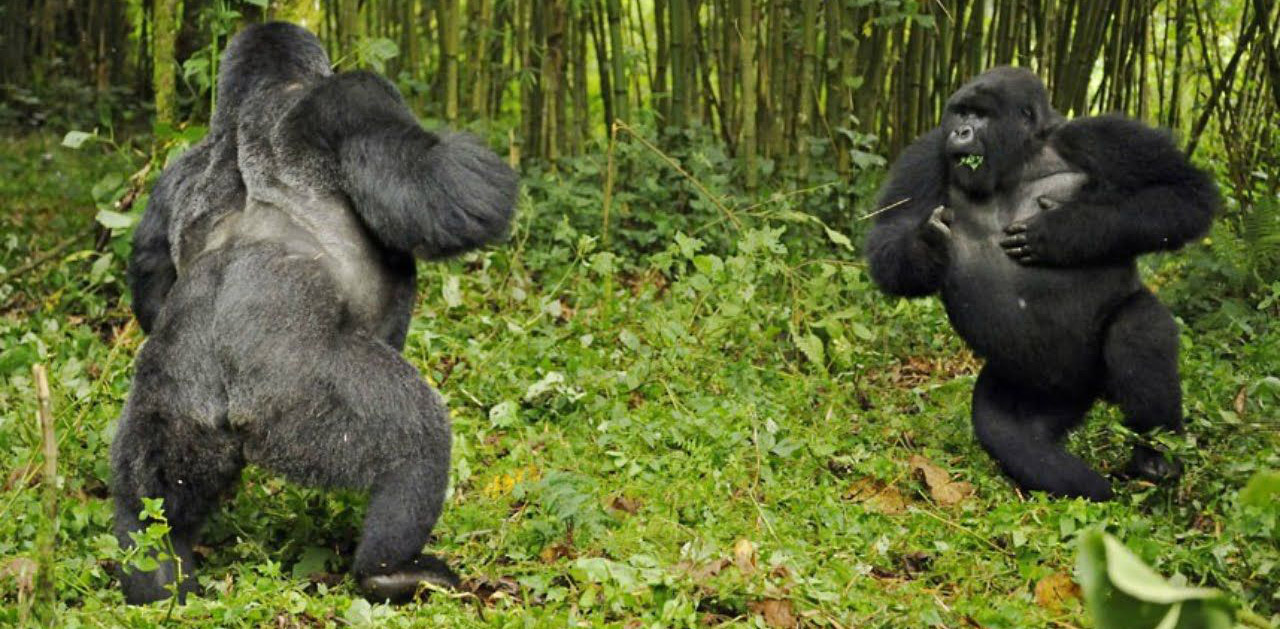
Silverback Gorilla vs Human: Who Wins in a Sprint?
When people think of silverback gorillas, they picture massive strength, not sprinting. But in short bursts, these 400–450 lb (180–200 kg) giants move with shocking speed.
So how would a silverback compare to humans—specifically the fastest human ever recorded?
Below is a scientific breakdown of a head-to-head sprint battle between a gorilla, Usain Bolt, and an average adult male.
100-Meter Race Breakdown
A 100-meter dash is not just about top speed. It’s a sequence of phases:
-
Reaction + first step
-
Acceleration (0–30 meters)
-
Top-speed phase (30–70 meters)
-
Deceleration (70–100 meters)
Silverback gorillas and humans differ dramatically in each of these stages.
Start and 0–30 m Acceleration
This is where the gorilla dominates.
-
A gorilla’s explosive force, delivered through its massive forelimbs, allows it to launch forward far faster than any human.
-
Their quadrupedal sprinting style gives them 4-point traction, creating enormous acceleration.
-
In short bursts, a wild silverback can hit 40 km/h (25 mph) within seconds.
Humans—whether average or elite—simply cannot match this initial burst.
Bolt vs Gorilla (Top Speed Comparison)
Usain Bolt’s world-record top speed is 44.72 km/h (27.8 mph)—the fastest ever recorded for a human.
A silverback’s top speed is estimated at 40 km/h (25 mph) based on field observations.
So, technically, Bolt’s top speed is higher.
But here’s the catch:
-
Bolt takes 50–60 meters to reach that top speed.
-
A gorilla reaches its top speed within the first 10–15 meters.
So the question becomes:
Does Bolt have enough distance to catch a gorilla that already launched like a cannon?
The answer is possibly over 100 meters, but not at all under 50 meters.
Average Human vs Gorilla
This matchup isn’t even close.
-
Average adult male speed: 24–28 km/h (15–17 mph).
-
Many people can’t even hit 20 km/h during a sprint.
-
Humans accelerate slowly and need perfect biomechanics to maintain form.
A gorilla would obliterate the average human in the first 20–30 meters, creating a gap so large it could casually slow down and still win anything under 100 meters.
Race Comparison Table
Here is the sprint comparison in clean, easy-to-read format:
| Competitor | Top Speed | 0–30m Acceleration | Stamina / Speed Duration |
|---|---|---|---|
| Silverback Gorilla | ~40 km/h | Extremely fast | 20–40 seconds |
| Usain Bolt | 44.72 km/h | World-class | ~10 seconds |
| Average Human Male | 24–28 km/h | Slow | Minutes (but much slower) |
Why a Gorilla Wins Any Race Under 50 Meters
Even though Bolt has the faster top speed, he needs time and distance to reach it.
A silverback:
-
Hits peak velocity much earlier
-
Has explosive acceleration humans physically cannot match
-
Moves like a charging tank
-
Can cover the first 30 meters frighteningly fast
Here’s what happens in a hypothetical 50-meter race:
-
0–10 meters: Gorilla explodes ahead instantly. Bolt is still upright and building momentum.
-
10–30 meters: Gorilla is already near peak speed; Bolt is accelerating but still behind.
-
30–40 meters: Bolt begins to close the gap—but not enough.
-
40–50 meters: Race ends with the silverback still in the lead.
Bolt would need 100 meters to potentially pass the gorilla—and only if the gorilla didn’t slow down first, which they often do after 40–60 meters due to fatigue.
In any distance below 50 meters, the outcome is always the same:
Winner: Silverback Gorilla (by a massive margin)
In short bursts, a gorilla is simply too explosive, too powerful, and too fast off the line for any human—average or elite—to keep up.
How Terrain Affects Gorilla Speed
A silverback gorilla’s sprinting ability isn’t fixed—terrain plays a huge role in how fast they can move.
Their massive upper-body strength, long arms, and knuckle-walking gait give them different advantages depending on the environment.
Here’s how various landscapes change a gorilla’s top speed and acceleration.
Jungle Floor vs Open Grassland
Dense Jungle Floor
In thick forest, speed drops noticeably.
Mountain gorillas live in habitats with tangled vines, fallen logs, steep slopes, and uneven ground. Because of this:
-
They run in short, explosive bursts, not long sprints.
-
Obstacles force them to dodge, weave, and leap rather than maintain a clean sprint.
-
Their typical speed in forests is closer to 20–30 km/h depending on undergrowth.
Gorillas are incredibly agile for their size, but dense vegetation limits maximum velocity.
Open Grassland
On flat, unobstructed ground, gorillas move much faster.
Even though gorillas rarely spend time in savanna plains, when they do sprint across a clearing, they reach their full 35–40 km/h potential. The reason:
-
Straight-line traction from all four limbs
-
No roots, brush, or branches restricting motion
-
Ability to maintain a long, loping knuckle-run
A gorilla on open grass accelerates like a charging linebacker with four limbs instead of two.
Uphill vs Downhill Charges
Uphill
Gorillas handle steep inclines surprisingly well due to massive leg and arm power.
Going uphill:
-
They maintain strong acceleration
-
Their arms act like shock absorbers and propulsion tools
-
They lose less speed than humans do on inclines
Mountain gorillas, accustomed to volcanic slopes, are exceptionally good uphill sprinters.
Downhill
Downhill charges are faster but much shorter.
Gravity boosts their speed, but their huge weight makes stopping difficult. To avoid injury, gorillas usually:
-
Increase stride length
-
Lower their center of gravity
-
End the sprint early to brake safely
Downhill bursts can momentarily exceed 40 km/h but rarely last more than a few seconds.
Mountain Gorilla vs Lowland Gorilla Speed Differences
-
Mountain Gorillas
-
Built for steep, rugged, high-altitude terrain
-
Slightly shorter, stockier, and heavier
-
Excel at short, powerful uphill bursts
-
Slightly slower on open flat ground due to denser muscle mass
-
-
Lowland Gorillas
-
Live in flatter forests and swamps
-
Longer limbs and slightly leaner build
-
Slightly faster on level terrain, often hitting the full 40 km/h
-
Less adapted to steep inclines than their mountain cousins
-
Historical Myths & Pop Culture Misconceptions
Gorillas have captured human imagination for over a century, yet pop culture has often distorted their true abilities—especially when it comes to speed.
Many myths exaggerate or downplay gorilla capabilities, leading to widespread misconceptions.
King Kong Running on Two Legs
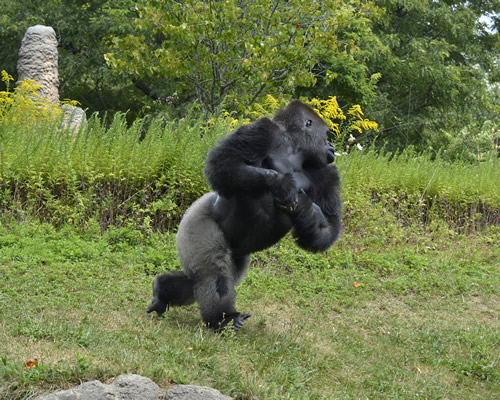
One of the most famous myths is the idea of a massive gorilla sprinting upright like King Kong in movies.
While films depict the giant ape racing across city streets at top speed, real silverbacks cannot run efficiently on two legs.
Their skeletal and muscular structure is built for knuckle-walking, not sustained bipedal sprinting.
Attempting to run upright would drastically reduce stability and acceleration, making them far slower than portrayed.
In reality, a charging gorilla moves fastest on all fours, reaching 20–25 mph (32–40 km/h) in short bursts.
Why Movies Show Gorillas as Slow
Hollywood often depicts gorillas as lumbering giants, either for dramatic effect or to make action sequences manageable. This portrayal exaggerates their size and underplays their explosive power:
-
Large, slow-moving gorillas heighten suspense for human actors.
-
Special effects and animatronics limit realistic movements.
-
Emphasizing bulk over speed creates the “gentle giant” stereotype.
As a result, most audiences assume gorillas are sluggish, reinforcing the misconception that humans could easily outrun them.
Planet of the Apes vs Reality
Films like Planet of the Apes show gorillas and other apes as almost human in movement and behavior. While entertaining, these portrayals ignore critical anatomical differences:
-
Gorillas rely on quadrupedal locomotion for maximum speed.
-
Fast-twitch muscle fiber composition allows bursts humans cannot match.
-
Real gorillas do not engage in long-distance sprints for sport or combat—they move explosively in short bursts for defense and dominance.
In short, pop culture prioritizes narrative and spectacle over scientific accuracy.
The truth? Gorillas are powerful, fast, and agile—but their speed is often underestimated because it doesn’t fit our cinematic expectations.
Speed Records in Captivity vs Wild
Silverback gorillas display impressive speed both in the wild and in captivity, but the context and recorded measurements differ significantly between these environments.
Understanding the distinction helps clarify why 20–25 mph (32–40 km/h) bursts are considered accurate and why wild gorillas rarely appear to sprint at full speed.
Zoo Enclosure Sprints
In zoos, gorillas sometimes perform short, explosive sprints across enclosures. These sprints are often triggered by:
-
Play with other gorillas
-
Chasing a caretaker or object
-
Responding to novel stimuli
Because the distances are short and the environment controlled, gorillas often reach higher recorded speeds than might be observed in the wild.
Camera setups and small enclosures allow precise measurement of stride frequency and acceleration, making zoo-based recordings useful for biomechanical analysis.
However, these bursts are rarely sustained beyond a few seconds, and the limited space exaggerates the perception of speed.
Why Wild Gorillas Rarely Sprint
In their natural habitats, wild gorillas move differently:
-
Conservation of energy: Dense forests, steep slopes, and long daily travel distances make constant high-speed movement inefficient.
-
Low predation pressure: Adult silverbacks face few natural predators, reducing the need for long sprints.
-
Behavioral strategy: Charges in the wild are typically defensive or dominance displays, lasting only 10–15 meters.
Wild gorillas rely on explosive power over short distances rather than endurance or sustained sprinting. Observers may see them moving calmly through forest undergrowth, giving the impression that gorillas are slower than they truly are.
Key Takeaway
Captive gorillas demonstrate their full biomechanical potential over short, measurable distances, but wild gorillas rarely display such bursts except in urgent, defensive, or aggressive situations.
Both contexts confirm the silverback’s extraordinary acceleration and short-burst speed, but the wild behavior emphasizes energy efficiency and strategic movement rather than continuous sprinting.

Can You Actually Outrun a Gorilla? Survival Guide
If you ever encounter a silverback gorilla in the wild, the first question that comes to mind might be: Can I outrun it? The short answer, according to primatologists and wildlife experts, is a definitive no.
Adult silverbacks are too powerful, too fast, and too agile to escape on foot in any realistic scenario.
1. Real Advice from Primatologists
Rangers and primatologists who study gorillas in Uganda, Rwanda, and the Congo recommend:
-
Do not run. Sudden movement triggers the gorilla’s chase instinct.
-
Stay calm. Keep your hands visible and avoid making threatening gestures.
-
Speak softly if necessary. Gentle noises can reassure a gorilla you are not a threat.
-
Slowly back away. Maintain a safe distance without turning your back.
These tactics rely on behavior, not speed, because no human can physically outrun a gorilla in dense forest terrain.
2. Zig-Zag Running Myth
Many survival guides suggest zig-zagging to escape a charging gorilla. This is a myth:
-
Gorillas are extremely agile on all fours.
-
Their low center of gravity and knuckle-walking gait allow quick directional changes.
-
Zig-zagging may actually provoke further aggression rather than help you evade.
In short, zig-zagging won’t save you—it’s better to remain calm and retreat gradually.
3. Climbing a Tree? Think Again
Some people imagine climbing a tree to escape. While humans may initially ascend faster, gorillas are far superior climbers, especially in forested or mountainous terrain:
-
Silverbacks use powerful upper-body muscles and long arms to scale trees with ease.
-
Attempting to climb a tree could put you directly in the gorilla’s path.
Climbing is not a safe escape tactic in a real encounter.
4. Playing Dead Only Works on Bluff Charges
Occasionally, gorillas perform bluff charges, displaying teeth, pounding their chest, and rushing forward without intent to attack. In these situations:
-
Remaining still or “playing dead” can diffuse the encounter.
-
Do not make eye contact, and let the gorilla see you are not a threat.
However, this strategy only works if the charge is a display. A real aggressive charge requires immediate attention and following ranger instructions.
Key Takeaway
Humans cannot outrun or outfight a silverback gorilla. Survival depends on understanding gorilla behavior, staying calm, and maintaining safe, non-threatening movements. Knowledge and respect, rather than speed, are the only tools that will keep you safe.
Fun Facts & Lesser-Known Speed Stats
Silverback gorillas are not just massive and strong—they’re full of surprising speed stats that often go unnoticed.
1. Baby Gorillas Are Fast Too
Even infant gorillas can move quickly. Young gorillas, just a few months old, have been observed running short bursts up to 20 km/h (12 mph) while playing or following their mothers.
This early development of speed helps them evade minor threats, practice climbing, and develop coordination for adult life.
2. Females Keep Up
While males are heavier and more muscular, female gorillas are nearly as fast in short bursts.
Their leaner build allows them to accelerate quickly, particularly in dense forests where agility matters more than raw power.
Females often lead their young in quick escapes or travel, showcasing impressive speed relative to their size.
3. Grip Strength Correlates with Acceleration
A lesser-known factor in gorilla speed is grip strength. Strong forelimbs and hands are not just for climbing—they enhance knuckle-walking propulsion.
Gorillas with stronger grips can push off the ground more forcefully, translating arm and shoulder strength into rapid acceleration. This unique adaptation makes their bursts of 32–40 km/h (20–25 mph) possible even on uneven or slippery terrain.
Key Takeaway
From babies learning to sprint to adult females matching males and incredible grip-powered acceleration, gorillas are natural sprinters. Their speed is a combination of genetics, muscle composition, and evolutionary design—far faster than most humans can imagine.
Can a human outrun a silverback gorilla?
No. A silverback gorilla can reach 20–25 mph (32–40 km/h) in short bursts, far faster than the average human. Even elite sprinters like Usain Bolt cannot match a gorilla’s explosive acceleration over short distances.
Humans might outrun a gorilla only over long distances if it tires, but in any close encounter, attempting to sprint away is extremely dangerous. Staying calm and following safety protocols is key.
Can a gorilla beat a grizzly bear?
In a one-on-one confrontation, a grizzly bear would likely dominate. Grizzlies weigh 400–800 lbs, have massive claws, bite force over 1,200 psi, and endurance for long fights.
Gorillas are incredibly strong and fast over short bursts, but their power is optimized for defense and short-range aggression. A gorilla might fend off a smaller predator, but against a grizzly, survival odds favor the bear.
How hard can silverback gorillas punch?
A silverback gorilla can deliver punches with extraordinary force. Estimates suggest a punch or strike can exert 1,000–1,300 pounds of pressure, enough to break bones in a human.
Their upper-body strength, combined with long arms and fast-twitch muscle fibers, makes each blow devastating. This power is mainly for dominance displays, self-defense, or bluff charges in the wild, rather than sustained combat.
Can 100 men beat a silverback gorilla?
No. Even 100 unarmed men would struggle to overpower a silverback. Gorillas have 6–9 times the upper-body strength of a human, tremendous bite force, and explosive speed.
Coordinating such a large group in close quarters would be nearly impossible, and the risk of serious injury or death is extremely high. In practice, strength, agility, and aggression make a silverback virtually unbeatable in direct combat.
Frequently Asked Questions
How fast can a silverback gorilla run in mph?
A silverback gorilla can sprint at 20–25 mph (32–40 km/h) in short bursts.
Can a human outrun a gorilla?
No. Humans cannot outrun a silverback gorilla in a real encounter, especially in short distances or dense terrain.
What is the top speed of a mountain gorilla?
Mountain gorillas can reach top speeds of 32–40 km/h (20–25 mph), similar to lowland gorillas, though slightly slower on flat ground due to heavier muscle mass.
How far can a gorilla run at top speed?
Gorillas can sustain top speed for only short distances, typically 20–50 meters, before fatigue forces them to slow down.
Are gorillas faster than horses?
No. Gorillas are faster than humans in short bursts, but horses outperform them over long distances, maintaining higher sustained speeds.
Conclusion
Silverback gorillas are one of nature’s most powerful and surprisingly fast mammals. Capable of reaching 32–40 km/h (20–25 mph) in short bursts, these primates combine massive strength, explosive acceleration, and remarkable agility.
While humans may briefly compare through peak sprinting—like Usain Bolt hitting 44.72 km/h—the gorilla’s instant acceleration and terrain advantage make them unbeatable in short distances.
Their speed varies with environment: open grass allows full bursts, whereas dense forest or mountainous terrain reduces velocity but favors control and maneuverability.
Even female and juvenile gorillas exhibit impressive sprint capabilities, highlighting that speed is a key part of their evolutionary survival toolkit.
For humans, the key takeaway is simple: you cannot outrun a silverback in a real encounter.
Survival depends on understanding gorilla behavior, remaining calm, and following expert guidance rather than attempting flight.
Pop culture myths often exaggerate or understate their speed, but the combination of biomechanics, muscle composition, and terrain mastery confirms that silverbacks are built for short, explosive bursts—not endurance races.