
How the Gorilla Family Hierarchy Explained: Ultimate Guide 2026
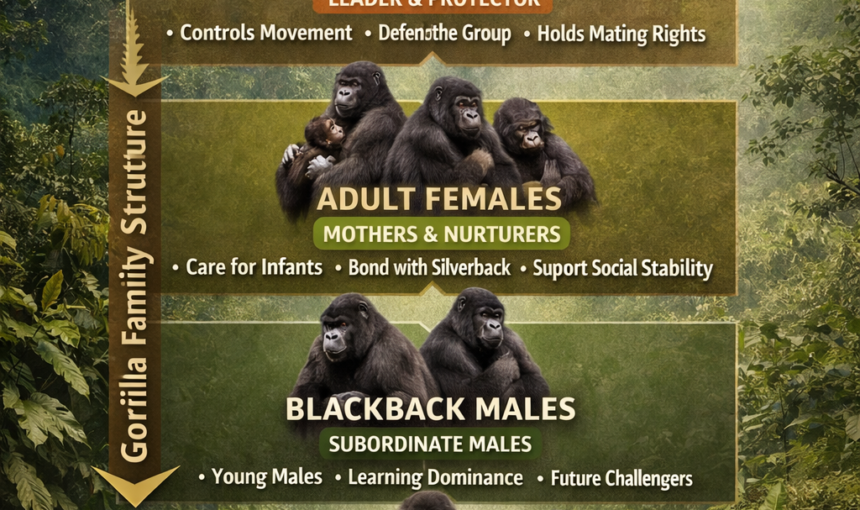
Gorilla Family Hierarchy Explained: Gorilla troops are led by a dominant silverback, the powerful adult male who makes key decisions on movement, nesting, and protection.
In mountain gorillas, groups average 10–20 members (up to 65 recorded), often with one main silverback plus 3–6 adult females, their offspring, and sometimes subordinate silverbacks or blackbacks.
Females maintain their own stable ranking based on age, tenure, and silverback preference. Young gorillas learn hierarchy through play and observation.
The silverback’s chest-beating displays, mediation, and nurturing role (grooming infants, carrying orphans) keep the family cohesive and safe from threats like rival males. This structured yet flexible social system ensures survival and strong bonds.
As an experienced African safari tour operator specializing in gorilla trekking adventures across Rwanda, Uganda, and the Democratic Republic of Congo, we’ve guided countless international travelers from the USA, UK, Europe, Canada, Asia, and the Middle East through the misty forests where these magnificent primates thrive.
Understanding gorilla family hierarchy begins with recognizing the diversity among gorilla species and their subspecies, which directly influences how their social structures form and function.
Gorillas are divided into two main species: the eastern gorilla (Gorilla beringei) and the western gorilla (Gorilla gorilla), each further split into subspecies that exhibit unique adaptations to their environments.
These variations not only affect physical traits like fur color and body size but also play a pivotal role in group dynamics, stability, and hierarchy enforcement.
For instance, mountain gorillas (Gorilla beringei beringei), found in the volcanic highlands of Rwanda’s Volcanoes National Park and Uganda’s Bwindi Impenetrable Forest, often form larger, more stable groups due to abundant food resources and lower predation risks.
These groups can include multiple silverbacks, fostering a complex male hierarchy that promotes cooperative defense and longevity—traits you’ll witness firsthand on a guided trek where the air hums with their low grunts and the ground vibrates from chest-beats.
In contrast, eastern lowland gorillas, also known as Grauer’s gorillas (Gorilla beringei graueri), inhabit the lowland forests of eastern Congo, where groups tend to be smaller and more fluid, averaging 5 to 30 members but occasionally exceeding that in resource-rich areas.
Their social structures are influenced by denser vegetation and higher human pressures, leading to more frequent female transfers between groups to avoid inbreeding, which subtly shifts hierarchies and requires silverbacks to continually assert dominance through displays rather than long-term alliances.
Moving westward, western lowland gorillas (Gorilla gorilla gorilla), the most numerous subspecies roaming the swampy forests of Cameroon, Gabon, and the Republic of Congo, typically maintain single-silverback groups of 3 to 11 individuals, emphasizing a strict, centralized hierarchy where the dominant male holds exclusive breeding rights.
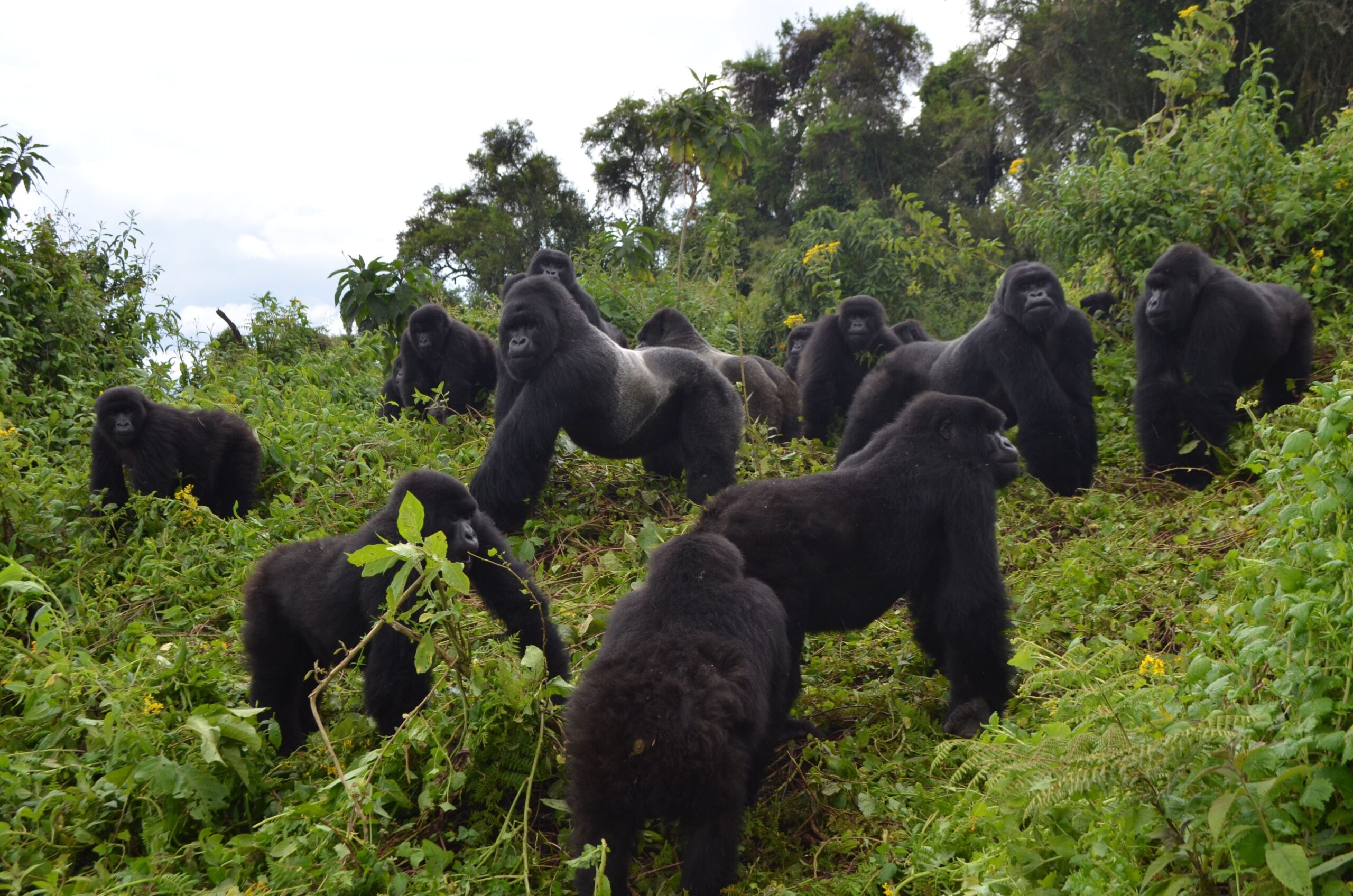
This setup contrasts sharply with mountain gorillas, as western lowlands face greater isolation between groups, reducing multi-male configurations and heightening the silverback’s role as sole protector.
Finally, the critically endangered Cross River gorillas (Gorilla gorilla diehli), confined to the Nigeria-Cameroon border, form the smallest groups—often just 2 to 6 members—due to fragmented habitats, resulting in hierarchies that are highly vulnerable to disruption from even minor threats like poaching.
These subspecies variations underscore how environmental factors shape gorilla family hierarchy.
For example, in multi-male mountain gorilla groups, subordinate silverbacks may assist in defense, creating a layered power structure that enhances group survival rates—something we’ve observed in groups like the historic Pablo group in Rwanda, which once swelled to 65 members under legendary silverback Cantsbee’s leadership.
This adaptability is evolutionary genius, allowing gorillas to thrive in diverse ecosystems. On our safaris, travelers often marvel at these differences; a trek in Bwindi might reveal a bustling multi-male troop, while a Congo expedition highlights the intimate bonds in smaller western lowland families.
Group sizes fluctuate based on food availability, with mountain gorillas averaging 10-20 members in stable hierarchies, while western subspecies hover around 5-10, prone to fission-fusion dynamics where subgroups temporarily split for foraging.
Studies from the Dian Fossey Gorilla Fund reveal that larger groups in mountainous regions correlate with lower infanticide rates, as multiple males deter rivals.
For conservation-minded visitors from Europe or the Middle East, understanding these nuances enriches the experience, turning a simple sighting into a profound lesson in primate sociology.
As we transition to exploring typical troop compositions, remember that these variations set the stage for the intricate hierarchies that make gorilla societies so human-like and captivating.
Typical Gorilla Troop Composition & Sizes
Delving deeper into gorilla family hierarchy, the composition and size of a troop provide the foundational framework for social interactions, much like the extended families you might encounter in cultural tours across Africa.
A typical gorilla troop, often called a “family” or “group,” revolves around a core structure designed for protection, reproduction, and resource sharing—elements that ensure survival in the wild and offer breathtaking insights during safari treks.
At the heart is usually one dominant silverback, a mature male over 12 years old, weighing up to 440 pounds and standing 5-6 feet tall, who leads with authority derived from physical prowess and social acumen.
Surrounding him are 3 to 6 adult females, each bonded through grooming and proximity, forming the reproductive nucleus. Their offspring—infants, juveniles, and adolescents—complete the unit, with blackbacks (young males aged 8-12) often serving as auxiliary protectors.
This setup mirrors a patriarchal system, where the silverback’s decisions on movement and nesting sites dictate daily life, a dynamic you’ll observe in real-time on a Uganda gorilla permit trek through Mgahinga Gorilla National Park.
Troop sizes vary significantly, influenced by subspecies and habitat, but generally range from 5 to 30 members, with extremes highlighting the flexibility of gorilla hierarchies.
Smaller groups, like those of Cross River gorillas (2-6 individuals), prioritize stealth in fragmented forests, reducing visibility to threats and easing resource competition.
In contrast, mountain gorilla troops in Rwanda’s Virunga Mountains can expand to 20-30, or even 65 as in the record-breaking Pablo group led by Cantsbee, where abundant bamboo and herbs support larger hierarchies with multi-tiered male roles.
Eastern lowland groups average 10-20, balancing between stability and adaptability in Congo’s vast lowlands. Western lowland troops, often 3-11, reflect a more solitary hierarchy due to dispersed fruit sources, leading to fluid compositions where females may transfer groups, reshaping dynamics.
For travelers from Canada or Asia, these sizes mean varied trekking experiences—smaller troops offer intimate views of tight-knit bonds, while larger ones showcase dramatic interactions like silverback charges during our guided safaris.
Beyond family troops, all-male bachelor groups exist, comprising 2-8 dispersing males or up to 20 in rare cases, where hierarchies form through play-fighting and alliances, preparing them for future leadership.
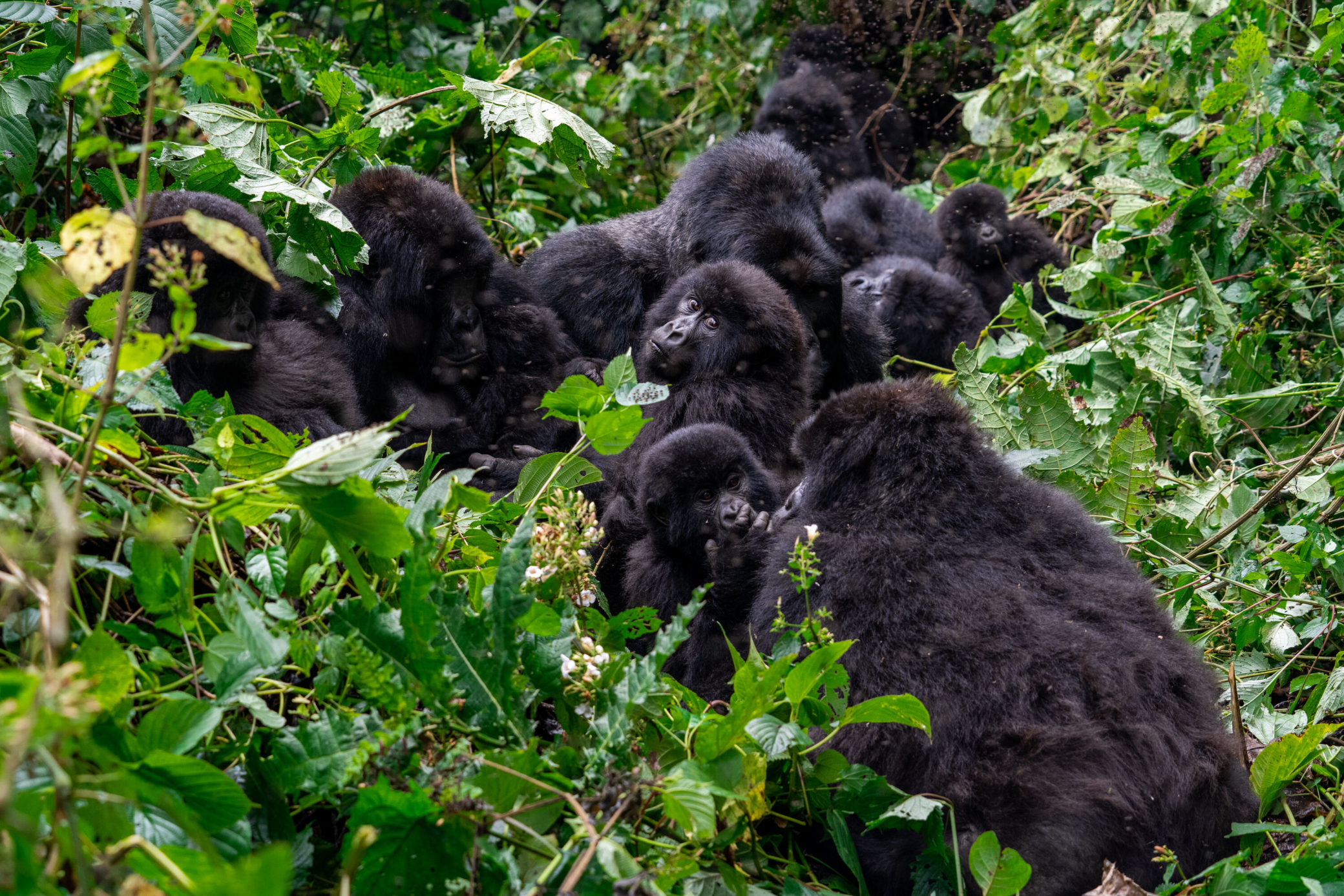
These non-breeding units, common among mountain gorillas, act as “training grounds” for blackbacks, with a dominant male guiding without females present.
In multi-male family troops, seen in up to 30% of mountain groups, subordinate silverbacks queue for dominance, enhancing protection against infanticide—a risk when silverbacks die or are challenged.
This composition fosters resilience, as observed in the Titus group monitored by the Dian Fossey Gorilla Fund, where shared roles stabilized the hierarchy.
For international visitors, booking a safari reveals how troop size impacts visibility; larger groups in Bwindi provide more photo opportunities, but require respectful distance to preserve their natural behaviors.
As we explore the dominant silverback’s pivotal role next, consider how these compositions create the canvas for gorilla society’s intricate power plays.
The Dominant Silverback: Heart of the Hierarchy
In the realm of gorilla family hierarchy, the dominant silverback stands as the undisputed cornerstone, embodying strength, wisdom, and guardianship in a way that captivates every safari-goer fortunate enough to witness it.
As a seasoned tour operator, we’ve seen travelers from the UK and Europe gasp in awe as a silverback like those in Rwanda’s Susa group emerges from the foliage, his silver saddle gleaming under dappled light, a living symbol of primal leadership.
Reaching maturity around 12-15 years, silverbacks develop distinctive physical markers: silver hair across their backs, massive canines up to 2 inches long, and a muscular build averaging 400 pounds, all signaling their apex status.
Gaining power often involves inheritance from a deceased leader, aggressive takeovers from rivals, or subtle ascensions in multi-male groups, where displays like chest-beating, ground-slapping, and vocal roars assert dominance without constant violence—a strategy that minimizes energy loss in calorie-scarce forests.
The silverback’s daily roles are multifaceted, making him the heart of the hierarchy and the troop’s survival engine.
As decision-maker, he charts the group’s movements, selecting foraging sites rich in vegetation—up to 75 pounds daily for adults—and nesting locations for safety, often building the largest nest last to oversee his family.
In protective mode, he stands vigil against predators like leopards or rival males, charging at threats with speeds up to 25 mph, his presence alone deterring most incursions.
This role is crucial in preventing infanticide, where invading silverbacks kill unrelated infants to prompt females into estrus; multi-male groups reduce this risk by 50%, as subordinates aid in defense.
As mediator, the silverback resolves intra-group conflicts through interventions, using grunts or stares to enforce peace, fostering a stable hierarchy that echoes human family dynamics.
Breeding privileges are exclusive in single-male troops, where he sires most offspring, but in mountain groups, he may share with subordinates, ensuring genetic diversity.
Surprisingly nurturing, silverbacks like Cantsbee, who led the Pablo group for over 20 years and sired more than 27 offspring, often groom infants, play with juveniles, and carry orphans, behaviors that strengthen bonds and teach hierarchy.
Real-world examples illuminate this role’s depth. Take Titus, a legendary silverback from the Dian Fossey Gorilla Fund’s studies in Rwanda, who rose from a bachelor background to lead with tolerance, allowing multi-male coexistence and group stability for decades.
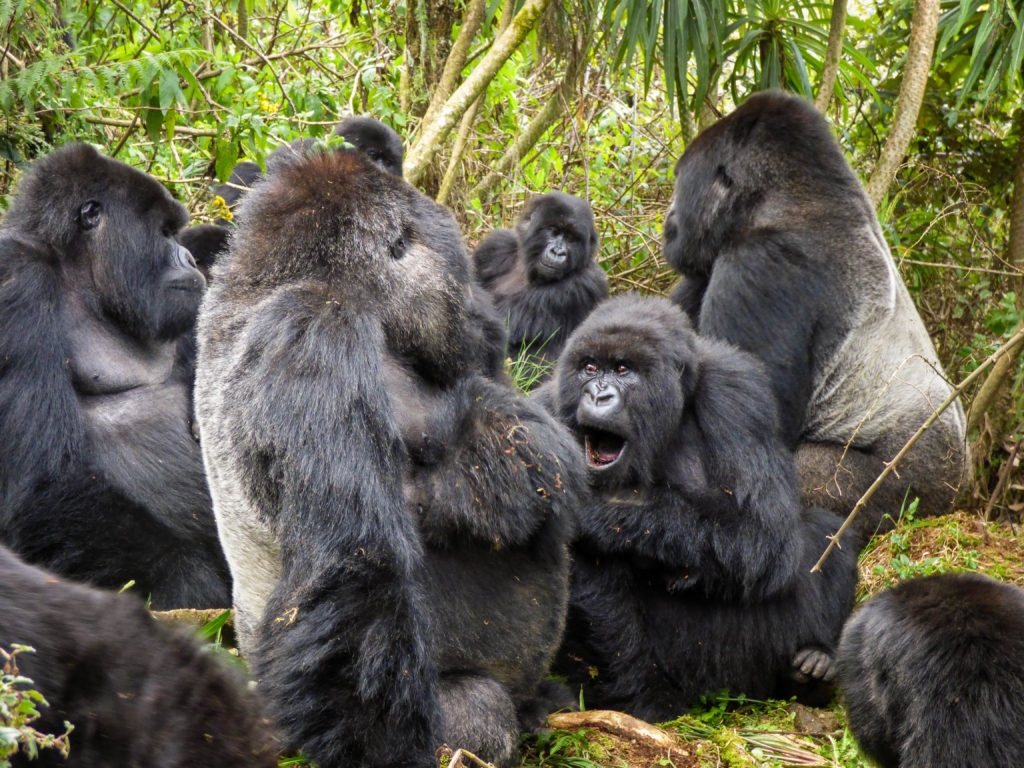
His diplomatic style, inherited perhaps from early experiences, minimized aggression, enabling his troop to thrive amid conservation challenges.
Similarly, Cantsbee’s reign over the largest recorded group of 65 showcased masterful hierarchy management, balancing protection with expansion through alliances.
On our GoSilverback Safaris, visitors from the Middle East or USA often encounter such leaders in Virunga, where a silverback’s chest-beat echoes through the valleys, a thrilling reminder of their authority.
Maintaining power requires vigilance; aging silverbacks face challenges from blackbacks, leading to displacements that reshape hierarchies, as seen in recent shifts in the Titus group where Urwibutso subtly overtook Pato through consistent displacements.
This role’s complexity—blending brute force with social intelligence—makes the silverback not just a leader, but the emotional anchor, a sight that transforms safaris into life-changing journeys. Transitioning to male hierarchy stages, we see how young gorillas prepare for this pinnacle position.
Male Hierarchy & Life Stages
Gorilla family hierarchy among males unfolds through distinct life stages, each building toward potential leadership and offering safari enthusiasts a window into evolutionary progression.
From birth, male gorillas navigate a structured path shaped by age, strength, and social learning, much like the rites of passage in African cultures we highlight on our tours.
Infants (0-3 years) cling to mothers, observing hierarchies passively while developing bonds that influence future alliances. As juveniles (3-6 years), they engage in play-wrestling, mimicking adult displays to hone skills without real stakes, a phase where hierarchies are fluid and fun-oriented, preparing them for adolescence.
Blackbacks, aged 8-12, mark a critical transition in male hierarchy, where young males grow darker fur and bulk up to 300 pounds, serving as subordinate protectors in the troop.
In this stage, they defer to the dominant silverback through displacements—yielding food or space—learning the nuances of power dynamics.
In multi-male mountain gorilla groups, blackbacks may assist in defense, gaining respect and queuing for dominance, a system that reduces lethal conflicts and boosts group cohesion.
For travelers from Canada trekking in Bwindi, spotting a blackback shadowing the silverback reveals this apprenticeship, where patience trumps aggression.
Upon reaching silverback status at 12-15, males face pivotal choices that define their place in gorilla hierarchy: stay as subordinates, disperse solitarily, or form bachelor groups.
About 50% of maturing males remain in natal groups, inheriting leadership if the dominant dies, as in the Titus group’s subtle shifts.
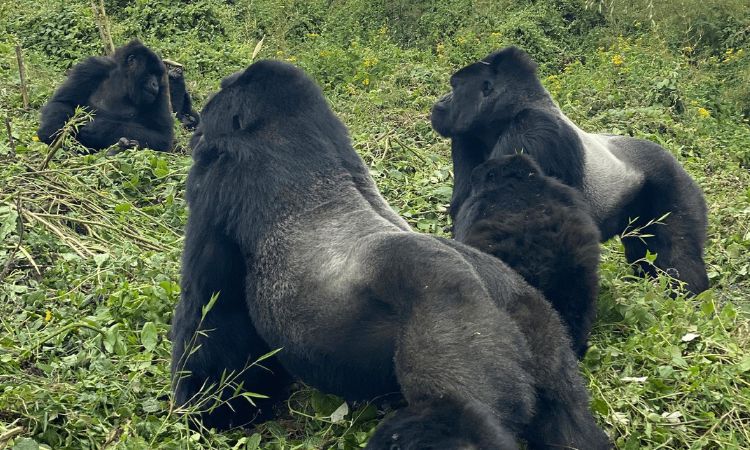
Subordinate silverbacks in multi-male troops, common in mountains (up to 8 per group), handle secondary roles like perimeter patrols, enjoying limited breeding access while supporting the alpha—a cooperative hierarchy unique to gorillas.
Dispersal, often at 15-20 years, involves solitary wandering to attract females, a risky phase with higher mortality from rivals or isolation, but essential for genetic diversity.
Bachelor groups, comprising 2-20 males, foster their own hierarchies through mock fights and grooming, serving as “skill-building academies” where dominants emerge via endurance rather than size alone. Titus exemplified this, honing leadership in a bachelor phase before ruling.
Aging silverbacks (30+ years) maintain hierarchy through experience, but face challenges; Cantsbee led until 38, outlasting norms by diplomacy.
In safaris across Uganda and Rwanda, these stages manifest in group interactions, enriching visits for Asian or European travelers seeking authentic wildlife narratives. This male progression ensures hierarchy’s continuity, setting the stage for female roles in social bonds.
Female Hierarchy & Social Bonds
Female gorillas anchor the emotional core of family hierarchy, weaving a web of social bonds that sustain troop stability and mirror the communal ties in human societies.
Unlike males’ power-driven structures, female hierarchies are subtle, based on age, tenure, silverback favoritism, and maternal status, creating a supportive network vital for rearing offspring.
Adult females, maturing at 6-10 years, rank higher with longevity and proximity to the silverback, who grants protection and breeding priority through grooming sessions—acts that reinforce bonds and elevate status.
In mountain gorilla groups, older females often lead foraging subgroups, their experience guiding decisions when the silverback rests, a dynamic visible on Congo treks where females cluster protectively around infants.
Social bonds among females are lifelong, often along maternal lines, forming sub-cliques that buffer against stress and enhance survival. Grooming, sharing food, and co-nesting strengthen these ties, reducing aggression in dense hierarchies.
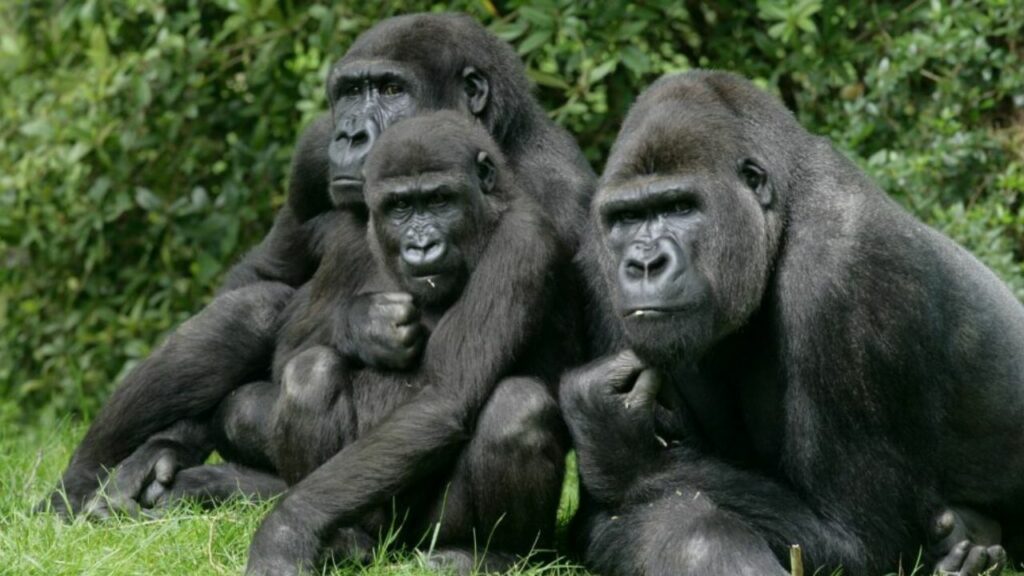
Female transfers, occurring 60% of the time to avoid inbreeding, disrupt but also refresh hierarchies; a transferring female starts low but climbs via alliances, as seen in western lowland groups where fluidity demands adaptability.
The silverback’s preference—shown by defending favored females—accelerates rank ascension, ensuring higher-ranked mothers’ offspring thrive.
For UK travelers on Rwanda safaris, observing these bonds during rest periods reveals tender moments, like females cradling each other’s young, fostering empathy for conservation.
Maternal status elevates females, as those with infants gain priority access to resources, their bonds with the silverback intensifying for protection against infanticide.
In multi-female troops, hierarchies minimize conflict through ritualized submissions, like averting gaze, maintaining harmony. Studies show these bonds extend beyond troops in complex tiers, per the 2019 Cambridge research, where females maintain distant kin connections.
This female framework complements male dominance, creating resilient hierarchies that international visitors from the Middle East appreciate as parallels to family values. As we examine offspring development, note how females impart hierarchy lessons through daily interactions.
Offspring Development & Learning the Hierarchy
Offspring in gorilla families embody the future of hierarchy, learning social norms through immersive development stages that prepare them for adult roles.
Infants (0-3 years) depend entirely on mothers, nursing for 2-3 years while observing troop dynamics from safety, absorbing hierarchy via proximity to high-ranking females.
This phase builds foundational bonds, with silverbacks occasionally carrying orphans, instilling trust in leadership.
Juveniles (3-6 years) venture independently, engaging in play that mimics hierarchy: wrestling establishes mini-ranks, while imitating chest-beats teaches displays.
Full independence hits at 6-8 years, but learning continues through observation—watching displacements to understand submission. In safari settings like Uganda’s Bwindi, juveniles’ antics delight European travelers, showcasing hierarchy’s playful side.
Adolescents refine skills in gendered ways: young females shadow mothers for bonding cues, males practice with blackbacks for dominance.
This ensures hierarchy perpetuation, a process visible on treks where young mimic adults, linking to daily behaviors that reinforce structure.
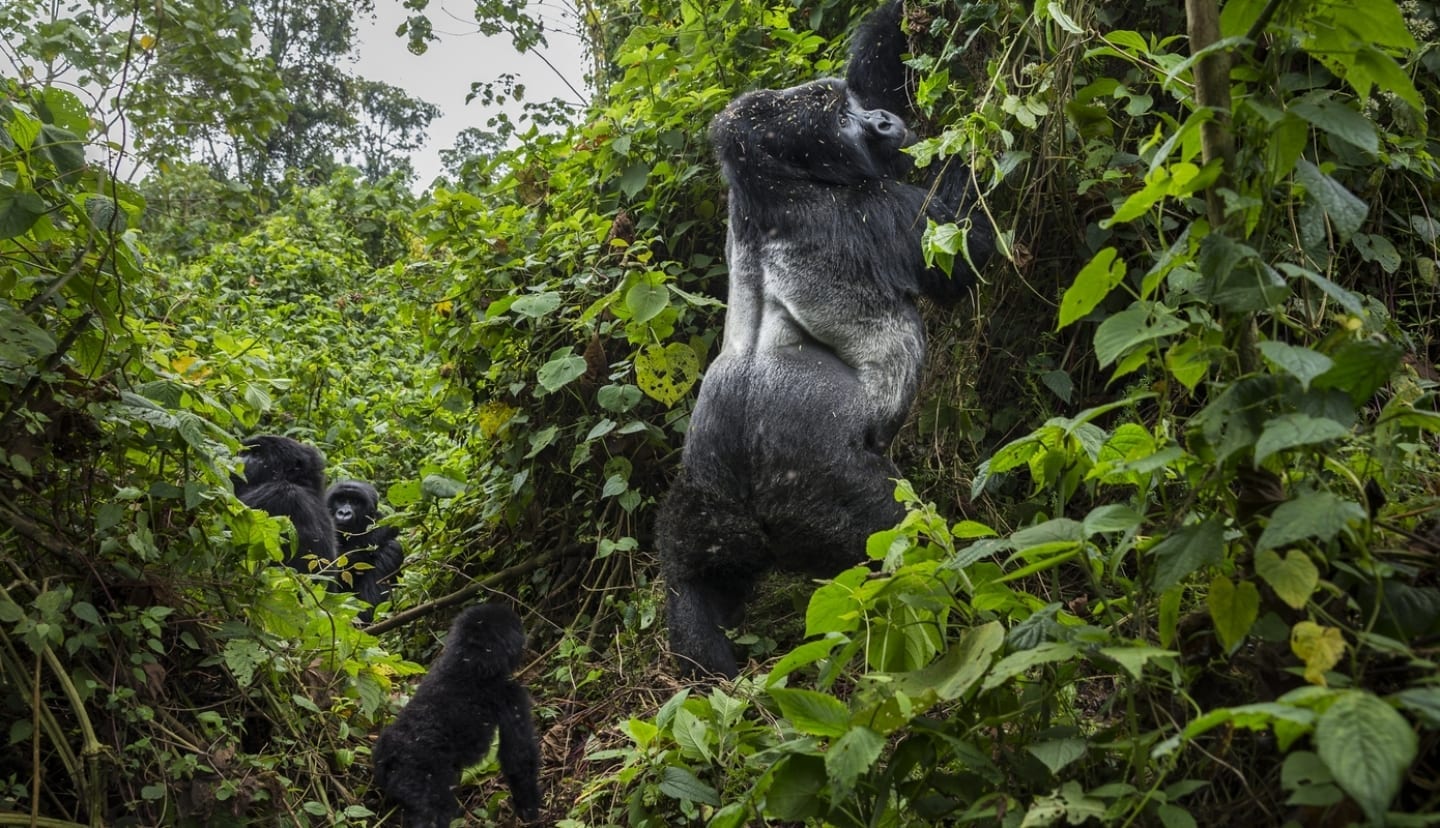
Daily Life & Behaviors That Reinforce Hierarchy
Daily routines in gorilla troops are rituals that solidify family hierarchy, blending foraging, rest, and interactions into a harmonious rhythm.
Mornings start with the silverback’s lead on travel, covering 0.5-2 miles for food, where subordinates yield prime spots, reinforcing ranks.
Grooming sessions midday strengthen bonds, with higher-ranked individuals groomed more, a behavior safari-goers from Asia capture in Volcanoes Park.
Nest-building evenings see the silverback oversee construction, his nest largest and last, symbolizing authority. Play and displays—chest-beats resolving tensions—maintain order without escalation.
Inter-group encounters, rare but intense, unite the troop under the silverback, as in Congo forests where hierarchies shine in defense. These behaviors, observed on our tours, highlight hierarchy’s role in survival, transitioning to complex social tiers beyond the core.
Beyond the Core Troop: Complex Social Tiers
Gorilla societies extend into multi-layered tiers, revealing a modularity akin to human communities. The 2019 Cambridge study on western lowlands identified three nested levels: immediate family (13 individuals), extended associations (39), and broader aggregations at resource hotspots.
Lifetime bonds between distant males, often kin, facilitate these, as in Lokoué where half-siblings cluster. For travelers in Gabon, this means occasional multi-group sightings, enriching safaris with societal depth.
These tiers enhance resilience, paralleling human evolution and underscoring conservation needs amid threats.
Human Parallels & Evolutionary Insights
Gorilla hierarchies mirror human social evolution, with modular tiers suggesting ancient roots for our complexity. Silverback leadership echoes patriarchal systems, while female bonds resemble matrilineal networks.
Less aggressive than chimps, gorillas’ stable ties highlight cooperation’s benefits, offering insights for visitors from Canada reflecting on primate ancestry during treks.
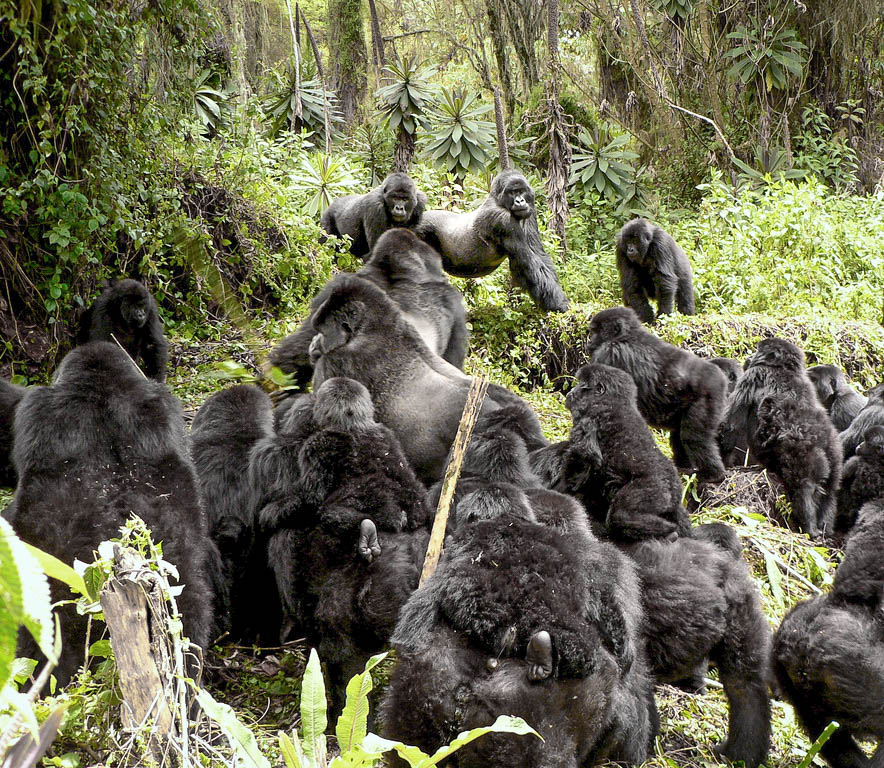
Conservation Threats to Gorilla Families
Poaching, habitat loss, disease, and unrest disrupt hierarchies, threatening gorillas. Poaching for bushmeat or infants fragments groups, as in Congo where declines reach 80%.
Habitat destruction from logging affects 78% of unprotected areas, destabilizing tiers. Diseases like Ebola decimate populations, while human contact risks Covid transmission. Conservation successes in Virunga show patrols work, but sustained efforts are vital.
Check this guide to learn more about gorilla poaching statistics.
Frequently Asked Questions
What is a silverback gorilla’s main job?
The silverback leads, protects, and mediates, ensuring troop survival.
Do female gorillas have their own hierarchy?
Yes, based on age and bonds, with maternal lines key.
How big can a gorilla family get?
Up to 65, as in Pablo group.
What happens when the silverback dies?
Groups may split or females transfer to avoid infanticide.
Why do gorillas form bachelor groups?
For young males to learn skills before leading.
How do gorillas learn hierarchy?
Through play and observation from infancy.
What are the social tiers in gorillas?
Three levels: family, extended (13), aggregated (39).
How does hierarchy differ by species?
Mountain: multi-male; Western: single-male.
What threats disrupt gorilla hierarchies?
Poaching, habitat loss, disease.
Can humans observe these hierarchies safely?
Yes, via permitted treks.
How long do silverbacks lead?
Up to 20+ years, like Cantsbee.
Are gorilla hierarchies like human families?
Yes, with parallels in bonds and modularity.
Conclusion + Key Takeaways
In summary, gorilla family hierarchy is an elegant, adaptive system blending dominance with bonds. Key takeaways: Silverbacks lead with multifaceted roles; hierarchies vary by subspecies; social tiers extend beyond troops. For profound experiences, join our safaris.
Ready to witness gorilla family hierarchy up close? Book your gorilla permit through GoSilverback Safaris today—expert guides, sustainable tours, and unforgettable adventures await travelers from the USA, UK, Europe, Canada, Asia, and the Middle East. Contact us now to secure your spot!