Menu
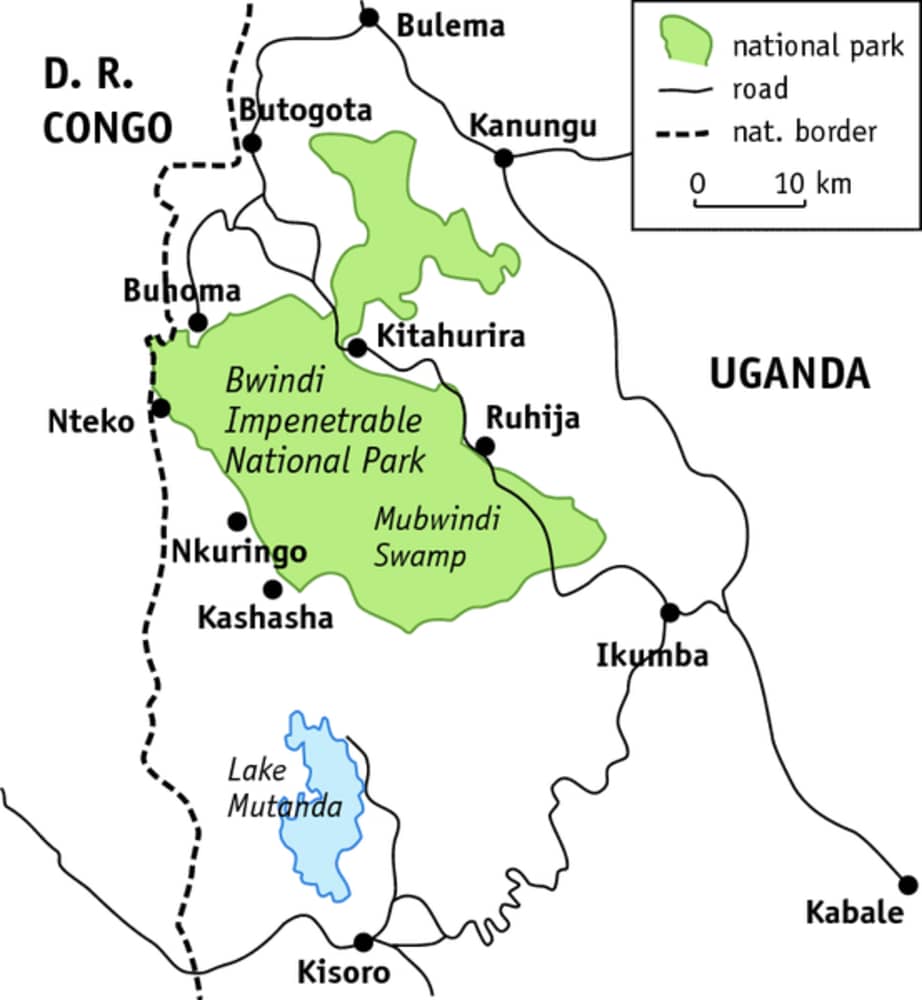
Bwindi Impenetrable Forest Map

Ultimate Bwindi Impenetrable Forest Map: Your Complete Guide to Gorilla Treks and Adventures

Bwindi Impenetrable Forest Map is the essential starting point for anyone planning to explore one of Africa’s most extraordinary natural wonders.

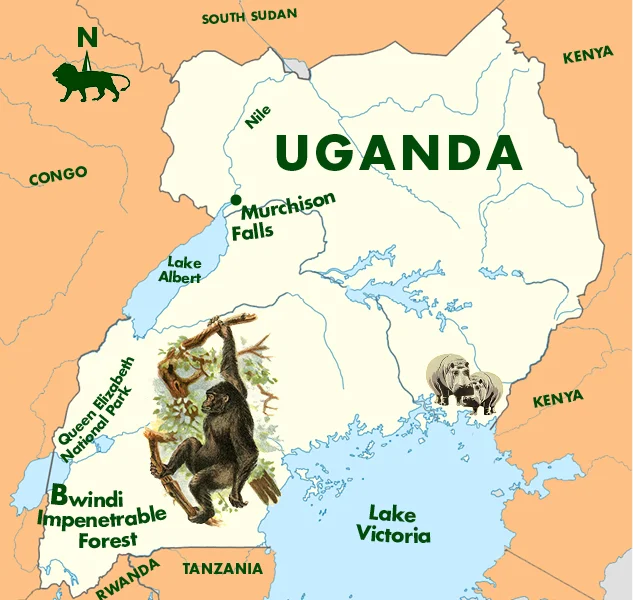
Nestled in southwestern Uganda, Bwindi Impenetrable National Park is a UNESCO World Heritage Site celebrated for its unmatched biodiversity and, most famously, as home to over 460 endangered mountain gorillas—nearly half of the world’s remaining population.

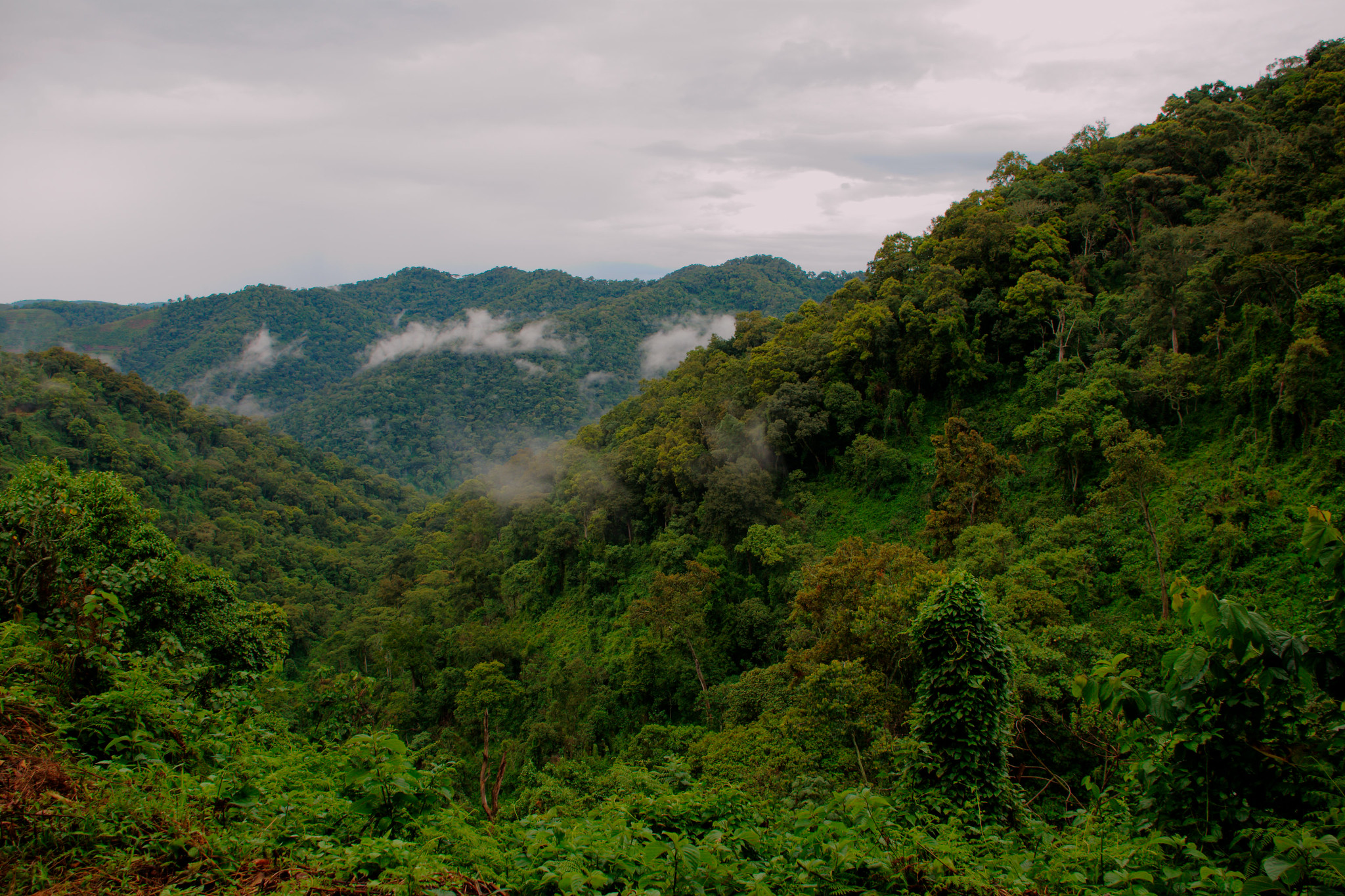
This ancient rainforest, estimated to be more than 25,000 years old, offers a rare blend of ecological richness, mist-covered hills, and life-changing wildlife encounters.

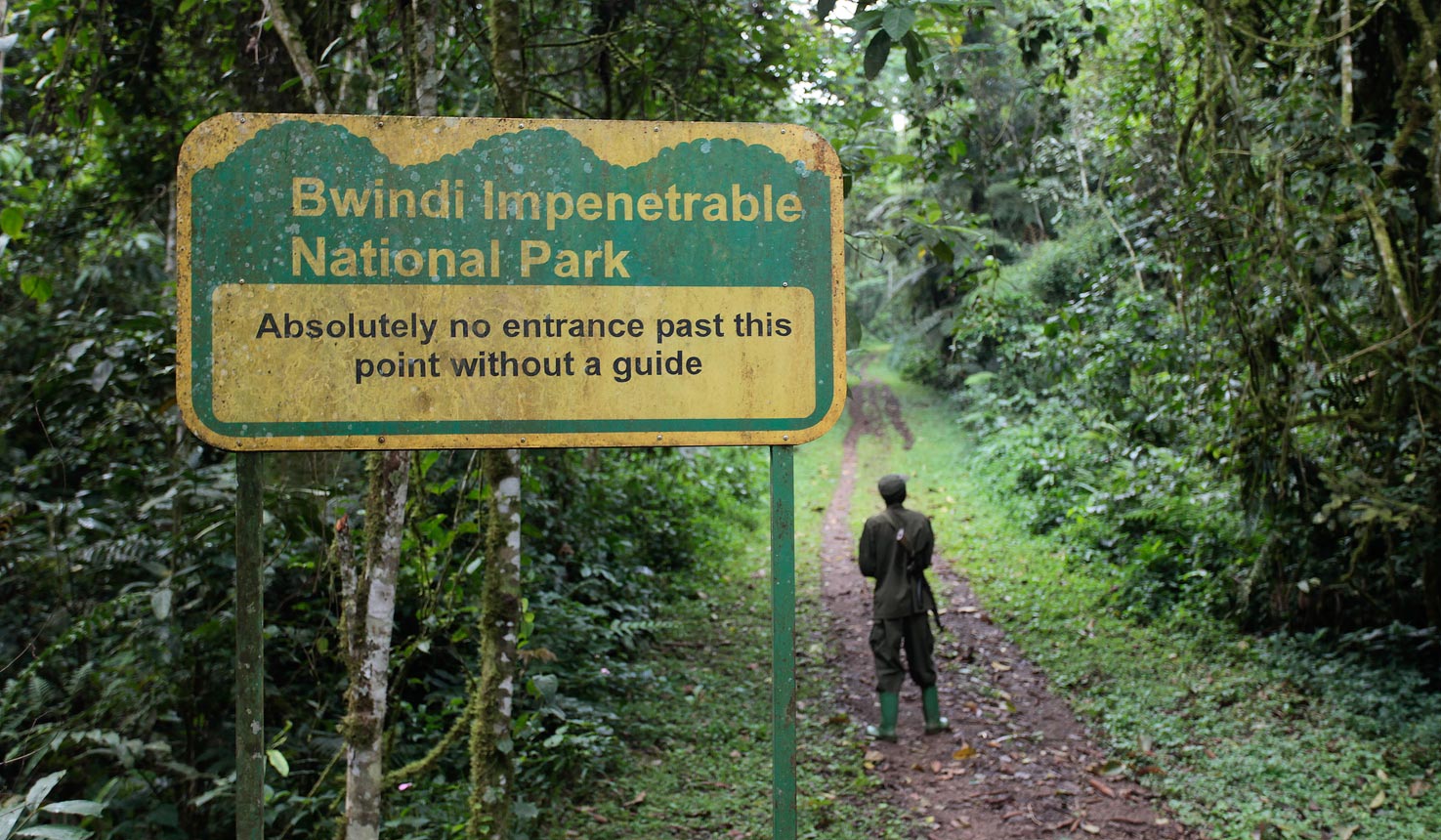
Covering approximately 321 km² of dense, rugged forest, Bwindi truly lives up to its name: “Impenetrable.” Thick vegetation, steep valleys, and limited road networks can make navigation challenging, even for experienced travelers.

That is where a detailed Bwindi Impenetrable Forest Map becomes invaluable.

Whether you are a first-time gorilla trekker, a seasoned safari guide, or a conservation researcher, the map helps you understand the park’s layout, trail systems, sector boundaries, and access points—saving time, improving safety, and enhancing your overall experience.

This map is more than just a navigation tool.

It highlights key gorilla trekking sectors such as Buhoma, Ruhija, Rushaga, and Nkuringo, major roads, ranger posts, nearby communities, and accommodation hubs.

It also provides context for elevation changes and terrain, which is critical when preparing for physically demanding gorilla treks in thick rainforest conditions.

In the sections ahead, you’ll discover how to read the map effectively, how it supports gorilla trekking planning, and why it is a must-have resource for visitors to Bwindi.

Download your free Bwindi Impenetrable Forest Map PDF today and plan your journey with confidence into Uganda’s most iconic rainforest.
History of Bwindi Impenetrable Forest

History of Bwindi Impenetrable Forest

Bwindi Impenetrable Forest has a long and complex history that reflects both conservation progress and human impact.

Long before formal protection, this ancient rainforest served as a vital habitat for wildlife and as a home for indigenous forest communities.

Its dense vegetation, rugged terrain, and rich biodiversity made it one of East Africa’s most ecologically significant forests.

The modern conservation history of Bwindi began in 1932, when the British colonial administration designated parts of the forest as Crown Forest Reserves.

This move aimed to regulate timber extraction and protect water catchments, although controlled human use was still permitted.

By 1942, the area was formally consolidated and recognized as the Bwindi Impenetrable Forest Reserve, acknowledging its ecological importance and the need for stronger management.

A major turning point came in 1991, when Bwindi was upgraded to Bwindi Impenetrable National Park.

This new status provided the highest level of protection under Ugandan law and marked a shift from resource use to strict conservation.

The designation was driven largely by the urgent need to protect endangered mountain gorillas, whose survival was threatened by habitat loss, poaching, and human encroachment.

Gorilla tourism was later introduced as a conservation strategy, linking wildlife protection to local economic benefits.

In 1994, Bwindi gained global recognition when it was declared a UNESCO World Heritage Site.

UNESCO cited its exceptional biodiversity, ancient ecosystems, and role as a refuge for endangered species, including mountain gorillas, chimpanzees, and hundreds of bird species.

This status strengthened international support for conservation and research efforts within the park.

However, Bwindi’s conservation history also includes painful social consequences.

The Batwa people, indigenous hunter-gatherers who had lived in the forest for generations, were displaced during the creation of the national park.

Their eviction, carried out without adequate compensation or alternative livelihoods, remains one of the most debated aspects of Bwindi’s history.

In recent years, conservation has evolved to be more inclusive, with efforts to recognize Batwa cultural heritage, support community projects, and involve local people in tourism and conservation initiatives.

Today, Bwindi stands as a powerful example of how conservation has evolved—from colonial forest reserves to globally significant protected areas—while continuing to grapple with the need to balance environmental protection and social justice.

Key Historical Timeline

Year Event
1932 Designated as Crown Forest Reserves
1942 Bwindi Impenetrable Forest Reserve established
1991 Renamed Bwindi Impenetrable National Park
1994 Declared a UNESCO World Heritage Site

Geography and Biodiversity of Bwindi Impenetrable Forest

Geography and Biodiversity of Bwindi Impenetrable Forest

Bwindi Impenetrable National Park is located in southwestern Uganda, spanning parts of Kanungu, Kabale, and Kisoro districts near the borders of Rwanda and the Democratic Republic of Congo.

Positioned along the edge of the Albertine Rift Valley, Bwindi lies within one of Africa’s most biologically rich regions.

Its dramatic landscapes, ancient ecosystems, and exceptional species diversity make it one of the continent’s most important conservation areas.

1. Terrain

Bwindi’s terrain is rugged, steep, and deeply dissected by valleys and ridges, giving rise to its name “Impenetrable.”

The park covers approximately 321 km² and ranges in elevation from about 1,160 meters to over 2,600 meters above sea level.

This wide altitudinal gradient creates a variety of microclimates, from warm lowland forest zones to cool montane habitats.

Frequent mist, high rainfall, and thick undergrowth make movement challenging, which is why navigation tools such as the Bwindi Impenetrable Forest Map are essential for trekkers and researchers alike.

Numerous rivers and streams originate in Bwindi, making it an important water catchment area for surrounding communities.

2. Flora

Bwindi is one of the most botanically diverse forests in East Africa.

The park hosts over 220 tree species and more than 100 species of ferns, many of which are endemic to the Albertine Rift.

The vegetation is a complex mosaic of lowland rainforest, montane forest, bamboo zones, and swamp vegetation, shaped by changes in altitude and rainfall.

Towering hardwood trees form dense canopies, while mosses, vines, orchids, and medicinal plants thrive beneath.

This ancient forest is believed to have survived the last Ice Age, making it a living museum of plant evolution and a critical refuge for rare flora.

3. Fauna

Bwindi’s biodiversity is globally renowned.

Most famously, it is home to over 460 mountain gorillas, making it the single most important stronghold for this critically endangered species.

In addition to gorillas, Bwindi supports populations of chimpanzees, forest elephants, L’Hoest’s monkeys, and numerous small mammals.

Birdlife is equally remarkable, with 350+ bird species, including 23 Albertine Rift endemics.

One of the park’s flagship species is the rare African green broadbill, a must-see for birdwatchers.

Reptiles, amphibians, and countless insect species further contribute to Bwindi’s status as a biodiversity hotspot.
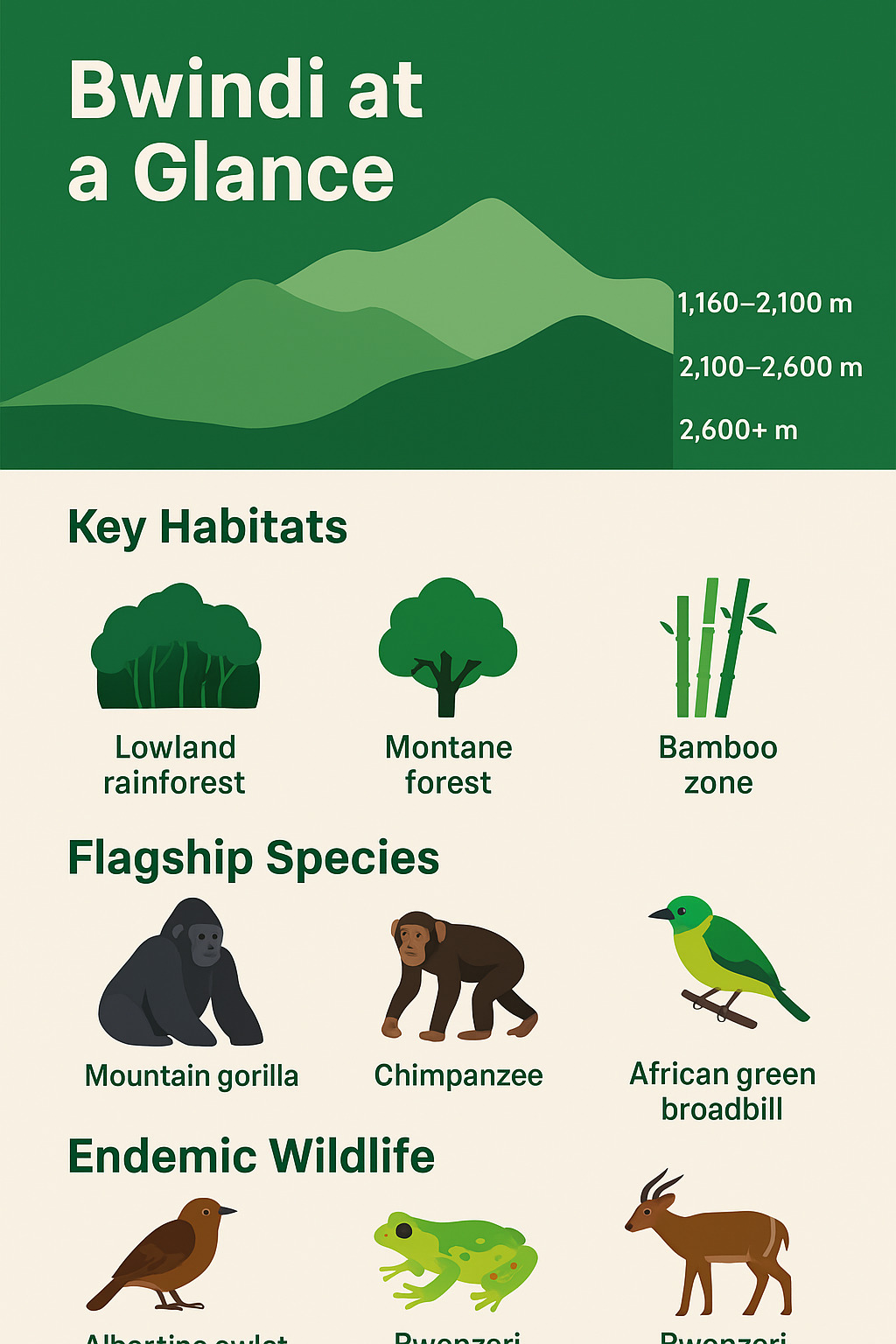
Bwindi Biodiversity

Together, Bwindi’s unique geography and extraordinary biodiversity explain why it is both a UNESCO World Heritage Site and one of Africa’s most treasured natural landscapes.
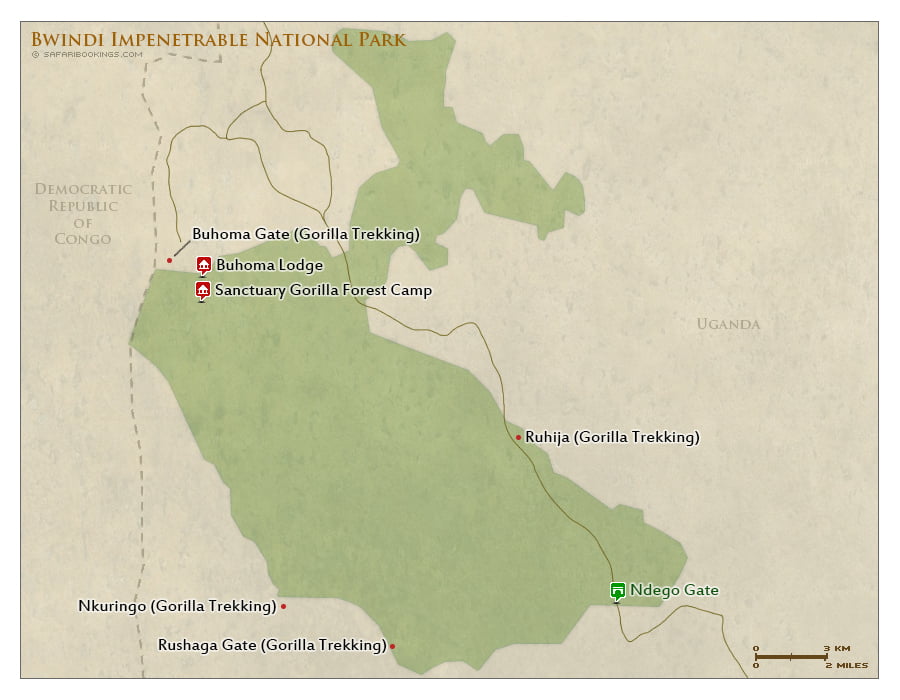
Bwindi Impenetrable Forest Map

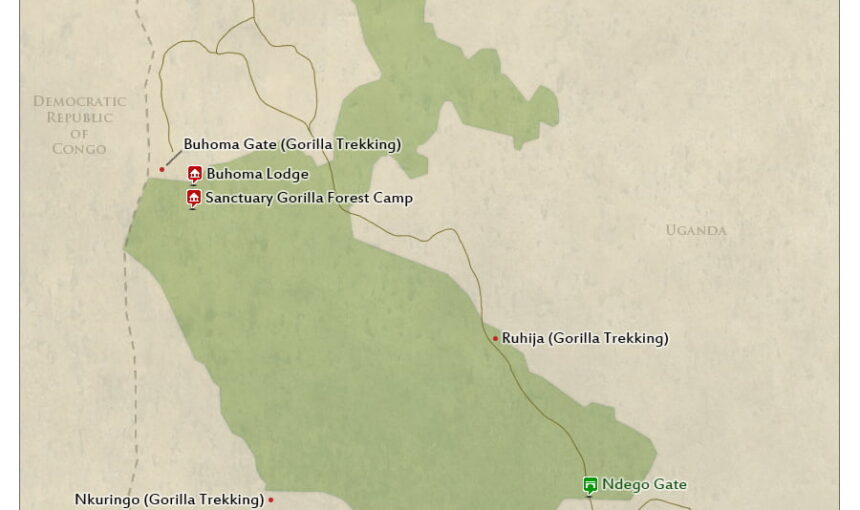
Detailed Bwindi Impenetrable Forest Map Breakdown

The Bwindi Impenetrable Forest Map is the core planning tool for navigating one of Africa’s most complex rainforest ecosystems.

Due to the park’s dense vegetation, steep terrain, and limited internal road network, understanding the map is essential for gorilla trekking, birding, research, and logistics.

This section breaks down the map into its most important components, explaining how each feature helps visitors, guides, and conservation teams move safely and efficiently within the park.

Overall Map Structure: Boundaries, Roads, and Drainage

At a glance, the Bwindi map clearly outlines the official park boundaries, enclosing approximately 321 km² of protected rainforest.

These boundaries separate the national park from surrounding community lands, tea plantations, and villages, making them critical for conservation enforcement and visitor orientation.

The road network shown on the map is sparse inside the park itself, reflecting Bwindi’s protected status.

Most roads run around the forest rather than through it, connecting key access towns and trekking sectors.

These include rough murram roads linking Buhoma, Ruhija, Rushaga, and Nkuringo, which are essential for planning travel times and selecting accommodation.

Equally important is the drainage system.

The map highlights rivers and streams that originate within Bwindi’s highlands, including the Ivi River, one of the park’s major waterways.

These rivers flow outward to surrounding regions, reinforcing Bwindi’s role as a vital water catchment area.

Drainage lines also help trekkers anticipate steep valleys and slippery sections along forest trails.
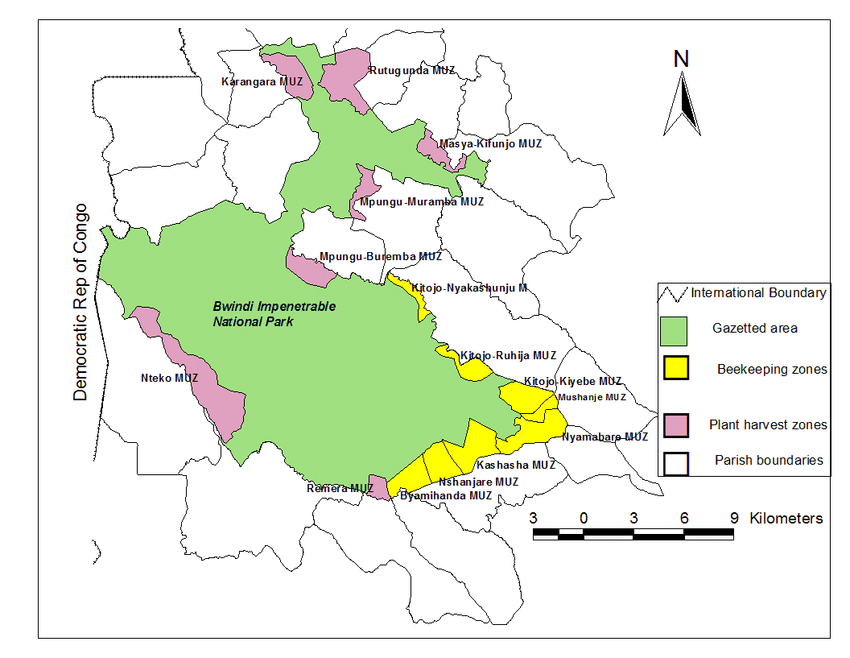
Bwindi Impenetrable Forest Map Breakdown

Bwindi’s Gorilla Trekking Sectors on the Map

The Bwindi Impenetrable Forest Map divides the park into four main gorilla trekking sectorsBuhoma, Ruhija, Rushaga, and Nkuringo.

Each sector has distinct terrain, access routes, trekking difficulty, and wildlife highlights.

Understanding these sectors on the map helps visitors choose the best experience based on fitness level, interests, and travel logistics.

Buhoma Sector (North)

Buhoma, located in the northern part of Bwindi, is the most established and easily accessible trekking sector, especially for travelers arriving from Queen Elizabeth National Park.

On the map, Buhoma is marked by well-defined access roads, clear trail networks, and a concentration of lodges near the park boundary.

This sector is ideal for first-time gorilla trekkers.

Trails here are generally shorter and less steep compared to southern sectors, though the forest remains dense.

The map highlights multiple trailheads radiating from the Buhoma ranger station, making navigation straightforward.

Mini-map highlights:

  • Main access road from Kihihi and Ishasha

  • Buhoma park headquarters

  • River crossings and loop trails

Permit & trek info:

  • Gorilla permits are issued at the Buhoma ranger station

  • Average trek duration: 2–4 hours

  • Suitable for moderate fitness levels

Buhoma also has the widest range of lodges, camps, and community walks, clearly marked on the map, making it a popular and convenient base.

Ruhija Sector (East)

The Ruhija sector lies in the eastern highlands of Bwindi and is clearly identified on the map by its higher elevation contours.

Sitting between 2,300 and 2,600 meters above sea level, Ruhija offers cooler temperatures and expansive forest views.

Ruhija is particularly famous for birding, with the map highlighting nearby swamps and forest edges where Albertine Rift endemics are often spotted.

Elevation profiles on the map show steeper climbs, but trails are well spaced and less crowded.

Mini-map highlights:

  • Elevation contours and ridgelines

  • Birding hotspots and swamp zones

  • Connecting road from Kabale

Permit & trek info:

  • Permits issued at Ruhija ranger post

  • Average trek duration: 3–5 hours

  • Moderate to challenging due to altitude

This sector suits travelers seeking quieter treks, birdwatching, and scenic forest landscapes.

Rushaga Sector (South)

Rushaga, located in southern Bwindi, is the most extensive trekking sector on the map.

It hosts the largest number of habituated gorilla families, which increases permit availability and trekking options.

The map shows a dense network of trails spreading across varied terrain—ridges, valleys, and riverine forest—making Rushaga suitable for both short and long treks. Trek difficulty levels vary widely, and the map helps guides assign groups based on fitness.

Mini-map highlights:

  • Multiple gorilla family ranges

  • Road access from Kisoro

  • River valleys and steep slopes

Permit & trek info:

  • Permits available at Rushaga headquarters

  • Average trek duration: 2–6 hours

  • Options range from easy to strenuous

Rushaga is also the main sector for gorilla habituation experiences, a detail often noted on advanced trekking maps.

Nkuringo Sector (Southwest)

The Nkuringo sector, positioned in the southwestern corner of Bwindi, is known for its dramatic topography.

On the map, tightly packed contour lines immediately signal steep and demanding hikes.

Treks here are physically challenging but incredibly rewarding, offering panoramic views toward the Virunga Volcanoes and deep forest valleys.

The map emphasizes safety features such as designated trails, rest points, and ranger coverage.

Mini-map highlights:

  • Steep elevation gradients

  • Scenic viewpoints

  • Limited but clear trail routes

Permit & trek info:

  • Permits issued at Nkuringo ranger station

  • Average trek duration: 4–6+ hours

  • Best for fit, experienced hikers

Safety tips (map-based):

  • Study elevation profiles before trekking

  • Follow marked trails only

  • Use porters for steep descents

Choosing the Right Sector Using the Map

By comparing access roads, elevation, trail density, and wildlife zones on the Bwindi Impenetrable Forest Map, visitors can confidently select the sector that best matches their expectations—whether that’s an easy first trek in Buhoma, birding in Ruhija, variety in Rushaga, or adventure in Nkuringo.
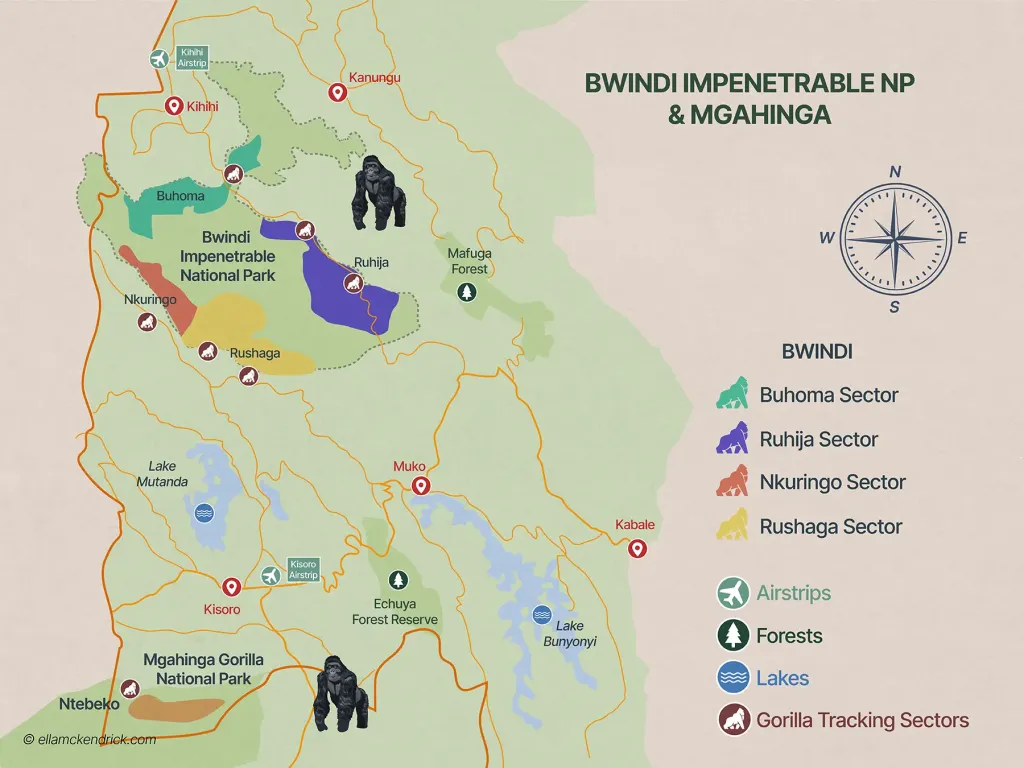
Bwindi’s Gorilla Trekking Sectors on the Map

Top Attractions and Activities Mapped Out in Bwindi

Using the Bwindi Impenetrable Forest Map allows visitors to visualize where the park’s most rewarding attractions and activities are located, helping them plan time, energy, and logistics efficiently.

From iconic gorilla habitats to cultural trails and birding hotspots, the map connects Bwindi’s experiences into one coherent journey.

Gorilla trekking is the park’s flagship activity and is mapped across all four sectors—Buhoma, Ruhija, Rushaga, and Nkuringo.

The map shows sector boundaries, ranger stations, and trail networks leading into gorilla family ranges.

This spatial layout explains why Bwindi protects about 43% of the world’s remaining mountain gorillas, making it the most important destination globally for gorilla tourism and conservation.

For bird enthusiasts, the map highlights birdwatching zones spread across varying elevations. Bwindi hosts 350+ bird species, including Albertine Rift endemics.

Key birding areas such as forest edges, bamboo belts, and swampy valleys are clearly marked, helping birders target species like the African green broadbill, Shelley’s crimsonwing, and handsome francolin.

Nature walks and forest trails are another major attraction.

On the map, these appear as dotted or looped trails near Buhoma and Ruhija, often following rivers, ridges, or waterfalls.

These guided walks offer close encounters with forest ecology, butterflies, primates, and medicinal plants while requiring less physical intensity than gorilla trekking.

Cultural experiences are also mapped. Batwa cultural trails, located near park edges, show routes where visitors learn about the indigenous Batwa people’s traditional forest life.

These trails connect sacred sites, caves, and storytelling points, providing cultural context to Bwindi’s conservation history.

Water features and vegetation zones add further depth to the map.

Scenic landmarks such as waterfalls and bamboo forests are pinned as points of interest, enriching both trekking and photography experiences.

Bwindi Attractions at a Glance (Mapped)

Attraction Map Location Highlights
Gorilla Habitats All sectors Home to ~43% of the world’s mountain gorillas
Munyaga Waterfall Buhoma Scenic forest hike, photography
Bamboo Zone Ruhija Rare birds, montane vegetation
Birdwatching Trails Ruhija & Buhoma 350+ species, Albertine Rift endemics
Batwa Cultural Trails Park edges Indigenous culture, guided storytelling

By linking attractions directly to their locations, the Bwindi Impenetrable Forest Map transforms planning into a clear, visual experience—ensuring visitors don’t just explore Bwindi, but truly understand it.

How to Get to Bwindi: Routes and Transportation Maps

Reaching Bwindi Impenetrable National Park requires advance planning, and transportation maps play a key role in choosing the most efficient route.

Located in southwestern Uganda, Bwindi is remote but accessible by both road and air, with mapped routes clearly showing travel times, distances, and entry sectors.

Road Routes from Entebbe and Kampala

Most travelers begin their journey from Entebbe International Airport or Kampala.

Road maps indicate a driving distance of approximately 460–500 km, depending on the sector visited, with an average travel time of 8–10 hours.

The common route follows Kampala – Masaka – Mbarara – Kabale/Kisoro, branching toward Buhoma, Ruhija, Rushaga, or Nkuringo.

Transportation maps highlight key stopovers such as the Equator crossing in Masaka, fuel stations, and overnight towns like Mbarara.

While most of the route is paved, final access roads to Bwindi are often murram and can become slippery in rainy seasons, a detail clearly marked on detailed route maps.

Air Travel and Charter Flights

For travelers seeking comfort and speed, domestic air charters are mapped from Entebbe or Kajjansi to nearby airstrips.

The most commonly used are Kihihi Airstrip (for Buhoma) and Kisoro Airstrip (for Rushaga and Nkuringo).

Flights take about 1–1.5 hours, followed by a short road transfer of 1–2 hours, depending on the sector.

Cross-Border Access from Kigali, Rwanda

Maps also show an increasingly popular route from Kigali, Rwanda, especially for southern Bwindi sectors.

The drive from Kigali to Rushaga or Nkuringo is approximately 170–200 km and takes 4–5 hours, including border crossing at Cyanika or Katuna.

This route is shorter and often preferred by visitors combining Rwanda and Uganda itineraries.

Route Maps Included:

  • Entebbe/Kampala to Bwindi (all sectors)

  • Kigali to southern Bwindi sectors

  • Airstrip-to-lodge transfer routes

Using transportation maps ensures smoother logistics, realistic timing, and a stress-free journey into Uganda’s most iconic rainforest.

Best Time to Visit Bwindi and Practical Tips

Best Time to Visit Bwindi and Practical Tips

The best time to visit Bwindi Impenetrable National Park is during the dry seasons, when forest trails are clearer and trekking conditions are safer.

The main dry periods run from June to September and December to February.

During these months, rainfall is lower, reducing mud and slippery slopes—an important factor in a steep, densely forested park like Bwindi.

Wildlife viewing, especially gorilla trekking, is more comfortable, and access roads are generally in better condition.

That said, Bwindi can be visited year-round.

The wet seasons (March–May and October–November) bring lush scenery and fewer visitors, but trails can be muddy and treks more physically demanding. Permits may be easier to secure during these months.

Practical Packing Tips

  • Waterproof hiking boots with good ankle support

  • Long-sleeved shirts and trousers for protection against insects and nettles

  • Rain jacket or poncho, even in dry season

  • Daypack, reusable water bottle, and high-energy snacks

  • Camera (no flash for gorillas) and binoculars for birding

  • Walking stick (often provided at ranger stations)

Health and Safety Considerations

Bwindi is a malaria-risk area, so visitors should take malaria prophylaxis, use insect repellent, and sleep under treated nets.

Yellow fever vaccination is required for entry into Uganda.

Physical fitness is important—regular walking or hiking beforehand helps prepare for steep terrain.

With the right timing and preparation, a visit to Bwindi becomes safer, more comfortable, and deeply rewarding.

Accommodation Options on the Bwindi Impenetrable Forest Map

When planning your gorilla trekking adventure, choosing the right lodging by sector enhances both comfort and logistics—especially when matched to your gorilla permit location.

Below is a breakdown of luxury, mid-range, and budget options mapped to the four main trekking sectors in Bwindi.

These accommodations range from high-end lodges with panoramic forest views to community-based stays that support local development.

Buhoma Sector (North)

Luxury & Mid-Range

  • Trackers Safari Lodge – Premier luxury with top service and classic safari experiences just outside the northern park entrance.

  • Gorilla Forest Lodge, an A&K Sanctuary – Upscale, elegant guest experience with excellent access to gorilla trails.

  • Buhoma Lodge – Well-located mid-range lodge near the Buhoma briefing point.

Budget & Community

  • Gorilla Bluff Lodge – Great value with comfortable rooms and forest views.

  • Gorilla Hills Eco‑Lodge Bwindi – Eco-friendly budget option near Buhoma.

  • Buhoma Community Rest Camps – Basic bandas and camping run by the local community.

Ruhija Sector (East)

Luxury & Mid-Range

  • Kiho Gorilla Safari Lodge BWINDI UGANDA – Stylish lodge with quality service and elevated forest views.

  • Gift of Nature Lodge & Trekkers Tavern Cottages – Comfortable spaces close to hiking trails.

Budget

  • Broadbill Forest Camp – Charming, affordable lodge nestled near the Ruhija gate.

  • Bwindi Neckview Lodge – Budget-friendly stay on the Ruhija road.

  • Ruhija Community Rest Camp – Local hospitality near birding and trekking paths.

Rushaga Sector (South)

Luxury & Mid-Range

  • Four Gorillas Lodge, Rubuguri – Rushaga – Stylish, highly rated lodge close to Rushaga gorilla trails.

  • Gorilla Safari Lodge‑Rushaga Sector – Classic safari lodge with good amenities and access.

Other Options

  • ICHUMBI GORILLA LODGE – Comfortable mid-range option in Rushaga.

  • Bweza Gorilla Lodge – Well-situated for gorilla trekking with scenic outlooks.

  • Wagtail Eco Safari & Rushaga Gorilla Camp – Budget camps and simple bandas near the southern entrance.

Nkuringo Sector (Southwest)

Luxury & Mid-Range

  • Clouds Mountain Gorilla Lodge – Boutique lodge with superb views and proximity to Nkuringo trails.

  • Nkuringo Gorilla Lodge – Popular lodge with excellent service on Nteko Ridge.

Near-Sector Option

  • Chameleon Hill Forest Lodge Bwindi – A scenic option near Lake Mutanda, ideal for Nkuringo or Rushaga visits.

Quick Accommodation Table by Sector

Sector Luxury Mid-Range Budget
Buhoma Trackers Safari Lodge, Gorilla Forest Lodge Buhoma Lodge Gorilla Hills Eco, Gorilla Bluff Lodge, Community Rest
Ruhija Kiho Gorilla Safari Lodge Trekkers Tavern Broadbill Forest Camp, Bwindi Neckview
Rushaga Four Gorillas Lodge Gorilla Safari Lodge, Ichumbi Gorilla Lodge Rushaga Gorilla Camp, Wagtail Eco Safari
Nkuringo Clouds Mountain Gorilla Lodge Nkuringo Gorilla Lodge Nearby Mutanda options (e.g., Chameleon Hill)

Booking Tips

  • Stay in the same sector as your gorilla permit to minimize early-morning travel.

  • Many lodges offer full board packages and permit booking services—especially helpful during peak seasons.

  • Community-run options directly support local conservation and livelihoods.

Why Choose GoSilverback Safaris Ltd for Your Silverback Gorilla Trekking

Choosing the right safari partner can make the difference between a trip that’s forgettable and one that’s truly life‑changing.

Here’s why GoSilverback Safaris Ltd stands out as the ultimate choice for your Silverback gorilla trekking adventure in Uganda and Rwanda.

1. Expertise That Brings You Closer to the Gorillas

At GoSilverback Safaris Ltd, we don’t just book permits — we craft experiences.

Our team includes seasoned trekking guides with deep knowledge of gorilla behavior and the forests’ terrain.

They don’t just lead you — they interpret the jungle, helping you understand gorilla social structures, tracking signs, and how to observe these majestic animals respectfully and safely.

👉 Result: A more immersive, educational, and genuinely meaningful encounter.

2. Committed to Responsible Tourism & Gorilla Conservation

We are not onlookers — we are protectors.

GoSilverback Safaris Ltd works hand‑in‑hand with local communities and conservation organizations to ensure that your trek supports the very habitats you came to see.

We emphasize:

  • Respectful, minimum‑impact trekking

  • Community involvement and benefit sharing

  • Revenue going back to protect gorillas and local livelihoods

👉 Your safari becomes part of the solution, not the problem.

3. Safety, Comfort & Personalized Support

Your peace of mind matters. From the moment you book to the final farewell, we take care of details so you can focus on the wonder of the experience.

We provide:
✔ Pre‑departure briefing and essential trekking advice
✔ Transfer logistics to and from lodges
✔ Porter assistance (optional but very helpful)
✔ First‑aid–trained guides and support staff

👉 You trek with confidence — not worry.

4. Tailored Experiences That Suit Your Style

Whether you’re a seasoned adventurer or a first‑time traveler, GoSilverback crafts itineraries that match your preferences, pace, and budget.

We help you choose:
✨ Ideal trekking zones (Bwindi vs. Mgahinga vs. Volcanoes)
✨ Comfortable or luxury lodge options
✨ Complementary experiences (community visits, nature walks, birding)

👉 This isn’t a one‑size‑fits‑all trip — it’s your journey.

5. Unforgettable Moments Made for You

There’s a difference between seeing gorillas and connecting with them.

With GoSilverback:

  • You get prime positioning in your gorilla encounter

  • Guides help you anticipate and capture the best moments

  • You leave with stories — not just photos

👉 Memories that stay with you long after the safari ends.

Real Support From Real People

We’re not an impersonal booking engine — we’re real people invested in your adventure.

Our client care team is responsive, knowledgeable, and ready to help you every step of the way.

Whether you’re asking about:
📆 Best time to trek
💰 Permit availability and pricing
🛫 Travel planning and packing advice

—we’re here to support you.

In Short — Why GoSilverback Safaris Ltd?

Because you deserve more than a tour.
You deserve a meaningful, professionally supported, ethically mindful, and deeply memorable gorilla trekking experience.

👉 Choose GoSilverback Safaris Ltd
where your dream of seeing Silverbacks becomes an unforgettable reality.

Frequently Asked Questions

How many sectors are shown on the Bwindi Impenetrable Forest Map?

The map shows four main gorilla trekking sectors: Buhoma (North), Ruhija (East), Rushaga (South), and Nkuringo (Southwest). Each sector has its own ranger station, trail network, and gorilla families.

Does the Bwindi map show exact gorilla locations?

No. For conservation and safety reasons, the map does not show exact gorilla positions. Instead, it outlines sector boundaries and trekking zones where habituated gorilla families are usually found.

Can I use the Bwindi map for self-navigation inside the park?

The map is best used for planning and orientation only. All forest activities, including gorilla trekking and nature walks, must be done with park guides and rangers.

Does the map include roads and access routes?

Yes. The Bwindi map clearly shows main access roads, airstrips, park gates, and nearby towns, helping visitors plan travel times and accommodation by sector.

Are elevation and terrain shown on the map?

Detailed versions of the map include contour lines and elevation shading, which help trekkers understand trail difficulty, steep areas, and high-altitude zones.

Is the Bwindi Impenetrable Forest Map available as a PDF?

Yes. A downloadable PDF map is commonly available and recommended for offline use, especially in areas with limited mobile network coverage.

Does the map show attractions besides gorilla trekking?

Yes. The map highlights birding zones, waterfalls, nature walks, cultural trails, and vegetation zones, making it useful for planning a complete Bwindi experience.

Conclusion

The Bwindi Impenetrable Forest Map is an indispensable tool for anyone exploring Uganda’s iconic rainforest.

From navigating dense trails and identifying gorilla trekking sectors to discovering birding spots, waterfalls, and Batwa cultural trails, the map enhances both safety and experience.

Understanding park boundaries, elevation, and access points ensures a smoother, more rewarding adventure while respecting conservation guidelines.

Whether you’re a first-time visitor or an experienced trekker, the map helps you plan every step of your journey.

Plan your trek today—book with us for exclusive deals and immerse yourself in Bwindi’s extraordinary wildlife and landscapes.