
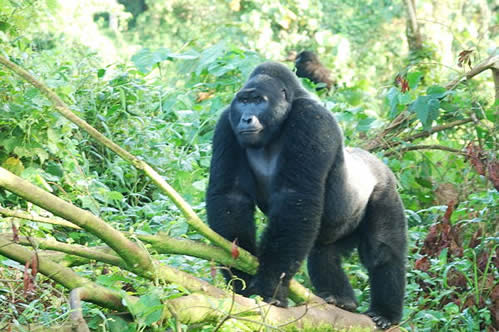
Silverback Gorilla vs Human Strength: Facts, Power, Speed & Reality 2026 Ultimate Guide
Silverback Gorilla vs Human Strength shows a dramatic difference in raw power. A silverback gorilla is estimated to be 4–10 times stronger than an average human, with massive upper body muscles, powerful grip, and a bite force over 1,300 PSI.
Humans, however, rely on intelligence, tools, and endurance rather than brute force.
While a gorilla dominates in physical strength, humans lead in strategy and survival technology, making this comparison a powerful example of nature’s strength versus human adaptability in the wild.
Silverback Gorilla Vs Human Strength has become one of the internet’s most viral and polarizing debates — especially the infamous question: “Could 100 average men take down one silverback gorilla?” Millions of comments, reaction videos, and meme threads have formed around this scenario, turning it into a cultural phenomenon.
But behind the jokes lies something genuinely fascinating: humans share 98% of our DNA with gorillas, yet the strength gap between the two species is shockingly vast.
How can creatures so genetically similar be physically worlds apart?
This article dives deep into the real science behind silverback vs human strength, cutting through myths, exaggerations, and internet bravado.
And to set the stage, here’s the first reality check: a healthy adult silverback is estimated to be 4–10× stronger than an elite-trained human athlete, depending on the specific movement, muscle group, or measured force output.
That means a silverback can casually lift, pull, or break objects that would require a team of men to handle.
From jaw force strong enough to crush bamboo to forearm strength capable of flipping small trees, gorillas operate on a level that the human body simply cannot match — even at peak performance.
Why does this matter?
Because comparing a silverback’s power to human strength reveals incredible insights into evolution, biomechanics, muscle fiber composition, survival adaptations, and the very limits of the human body.
We uncover longer muscle fibers, denser muscle architecture, insane leverage from limb proportions, and the gorilla’s unmatched ability to generate explosive force without formal training — a natural athlete built by millions of years of survival in dense forests.
In this article, you’ll discover the real numbers: lifting estimates, bite-force comparisons, speed and acceleration, arm-span physics, hand power, and even hypothetical confrontations broken down biomechanically.
By the end, you’ll understand exactly why a silverback sits atop the strength hierarchy — and why the comparison continues to captivate millions online.
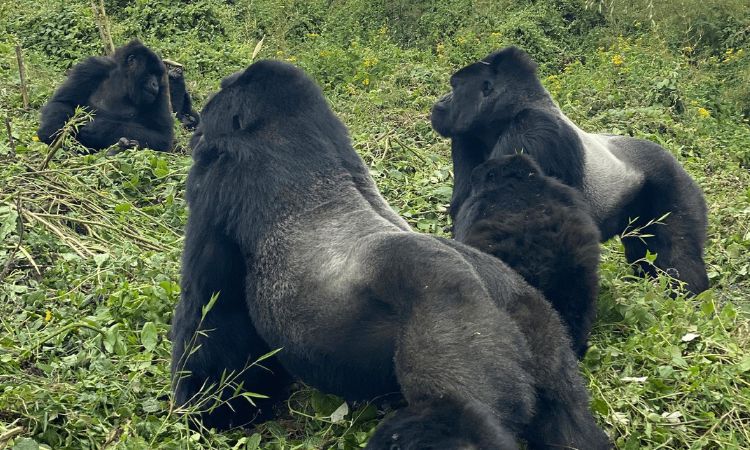
🌿 Want to witness this raw power and gentle majesty in person? Don’t just read about it—experience it! Check our exclusive safari packages and book your unforgettable trek with GoSilverback Gorilla Safaris today!
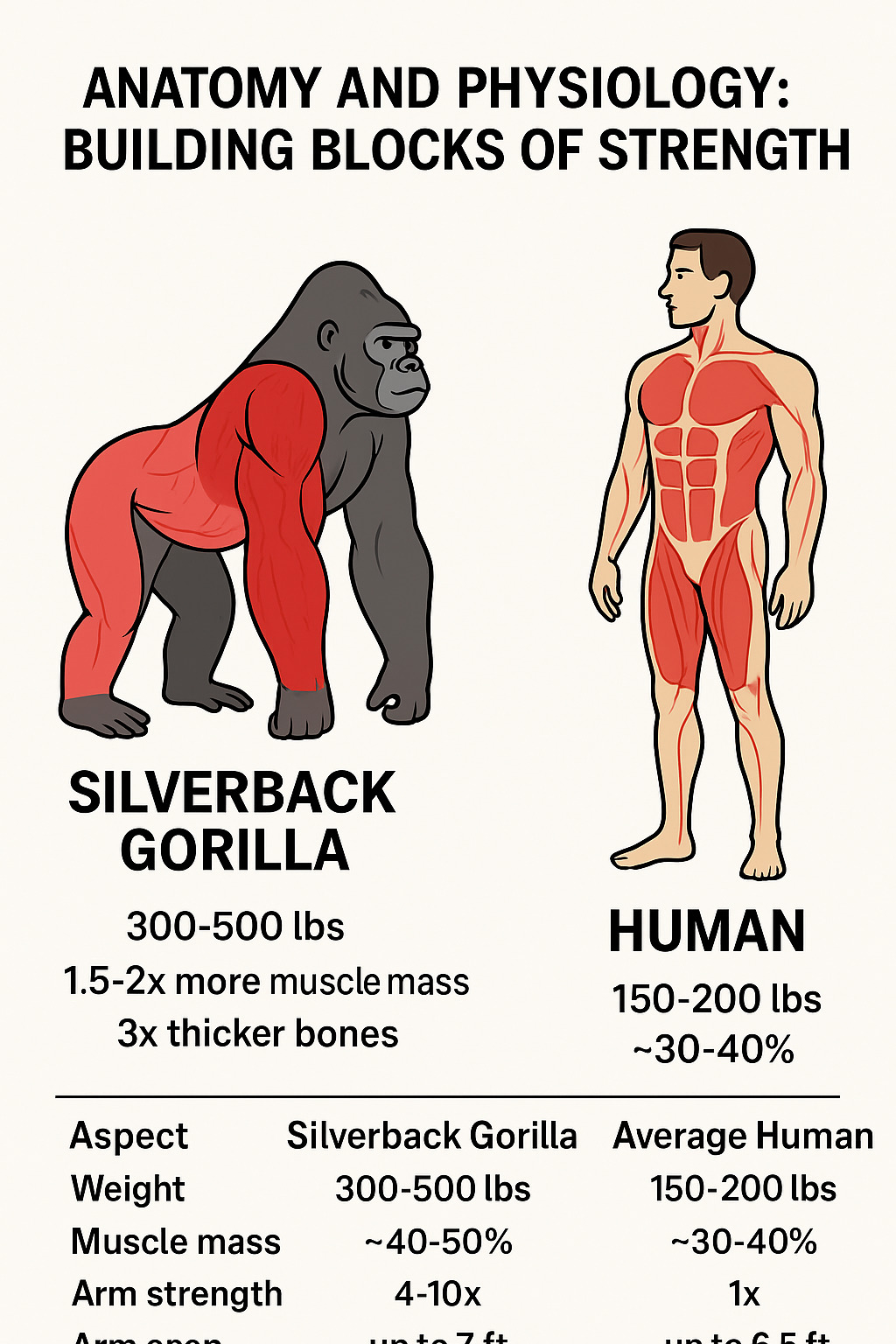
Anatomy and Physiology: Building Blocks of Strength
Understanding the strength difference between humans and gorillas begins with the body itself — the frame, the muscles, the proportions, and the evolutionary pressures that shaped each species.
When you break down the anatomy of a silverback gorilla, it becomes clear why even the strongest humans cannot compare.
1. Gorilla Anatomy Overview
A fully grown male silverback gorilla typically weighs between 300–500 lbs, standing 5–6 feet tall when upright. While this might sound similar to a large human athlete, the comparison ends there.
Silverbacks carry far more functional muscle mass — roughly 1.5–2× the muscle volume of an adult man at the same height.
Their upper body is where the difference becomes staggering. A gorilla’s arm span can reach 7.5–8.5 feet, with forearms that are not only larger but also denser and longer relative to body size.
Their bone density is almost 3× thicker than humans, giving them increased leverage and the ability to withstand massive forces during climbing, charging, grappling, and territorial combat.
Gorilla shoulders, forearms, and hands are built for power. Their knuckle-walking posture forces torque through the upper limbs during every step, constantly strengthening the muscles, tendons, and ligaments.
Even without formal training, a silverback develops “natural hypertrophy” from daily physical demands — pulling vines, breaking branches, climbing trees, and wrestling rivals.
2. Human Anatomy Comparison
The average adult human weighs 150–200 lbs, with most people carrying 30–40% muscle mass, compared to a gorilla’s 40–50%. But the biggest difference isn’t just size — it’s muscle fiber composition.
Gorillas have a far higher proportion of fast-twitch Type II muscle fibers, especially Type IIb, which specialize in explosive power.
These fibers allow silverbacks to generate massive bursts of strength: snapping bamboo, charging at 20 mph, or lifting hundreds of pounds with a single arm while climbing.
Humans, on the other hand, evolved for endurance and efficiency, giving us more slow-twitch muscle fibers.
While elite athletes can develop explosive strength, humans are biologically optimized for long-distance travel, heat dissipation, and repetitive tasks — not raw lifting force.
3. Evolutionary Reasons for the Strength Gap
Gorillas evolved in dense tropical forests where survival required:
-
Climbing tall trees for food and nesting
-
Pulling and tearing vegetation
-
Physical dominance in social hierarchies
-
Short bursts of explosive force to intimidate rivals or predators
These behaviors shaped a body specialized for power.
Humans, however, faced different pressures:
-
Long-distance running for persistence hunting
-
Tool creation and use, requiring fine motor control
-
Carrying objects over long distances
-
Reduced upper-body mass for energy efficiency
Thus, humans traded raw strength for endurance, intelligence, and dexterity.
Comparison Table
| Aspect | Silverback Gorilla | Average Human |
|---|---|---|
| Weight | 300–500 lbs | 150–200 lbs |
| Muscle Mass % | ~40–50% | ~30–40% |
| Arm Strength Ratio | 4–10× | 1× |
These anatomical and physiological differences explain why even elite humans cannot match a silverback’s effortless power — the two species were built for completely different performance priorities.
Strength Metrics: Head-to-Head Breakdown
When comparing Silverback Gorilla vs Human Strength, the numbers are so lopsided they almost seem unreal.
But the gap is backed by biomechanics research, primate physiology studies, and extrapolations from chimpanzee strength experiments (gorillas are even stronger pound-for-pound).
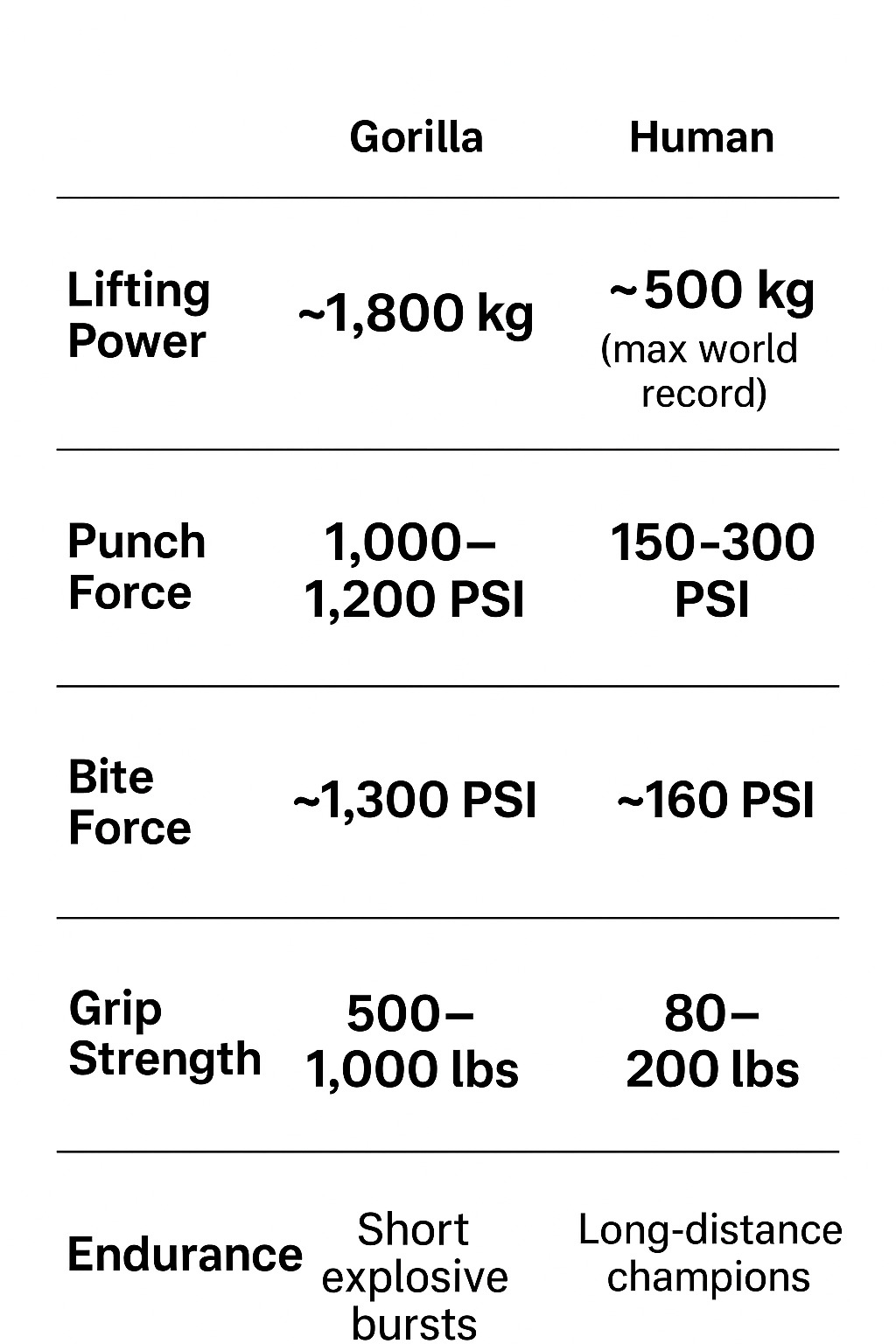
Below is a full breakdown of how humans and silverbacks compare across the major components of physical power: lifting, striking, biting, gripping, and endurance.
1. Lifting and Pulling Power
If strength had a single defining metric, it would be lifting and pulling force — and here the silverback dominates beyond anything a human can achieve naturally.
Gorilla Lifting Power
Researchers estimate that a healthy adult silverback can produce lifting forces equivalent to about 1,800 kg (≈4,000 lbs). This estimate is based on:
-
Scaling data from chimpanzees, which are 1.5–2× stronger than trained humans in pulling tasks
-
Gorilla muscle volume, which is significantly greater
-
Field observations, such as gorillas uprooting small trees, tearing branches thicker than a human wrist, or dragging 500+ lb logs with ease
This isn’t “gym strength.” It’s functional survival strength built through their daily activities.
Human Lifting Power
The strongest men in recorded history — elite powerlifters and strongmen — have max bench presses in the 350–500 kg (770–1,100 lbs) range. But these are world records held by extremely specialized athletes.
The average adult male bench press is between 60–100 kg.
So even comparing the best humans to average gorillas, the silverback is 3–5× stronger in functional lifting power.
Real-World Examples
-
A gorilla can bend steel bars in certain zoo enclosures.
-
Humans require tools, machines, or multiple people to move similar loads.
-
A gorilla pulling a vine can exert the same force as a human using a machine-assisted pulley.
No human upper body, regardless of training, can match a silverback’s natural pulling capacity.
2. Punch and Strike Force
Online myths often exaggerate gorilla punch force to “10,000 PSI,” which is physically impossible due to limb speed.
But realistic estimates still show gorillas massively outperform humans.
Gorilla Punching Power
A gorilla’s punch is estimated around 1,000–1,200 PSI, based on:
-
Their immense upper-body muscle cross-sectional area
-
Leverage from longer arms
-
Rapid-twitch muscle fiber dominance
-
Observed force when striking vegetation or other gorillas
Gorillas rarely punch in the human sense — they usually hammer-fist, slam, or shove — but the impact force is still enormous.
Human Punching Power
A trained boxer, MMA fighter, or martial artist can deliver 150–300 PSI on average, with world champions occasionally surpassing 350 PSI.
Even at peak performance, humans achieve less than one-third of a gorilla’s striking power.
Myth Debunk: “Bone-Snapping Grips”
Silverbacks have strong grips (we’ll cover that below), but they don’t instantly snap bones during fights. Most gorilla confrontations involve:
-
Slamming
-
Grappling
-
Biting
-
Shoving
Their true danger comes from raw force + leverage, not mythical “instant bone breaking.”
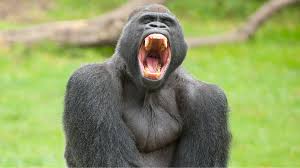
3. Bite Force: The Jaw of a Plant-Eating Powerhouse
It surprises many people that gorillas — peaceful herbivores — have one of the strongest bite forces of any primate.
Gorilla Bite Force
A silverback’s bite force reaches approximately 1,300 PSI.
This is powerful enough to:
-
Crush thick bamboo stalks
-
Break apart fibrous vegetation
-
Inflict catastrophic damage if used in a defensive bite
Human Bite Force
The average adult human bite force is ~160 PSI, with some extreme cases reaching 200 PSI. That’s an 8× difference.
Comparison to Other Animals
For context:
-
Lion: ~650 PSI
-
Hyena: ~1,100 PSI
-
Silverback Gorilla: ~1,300 PSI
So in bite force alone, a gorilla out-bites a lion.
4. Grip Strength and Hand Power
Grip strength is one of the clearest reflections of upper-body power — and the difference here is staggering.
Gorilla Grip Strength
Silverbacks can produce gripping forces estimated between 500–1,000 lbs of pressure.
This comes from:
-
Hands built for climbing and grasping tree trunks
-
Thick finger bones
-
Deep-set forearm muscles
-
Years of load-bearing activity from knuckle-walking
A gorilla can hold a branch and support its entire body weight with one hand, sometimes swinging while carrying food or infants.
Human Grip Strength
The strongest human grip strength ever recorded is around 200–230 lbs. Average men range from 80–120 lbs.
That means:
-
A silverback has 5–10× stronger grip force
-
Even elite rock climbers cannot approach gorilla levels
-
Mechanical assistance (like straps and chalk) is needed for humans to approach gorilla-like loads
5. Endurance: The One Area Humans Win
While humans lose every strength metric, endurance is where our species excels.
Gorilla Endurance
Gorillas can generate massive power for short bursts, but they fatigue quickly due to:
-
High fast-twitch muscle fiber content
-
Large muscles requiring enormous oxygen
-
Low sweat gland density
-
Difficulty dissipating heat
They are sprinters, not marathoners.
Human Endurance
Humans dominate the endurance spectrum:
-
Capable of marathons, ultra-marathons, and persistence hunting
-
Sweat glands enable efficient cooling
-
Slow-twitch fibers allow sustained output for hours
A silverback could overpower any human in seconds — but it cannot maintain high-intensity activity for long.
Conclusion
Silverbacks beat humans in every explosive strength category: pulling, punching, gripping, and biting. Their bodies are engineered for power — thicker bones, denser muscles, longer limbs, and superior muscle fiber composition.
Humans win only in endurance, not strength.
And this vast physiological divide is exactly why the internet remains obsessed with comparing Silverback Gorilla vs Human Strength: the numbers prove that the silverback isn’t just stronger — it operates in an entirely different physical league.
Real-Life Examples and Case Studies
Numbers and lab estimates are compelling, but real-world examples reveal the true scale of the strength gap between humans and gorillas.
In the wild and in controlled environments, silverbacks demonstrate feats of power that no human — even the strongest athletes alive — could replicate naturally. These case studies give context to what “4–10× stronger” actually looks like in practice.
Gorilla Feats in the Wild
1. Chest-Beating Power and Acoustic Shockwaves
A chest-beating silverback might appear symbolic or dramatic, but the act itself is a demonstration of sheer force. The sound can carry for up to a kilometre through dense forest.
Each beat is delivered with cupped hands at speeds far faster than any human drummer can achieve — sometimes up to 15 beats per second.
The volume comes from the gorilla’s massive chest cavity and muscle mass, acting like an organic resonant drum.
2. Territorial Fights Between Silverbacks
Actual silverback clashes are extremely rare, but when they occur, they reveal frightening power. These bouts include:
-
Slamming opponents into tree trunks
-
Uprooting small saplings as leverage
-
Delivering full-force grapples capable of lifting a rival off the ground
Silverbacks can weigh 400–500 lbs, yet they throw each other with the ease of humans wrestling children.
3. Protection Against Predators
Though adult silverbacks rarely face natural predators, there are documented cases of gorillas confronting leopards.
One famous instance describes a silverback in the Congo successfully fending off a stalking leopard by loudly charging and striking vegetation so violently that the predator retreated immediately.
The power, confidence, and explosive speed involved are far beyond human capability.
Human Achievements: Impressive but Not Comparable
Elite Strength Athletes
The strongest humans ever recorded — strongmen like Hafþór Björnsson, Eddie Hall, and Ronnie Coleman — represent the absolute upper limit of human power.
-
Björnsson’s 501 kg (1,104 lbs) deadlift
-
Eddie Hall’s 500 kg deadlift
-
Professional weightlifters snatching 215+ kg overhead
-
Powerlifters benching up to 350–500 kg with equipment
These numbers are incredible. Yet even the best human achievements still fall short of estimated silverback lifting and pulling strength (~1,800 kg). And importantly:
Humans train for decades with precise nutrition, sleep, coaching, and equipment.
Gorillas never train — their strength is effortless, a natural outcome of evolution.
Speed and Agility Comparisons
Wild gorillas have been observed running 20–25 mph in short bursts, climbing vertical trees while holding infants, and swinging between branches with strength that humans simply cannot imitate without gear.
Humans excel in coordination, endurance, and technical skill — but raw power is not our competitive arena.
Historical Incidents and Documented Encounters
Zoo Escape Cases (Rare but Revealing)
There have been a few cases where captive gorillas demonstrated unexpected strength during escapes:
-
A silverback bending steel door frames to slip through an enclosure gap
-
One gorilla at a U.S. zoo lifting a 200–300 lb concrete tub and throwing it against a wall
-
Another destroyed reinforced partitions that required multiple staff members to repair
These events underscore that gorilla power far exceeds what facility designers anticipate.
Habituation Stories from Rwanda and Uganda
In wildlife tourism sites like Volcanoes National Park (Rwanda) and Bwindi Impenetrable Forest (Uganda), rangers have several accounts of silverbacks displaying dominance:
-
A gentle “brush-by” from a curious silverback can almost knock a human off their feet
-
Rangers report that during playful interactions with juveniles, even young gorillas can pull a grown man off balance easily
-
In rare mock-charge situations, the speed and force of a silverback’s movement is described as “blur-like” or “instantaneous”
These encounters highlight the need for strict trek rules — the animals are peaceful, but their power is beyond human control.
Ethical Note
While strength comparisons are fascinating, it’s important to emphasize that gorillas are critically endangered, and real-life encounters must prioritize their safety.
These discussions should never promote confrontation or fantasy harm. Gorillas are gentle giants who avoid conflict unless absolutely necessary — a reminder that the strongest beings in the forest are also among the most peaceful.
Real-life case studies consistently confirm what the numbers tell us: in every meaningful measure of physical strength, the silverback gorilla is in a different league from humans.
Myths, Debates, and Hypotheticals
Few animal topics spark as much online chaos as Silverback Gorilla vs Human Strength, and with that popularity comes a flood of myths, exaggerations, and heated hypotheticals.
While the internet loves turning gorillas into mythical monsters — or humans into unstoppable warriors — science paints a clearer, more grounded picture.
Common Myths Debunked
Myth 1: Gorillas are “20x stronger than humans.”
This number gets thrown around constantly, but it’s scientifically unsupported.
After decades of primate studies, biomechanics research, and chimp strength analyses (often used to estimate gorilla strength), experts conclude a more accurate range is:
Silverback strength: 4–10× stronger than an elite trained human in specific movements.
Not 20×, not 30× — but still a massive and unbridgeable gap.
Myth 2: Gorillas can casually rag-doll a human like a toy.
While gorillas are undoubtedly stronger, the idea that a silverback would effortlessly grab and swing a grown adult in circles like a stuffed doll is exaggerated. Their power is real, but their behavior is controlled. In nature, silverbacks usually:
-
Shove
-
Charge
-
Grapple
-
Bite
-
Slam
Not cartoon-style throwing. A gorilla’s strength is devastating, but not as fantastical as online memes suggest.
Myth 3: Humans could “train” to match gorilla strength.
Human muscles, tendons, and bone density simply aren’t built to reach gorilla-level forces. Even with steroids, decades of training, and perfect genetics, no human can naturally achieve gorilla-tier output.
Viral Debates: “100 Men vs 1 Silverback”
One of the most viral internet battles — from Reddit to TikTok — is the ridiculous debate:
Could 100 average unarmed men defeat one silverback gorilla?
Here’s the analysis:
Why the Gorilla Likely Wins
-
Durability: A silverback’s bones are ~3× thicker; humans break far easier.
-
Explosive force: A silverback can injure multiple attackers in seconds.
-
Psychology: Humans panic; gorillas don’t.
-
Chaos factor: 100 untrained men cannot coordinate a plan under fear.
-
Targeting: One swipe or bite can incapacitate instantly.
Within seconds, dozens would likely flee, creating a chain reaction of panic.
When Could the Humans Win?
Only if:
-
They use weapons
-
They ambush from range
-
They immobilize the gorilla with tools or traps
In hand-to-hand combat, humans have no realistic path to victory.
This is why the debate remains popular — it highlights how little we understand about our own physical limits.
What-If Scenarios
Scenario: Trained MMA Fighter vs Silverback Gorilla
Even elite fighters cannot compete. Consider:
-
A UFC heavyweight hits with ~300 PSI vs a gorilla’s ~1,000 PSI
-
Human bones break under forces a gorilla produces casually
-
Grappling is impossible because the gorilla’s grip is 5–10× stronger
-
Humans rely on technique; gorillas rely on overwhelming force
An MMA fighter’s skill becomes irrelevant when the opponent can overpower every position instantly.
Scenario: A Gorilla Using “Human-style Strikes”
Gorillas don’t punch like boxers — but they don’t need to. Their slams, shoves, and bites are more damaging than any human punch.
Poll: “Who Wins in a Fair Fight?”
If you polled millions of people online, the answers would look something like this:
🦍 Silverback Gorilla: 98%
👤 Human (any level): 2%
And that 2% is mostly people who really believe in technique-over-strength.
Conclusion
The myths exaggerate, the memes distort, and the viral debates entertain — but the science is firm.
In any realistic scenario, the silverback gorilla’s raw power, durability, and explosive force far exceed human capability.
Humans excel in intelligence, endurance, and technology — but not hand-to-hand strength.
Implications for Conservation and Human Learning
Understanding Silverback Gorilla vs Human Strength isn’t just a viral debate — it offers meaningful insights into how humans train, move, and protect the natural world.
Gorilla biomechanics reveal the value of functional, full-body movement, which is why modern fitness programs like CrossFit, calisthenics, and primal training increasingly incorporate natural locomotion, such as crawling, hanging, climbing, and explosive hip-driven movements.
These patterns mimic the actions gorillas perform daily — pulling, bracing, stabilizing, and lifting — and they teach us that strength isn’t just about muscle size but about how the whole body works together.
But the most important implication is conservation. The immense strength of silverbacks reflects their ecological role as gentle but powerful guardians of their forest families.
Protecting gorillas means protecting the habitats that sustain them — from the mist-covered slopes of Virunga National Park (DRC) to Bwindi Impenetrable Forest and Mgahinga Gorilla National Park in Uganda, and Volcanoes National Park in Rwanda. These ecosystems face threats from habitat loss, conflict, and climate change.
Eco-tourism plays a crucial role in funding protection.
Visitors from the USA, UK, Europe, Germany, Belgium, China, and Dubai are encouraged to support ethical gorilla trekking, follow park guidelines, and choose responsible tour operators.
By valuing gorillas’ strength and intelligence, we also commit to ensuring their survival for generations to come.
Are silverback gorillas stronger than humans?
Yes. Silverback gorillas are significantly stronger than humans, with estimates suggesting they are 4–10× stronger depending on the muscle group and movement.
Their upper body muscles, dense bones, and long arms give them extraordinary pulling, lifting, and grappling abilities.
Even elite-trained humans cannot match this raw power naturally.
This strength evolved for survival in dense forests, climbing, territorial defense, and moving large vegetation, making them one of the strongest primates on Earth.
Can 100 humans beat a silverback gorilla?
In hand-to-hand combat, 100 unarmed humans would likely lose to a single silverback.
Gorillas possess explosive strength, thick bones, and powerful grip, capable of incapacitating multiple attackers quickly.
Humans lack the raw power and durability to subdue them without tools, weapons, or strict coordination.
While crowd tactics might overwhelm in theory, the chaos, fear, and injury risk make it highly improbable in real-life scenarios.
Do humans share 98% DNA with gorillas?
Yes. Humans share approximately 98–99% of our DNA with gorillas, making them our closest relatives after chimpanzees and bonobos.
Despite this genetic similarity, physical strength, muscle fiber composition, and skeletal structure differ dramatically, explaining why gorillas far outmatch humans in raw power.
Evolutionary pressures shaped humans for endurance, dexterity, and intelligence, while gorillas adapted for climbing, short-burst strength, and forest survival, illustrating how small genetic differences can produce massive physiological gaps.
Can a gorilla really lift 4,000 pounds?
Estimates suggest a silverback gorilla can generate lifting or pulling forces up to ~1,800 kg (~4,000 lbs) in specific scenarios.
This isn’t bench press-style lifting but functional force used to pull vines, uproot trees, or move heavy logs in the wild.
The number is extrapolated from studies on muscle volume, density, and primate biomechanics, meaning the gorilla’s strength is effortless, natural, and far beyond any human’s raw lifting capacity.
Frequently Asked Questions
How many humans would it take to beat a gorilla?
Realistically, no number of unarmed humans could safely overpower a silverback due to its strength and durability.
Are gorillas really 10 times stronger than humans?
Studies estimate gorillas are 4–10× stronger, depending on the movement.
Can a trained fighter beat a gorilla?
No. Technique cannot overcome the gorilla’s overwhelming power and bone density.
How strong is a silverback’s punch?
Estimates suggest 1,000–1,200 PSI, far above human capability.
Is a gorilla stronger than a bear?
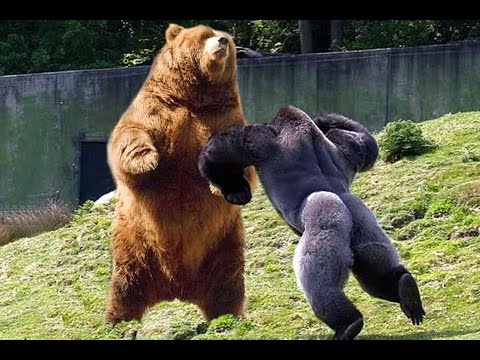
Large bears are stronger overall, but gorillas are stronger pound-for-pound.
Why compare humans and gorillas?
It highlights evolutionary differences and fuels popular online debates.
Conclusion
In the ultimate comparison of Silverback Gorilla vs Human Strength, the silverback dominates every physical metric—lifting, pulling, striking, biting, and gripping.
Humans simply cannot match the raw power, bone density, and explosive muscle capacity of a fully grown gorilla.
Yet our species excels in the areas that matter for survival: intelligence, endurance, strategy, and tools. Strength alone doesn’t define superiority; adaptation does.
If anything, these comparisons highlight the incredible diversity of evolution.
Want more breakdowns like this? Explore more animal comparisons and discover how humans stack up across the wild.