
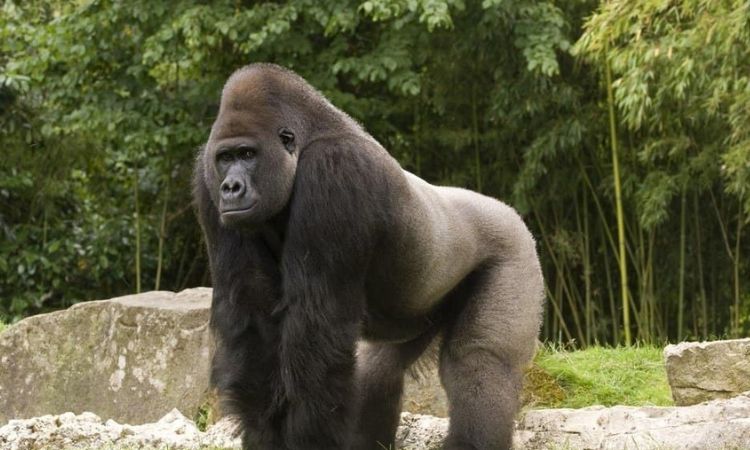
How Strong Is a Gorilla? Power, Strenght, Facts & Comparisons 2026 Ultimate Guide
How Strong Is a Gorilla? An adult silverback gorilla is 6 to 10 times stronger than an average human. Weighing up to 220 kg (485 lbs), a silverback can lift or pull the equivalent of 1,800–2,000 kg—roughly 10 times a strong man’s bench press.
Their dense muscle fibers, longer arms, and powerful shoulders give them incredible leverage for uprooting saplings, bending thick bamboo, and delivering chest-beating displays.
This extraordinary gorilla strength evolved for forest life in Bwindi and the Virunga Mountains, not aggression. In reality, mountain gorillas are gentle giants that rarely use their full power against humans.
Curious to witness this strength safely up close? Book your gorilla permit with GoSilverback Safaris today and experience these powerful primates in the wild.
How strong is a gorilla? This question captivates travelers planning mountain gorilla trekking in Uganda and Rwanda. At GoSilverback Safaris, we hear it daily from clients arriving from the USA, UK, Europe, Canada, Asia, and the Middle East.
The answer is both awe-inspiring and grounded in science: an adult male silverback gorilla possesses six to ten times the strength of an average human, pound for pound.

Mountain gorillas weigh up to 220 kg (485 lbs) yet can uproot saplings, bend thick bamboo, and deliver powerful displays that deter rivals without causing harm.
Their strength evolved for life in dense African rainforests, where they must navigate steep terrain, forage massive amounts of vegetation, and protect family groups.
This guide explores gorilla strength in depth—from muscle anatomy and real-world feats to comparisons with humans and other animals. We draw on the latest 2025 field studies by the Dian Fossey Gorilla Fund and Uganda Wildlife Authority.
Whether you are a local Ugandan exploring your heritage or an international traveler booking your first gorilla permit, understanding how strong a gorilla is deepens your appreciation of these gentle giants and the conservation efforts that protect them.
What Makes Gorillas So Strong?
Gorilla strength stems from a unique combination of anatomy, physiology, and evolutionary adaptation. Unlike humans, gorillas have dense muscle fibers packed with fast-twitch type IIb fibers optimized for explosive power rather than endurance. Their muscle-to-body-mass ratio far exceeds that of humans, allowing them to generate force efficiently.
A silverback’s pectoralis major and latissimus dorsi muscles—visible as the broad chest and V-shaped back—enable them to pull, push, and climb with remarkable power.
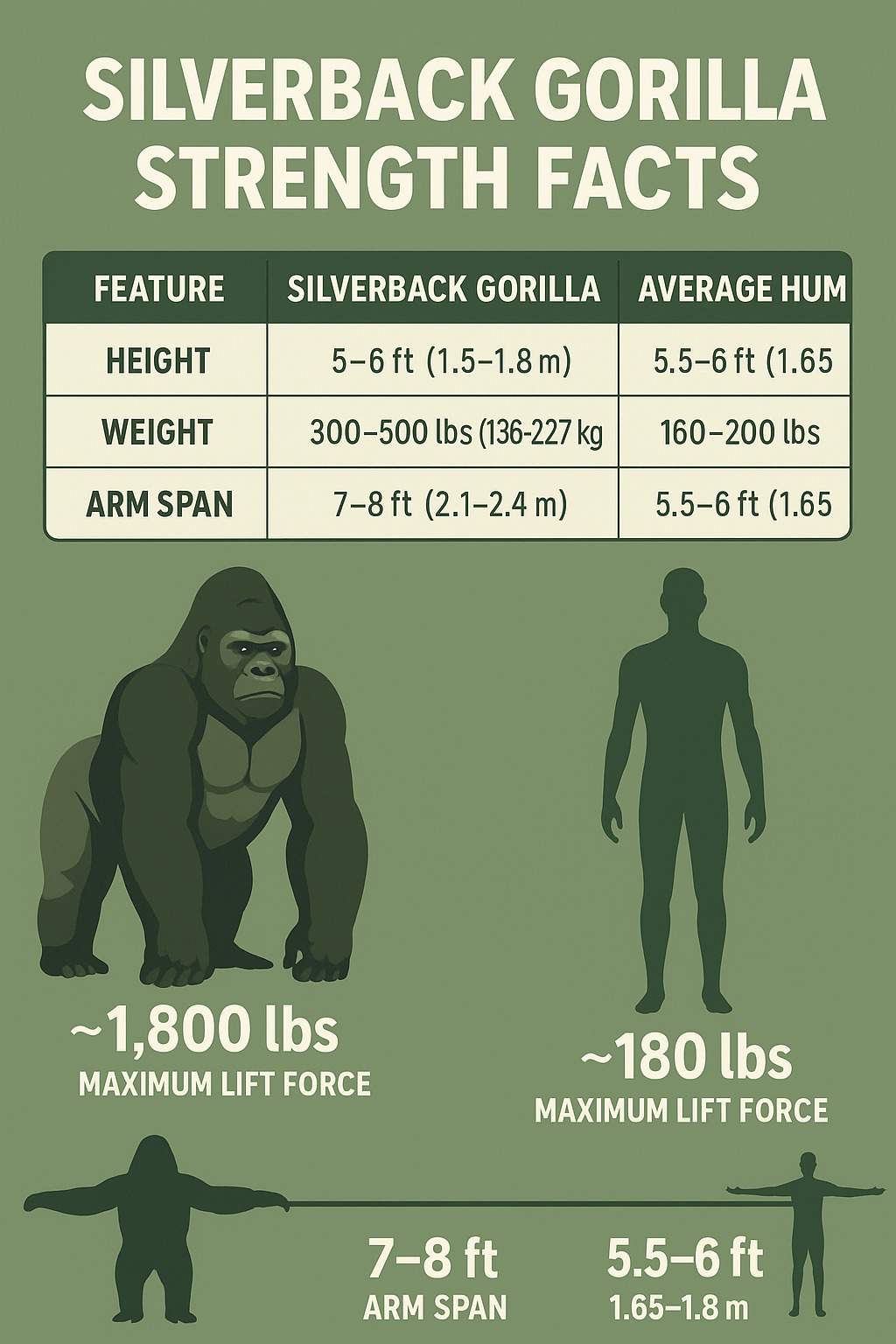
Their arms are 30% longer than human arms relative to body size, creating superior leverage. Bone density is higher, and tendons are thicker, reducing injury risk during displays or falls from trees.
Gorillas consume a high-fiber, plant-based diet of 30–40 kg daily, fueling constant muscle maintenance. Their digestive system ferments vegetation efficiently, providing steady energy.
Hormonal factors, particularly testosterone in dominant silverbacks, further enhance muscle mass and aggression thresholds.
Scientific estimates from biomechanical studies place a silverback’s bench-press equivalent at 1,800–2,000 kg—roughly 10 times a fit human male’s maximum.
This power is not for hunting but for daily tasks: bending bamboo stems, climbing vines, and occasional charges that rarely result in contact.
These adaptations make gorilla strength perfectly suited to the Albertine Rift’s rugged terrain in Bwindi Impenetrable National Park and the Virunga Volcanoes. Understanding this biology explains why gorillas appear so commanding yet rarely use their full force against humans.
How Strong Is a Silverback Gorilla?
The silverback gorilla represents the pinnacle of primate strength. An adult male stands 1.7–1.8 m (5 ft 7 in–5 ft 11 in) tall when upright and weighs 160–220 kg (350–485 lbs). His back hair turns silver around age 12, signaling maturity and dominance.
Silverback gorilla strength allows him to:
- Uproot small trees and snap branches thicker than a human thigh.
- Deliver chest-beating displays with force equivalent to a heavyweight boxer’s punch.
- Carry or drag objects weighing hundreds of kilograms during nest-building or territorial defense.
Field observations in Bwindi document silverbacks lifting and throwing fallen logs weighing 200 kg to clear paths or intimidate rivals. Their bite force reaches 1,300 PSI—stronger than a lion’s—used primarily for processing tough vegetation.
A 2024 study by the Gorilla Doctors veterinary team confirmed that silverbacks in habituated groups maintain peak condition through consistent foraging and minimal stress. Their strength peaks between ages 15–25, then gradually declines, passing leadership to younger males.
This raw power is tempered by intelligence. Silverbacks rarely fight to the death; displays of gorilla strength often resolve conflicts peacefully, preserving energy for family protection.
Can 100 men beat a gorilla?
No single human stands a chance, but 100 unarmed men would likely overwhelm a silverback gorilla through sheer numbers, coordination, and stamina. A gorilla is 4–10 times stronger than an average man and could inflict severe injuries or fatalities with bites (1,300 PSI) and charges.
However, experts note that humans could surround, exhaust, and subdue the gorilla, though at a high cost—dozens of serious injuries or deaths expected. In reality, a sensible gorilla would flee rather than fight such odds.
How strong is a gorilla punch?
A silverback gorilla’s punch delivers devastating force, estimated between 1,300–2,700 pounds of force (some analyses suggest up to 5,400 ft-lbs for a two-arm strike).
This is strong enough to shatter bones or cause fatal trauma to a human. Gorillas rarely “punch” like boxers; they use powerful slaps, charges, and bites in displays or defense.
Their upper-body strength—6–10 times that of humans—makes any strike extremely dangerous. In the wild, this power is used mainly for intimidation and protection, not hunting.
How much could a gorilla bench?
Estimates for a silverback gorilla’s bench press equivalent range from 1,800 to 4,000 pounds (800–1,810 kg), far exceeding the strongest human records (around 885–1,000+ lbs).
These figures come from biomechanical comparisons of muscle density, leverage, and observed feats like uprooting trees or dragging heavy logs.
Gorillas are built for pulling and explosive power rather than controlled lifting, so actual “bench press” is hypothetical. Pound for pound, their upper-body strength is 4–10 times greater than a trained human’s.
Gorilla Strength vs Humans
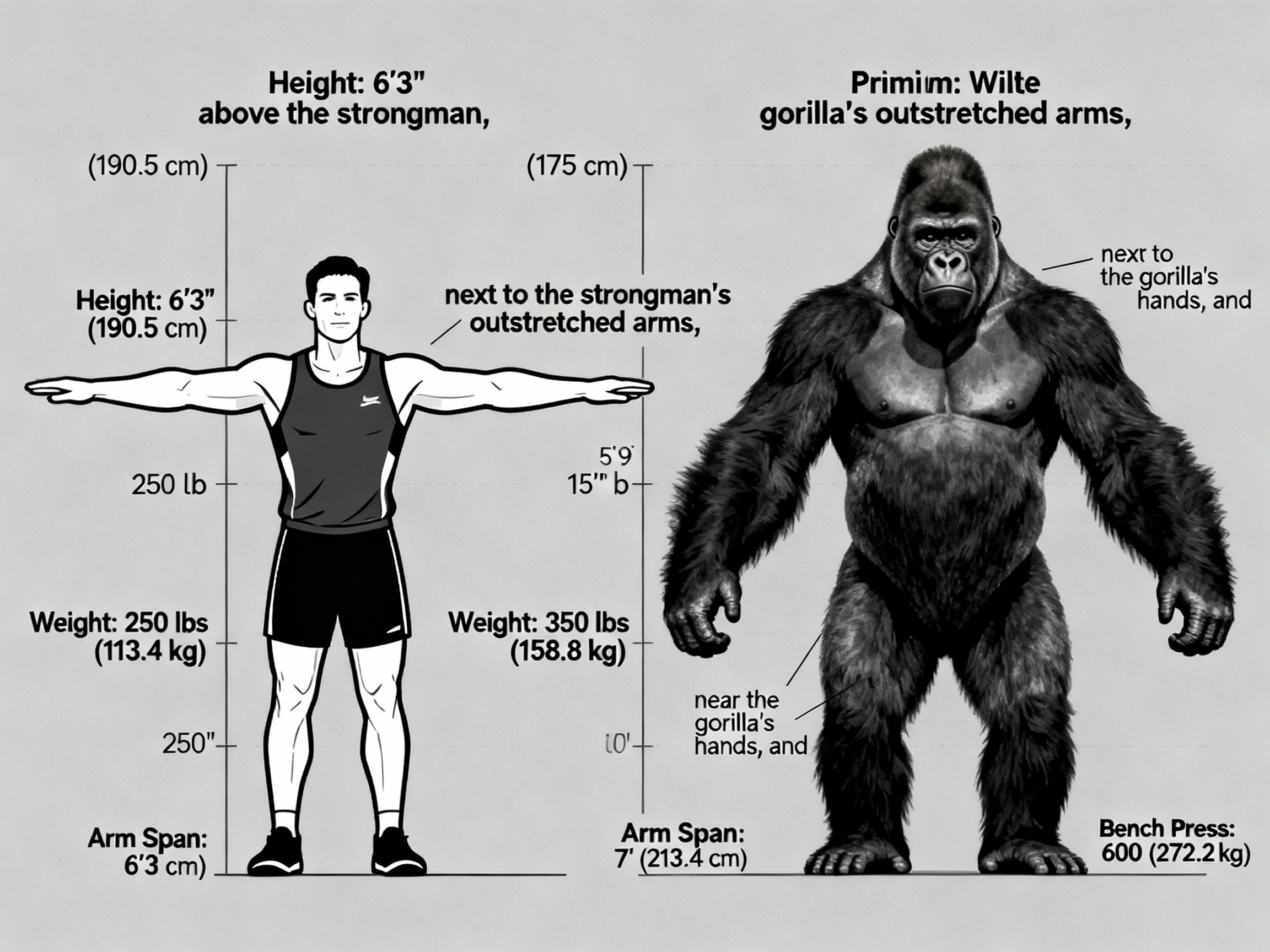
Gorilla strength vs humans reveals a dramatic disparity. A typical adult male human weighs 80–90 kg and can bench-press 100–150 kg with training. A silverback of similar weight generates 6–10 times more force due to superior muscle architecture and leverage.
In direct comparisons:
- Arm strength: A gorilla can curl 300–400 kg; elite human powerlifters max out at 140 kg.
- Pulling power: Gorillas pull with 1,000+ kg of force—enough to uproot saplings humans cannot bend.
- Endurance vs power: Humans excel in long-distance activity; gorillas dominate short bursts of explosive strength.
The famous 1920s experiments by Dr. John Bauman estimated a gorilla’s strength at 4–9 times a human’s. Modern dynamometer tests on captive gorillas support this range.
Pound for pound, gorillas outperform humans because their muscle fibers are denser and their skeletal structure distributes force more efficiently.
Importantly, gorilla strength vs humans is not a threat in responsible tourism. Habituated gorillas in Bwindi and Volcanoes National Park maintain the strict 7-meter rule during treks, respecting the space that keeps interactions safe.
How strong is a gorilla than a human?
A silverback gorilla is 4 to 10 times stronger than an average adult human, with some studies citing 6–9 times for upper-body power. They possess denser fast-twitch muscle fibers, longer arms for leverage, and greater bone density.
A 400+ lb gorilla can generate pulling/lifting force equivalent to 1,800–4,000 lbs, compared to a strong man’s 300–600 lbs. This makes gorillas vastly superior in short bursts of power, though humans excel in endurance and intelligence. In Bwindi and Virunga, this strength supports peaceful forest life.
Gorilla Strength vs Other Animals
Gorilla strength vs other animals depends on context—size, bite force, or agility.
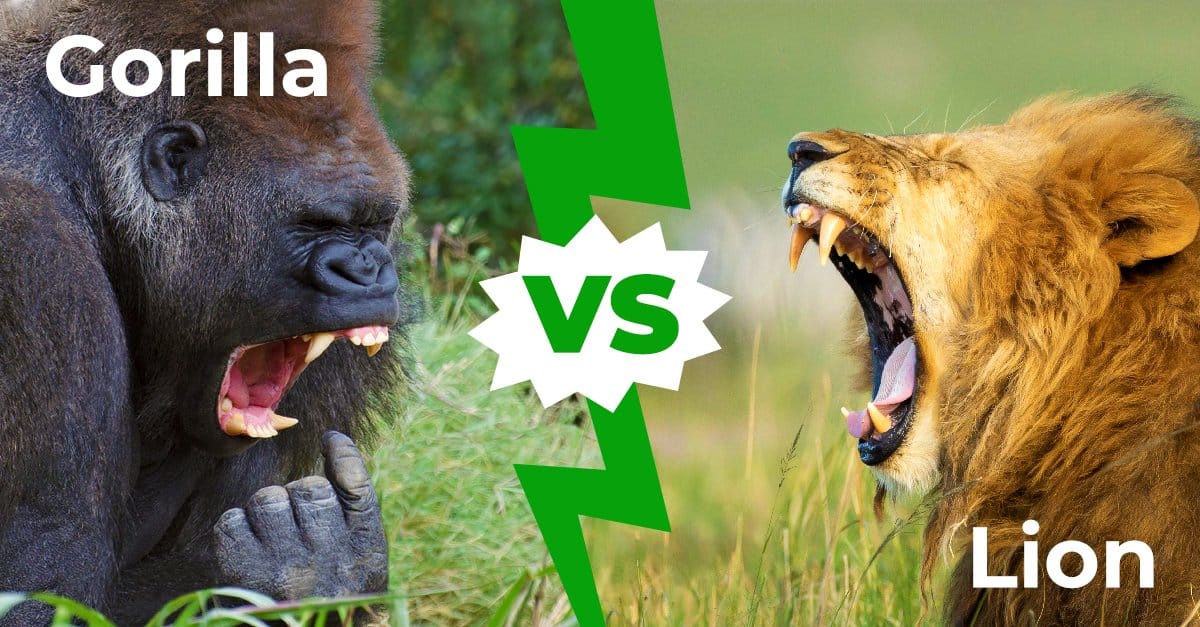
Against a lion (gorilla vs lion), the silverback’s muscular build and powerful arms give it a defensive edge in close quarters, though lions rely on speed and pack tactics.
A silverback’s 1,300 PSI bite force rivals a big cat’s, but gorillas lack claws.
Versus elephants or hippos, gorillas are outmatched by sheer mass. Against chimpanzees—their closest relatives—gorillas win decisively; a silverback outweighs a male chimp by three times and possesses far greater upper-body power.
Real-world observations show silverbacks dominating leopards in the Virunga region through sheer presence and occasional charges. Their strength evolved for forest life, not open savanna combat, making direct “versus” scenarios rare in nature.
Real-Life Gorilla Strength Examples
Real-life gorilla strength examples from the wild illustrate their power without exaggeration. In Bwindi Impenetrable National Park, trackers have filmed silverbacks snapping 10 cm-thick bamboo stalks in one motion to access tender shoots. During the 2023 bamboo flowering event, groups cleared entire thickets in days.
A documented incident in Volcanoes National Park saw a silverback named “Titus” drag a fallen tree trunk weighing over 150 kg to block a rival group’s path.
Habituated gorillas in Uganda routinely bend saplings to build night nests, a feat requiring sustained force humans cannot match.
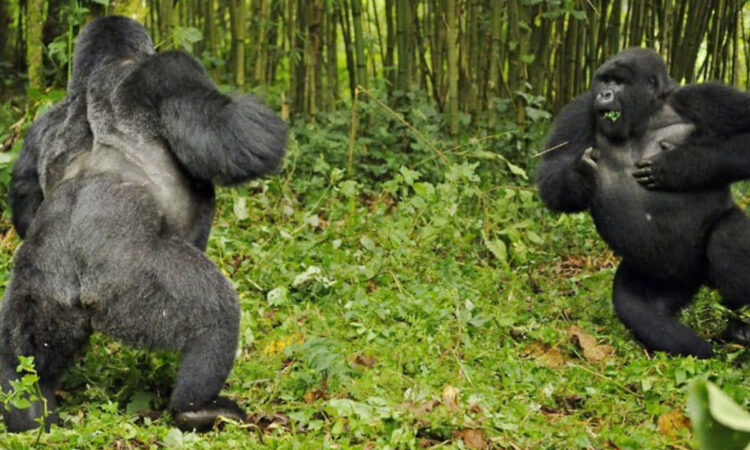
These examples highlight that gorilla strength serves peaceful purposes: foraging, nest construction, and gentle family interactions.
Behavior vs Strength: Are Gorillas Dangerous?
Gorilla strength does not equal danger. Mountain gorillas are among the least aggressive great apes toward humans. Their formidable power serves display and protection, not predation.
In over 30 years of habituated trekking in Uganda and Rwanda, serious incidents number fewer than five, usually involving tourists ignoring ranger instructions. Gorillas bluff-charge to establish distance, stopping short of contact in 95% of cases.
Behavior trumps raw strength. Silverbacks prioritize family safety and use vocalizations, chest-beating, and vegetation thrashing before physical contact. Habituated groups view humans as neutral observers, not threats.
Where to See Powerful Gorillas in the Wild
Where to see powerful gorillas in the wild is limited to two protected areas: Bwindi Impenetrable National Park (Uganda) and the Virunga Massif (shared by Rwanda, Uganda, and DRC). These misty highlands host the world’s entire population of 1,063 mountain gorillas (2025 census).
In Bwindi, eight habituated groups are available for trekking. Volcanoes National Park in Rwanda offers 10 groups, including famous families like the Susa group. Mgahinga Gorilla National Park provides a smaller but equally impressive experience.
Gorilla Trekking Experience: Seeing Strength Up Close
The gorilla trekking experience lets you witness gorilla strength safely and respectfully. After a briefing at the park gate, your group of maximum 8 trekkers follows experienced trackers through dense forest. The moment you reach the gorillas—often within 30–60 minutes—the silverback’s sheer presence commands respect.
You observe him feeding, grooming, or playfully tossing branches—each movement showcasing controlled power. The one-hour visit at a 7-meter distance reveals family dynamics: mothers carrying infants, juveniles wrestling, and the silverback maintaining calm authority.
This encounter transforms abstract facts about how strong a gorilla is into a visceral memory. Every trekker returns humbled, understanding why these giants deserve protection.
Conservation: Protecting These Powerful Giants
Conservation: protecting these powerful giants is critical. Despite population growth to 1,063, threats from habitat loss, disease, and poaching persist. Gorilla strength cannot protect them from snares or human encroachment.
Uganda Wildlife Authority’s HuGo teams and the International Gorilla Conservation Programme use revenue from $800 gorilla permits to fund ranger patrols, veterinary care, and community projects. 20% of permit fees directly support adjacent parishes, turning potential conflict into coexistence.
Your visit funds these efforts, ensuring future generations can ask—and witness—how strong a gorilla is in the wild.
Frequently Asked Questions
How strong is a gorilla compared to a human?
A silverback gorilla is 6–10 times stronger than an average human pound for pound. Their muscle density and leverage allow feats like uprooting trees that humans cannot match.
What is the strongest type of gorilla?
The silverback mountain gorilla is the strongest. Adult males reach 220 kg with superior upper-body power developed for forest life and family protection.
Can a gorilla beat a lion?
In close combat, a silverback’s strength and bite force give it a defensive advantage, but lions use speed and group tactics. Direct confrontations are extremely rare in nature.
How much can a gorilla lift?
Estimates suggest a silverback can lift or pull 1,800–2,000 kg equivalents—roughly 10 times a strong human’s bench-press maximum.
Are gorillas aggressive because they are strong?
No. Gorillas use strength for displays and protection, not aggression. Habituated groups in Uganda and Rwanda are calm around responsible visitors.
Where can I see the strongest gorillas?
Bwindi Impenetrable National Park in Uganda and Volcanoes National Park in Rwanda host the world’s only mountain gorillas. Book through authorized operators for safe viewing.
How does gorilla strength help in the wild?
Strength aids foraging, nest-building, climbing steep terrain, and protecting family groups from rivals or occasional predators.
Is gorilla trekking safe given their strength?
Yes. Strict rules, trained rangers, and habituation keep encounters peaceful. Serious incidents are extremely rare over decades of tourism.
What makes a silverback stronger than other gorillas?
Testosterone, age, and dominance drive larger muscle mass. Only mature males over 12 years develop the iconic silver back and peak power.
How do conservation efforts protect gorilla strength?
Anti-poaching patrols, habitat expansion, and community revenue-sharing funded by permits ensure healthy populations that maintain natural strength.
Can a gorilla’s strength harm tourists?
Only if rules are ignored. Rangers enforce distance and behavior protocols, making gorilla trekking one of Africa’s safest wildlife experiences.
Why book gorilla permits with GoSilverback Safaris?
We guarantee permits, pair you with expert guides, and direct funds to conservation—ensuring you see powerful gorillas while supporting their future.
Conclusion
How strong is a gorilla? The answer is profoundly impressive: six to ten times stronger than humans, with power shaped by millions of years of rainforest evolution. Yet this strength serves peace—protecting families, foraging sustainably, and commanding respect without unnecessary violence.
Standing before a silverback in Bwindi or the Virungas reveals far more than raw power. You witness intelligence, gentleness, and vulnerability that demand our protection.
At GoSilverback Safaris, every gorilla permit you purchase helps safeguard these giants through ranger patrols, community benefits, and habitat restoration. Limited permits sell out months ahead—secure yours today and transform curiosity into conservation action.
Book your gorilla permit through GoSilverback Safaris now and experience how strong a gorilla is up close in the wild. Our expert team will craft your private primate safari, ensuring safety, authenticity, and lasting impact. The silverbacks are waiting. Will you answer their call? Contact us today.